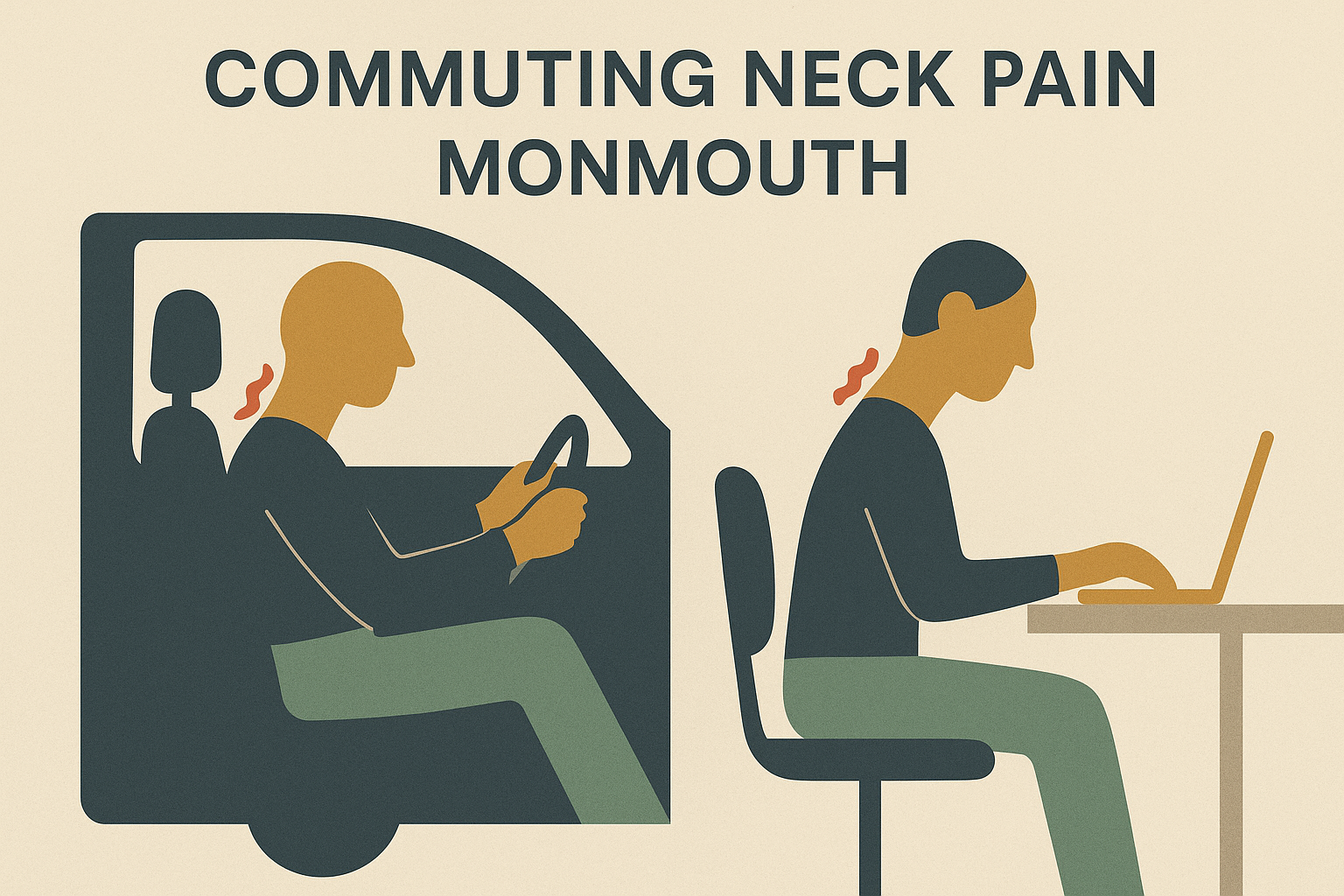
Commuting neck pain among Monmouth County desk workers is rising because the return to the office added a second daily load rather than replacing the first one: a fixed, vibrating, hands-forward seated posture in a car or a train seat, stacked on top of the desk hours that were already there. The neck is not failing because of one bad chair. It is failing because two different sustained loads now share the same day, recovery time between them has shrunk, and a plan that corrects only the desk leaves the other load running, which is why the pain comes back. Our clinical team in Colts Neck, Tinton Falls and Seabrook assesses both patterns together, because a commute and a desk leave different signatures in cervical rotation, shoulder blade control and breathing mechanics.
Why is my neck worse now that I am back in the office?
Because you added a commute and subtracted nothing. The desk hours did not change. What changed is what brackets them at both ends of the day. Seat belt on before the sun is properly up. Hands at the top of the wheel. Brake lights, then a green light, then brake lights again. Phone checked at the long light, because the light is long and the phone is right there. Then a full day at a screen, then the same drive in reverse with less patience and worse traffic.
That second load is not small. The New Jersey Department of Health reports an average travel time to work in New Jersey of 31.9 minutes in 2024, above the national figure of 27.2 minutes, with nearly half of New Jersey workers travelling more than 30 minutes each way. For this county specifically, the one-year American Community Survey estimate compiled by Census Reporter puts mean travel time to work in Monmouth County at 34.9 minutes. That is each direction, most days, on top of everything else the neck is asked to hold.
Here is the real problem. Nobody’s neck got weaker over a weekend. The tissue is the same tissue it was when the commute was a walk down the hallway to a spare bedroom. What changed is the daily dose of sustained loading and the amount of unloaded time available to recover from it, and when the dose goes up while recovery goes down, tissues that were coping start reporting. The pain is new. The cause is arithmetic.
What does commuting do to the neck that desk work does not?
It removes your options. At a desk you can stand up, shift your weight, roll your shoulders, walk to get water. In a car you cannot. Hands are committed to the wheel, the right foot is committed to the pedals, the eyes are committed to the road, and the seat decides where your head sits relative to your ribs for the whole trip.
The driving literature points at the same two mechanisms. A cross-sectional study of drivers published in PeerJ examined cervical pain and cervical mobility in 100 participants, 50 car drivers and 50 motorbike drivers, and attributed driver neck pain to prolonged static postures combined with repetitive neck movements. Static load and repeated movement, in the same exposure. That is the commute in one sentence.
Now add what a desk never does. Arms held forward and up against gravity turns the muscles across the top of the shoulder from movement muscles into postural ones. Road vibration means the neck makes small corrections continuously, none of which you notice. Blind spot checks and merges demand rotation at the end of available range while the shoulder girdle is already loaded. Train riders trade the steering for a different problem: a rocking base, a bag on one shoulder, and a laptop on the lap with the head unsupported and flexed. The body keeps the score either way.
How is commuting neck pain in Monmouth County different from home-office neck pain?
Home-office neck pain is usually one posture held too long by somebody who was free to move and did not. Commute neck pain is a loaded, vibrating, rotation-demanding posture that you are not permitted to leave. The exposures are different, so the findings on examination are different.
What our clinical team sees in Colts Neck and Tinton Falls is that desk-dominant complaints tend to sit closer to the midline, build slowly across the day, and change quickly when the person gets up and moves. Commute-dominant complaints more often show a side preference, track with the length of the drive rather than the length of the meeting, and come with restricted rotation toward one side and a shoulder girdle that will not organise itself under load. Neither of those descriptions is a diagnosis for you, because nobody has examined you. They are patterns, and patterns are what tell an examiner where to look.
This is also why treating the more obvious source feels like progress for about a fortnight. Change the monitor height and the midline ache eases. The drive is untouched, so the side-dominant pattern stays, gets loaded twice a day, and eventually recruits the part you just calmed down. That is the whole argument for looking at commuting neck pain in Monmouth County as one problem with two inputs rather than two problems, and it is the same logic our clinical team applies to where pain actually comes from.
How does a chiropractic assessment tell commute strain from desk strain?
By testing under the conditions that produce the pain, and by testing both sides separately. If you aren’t testing you’re guessing, and a neck examined at rest in a quiet room tells you very little about a neck that only complains after the second bridge.
An assessment worth the appointment covers more than the shape you sit in. The office-worker research has said so for years: a prospective cohort of office workers published in BMC Musculoskeletal Disorders grouped candidate risk factors for work-related neck pain into physical factors such as cervical posture, range of movement, muscle endurance and exercise frequency, work-environment factors such as sitting duration and frequency of breaks, and psychosocial factors including psychological distress. A single posture photograph covers roughly one line of that list. So our clinical team works through the rest of it:
- Rotation, side by side. Measured left against right, then compared with the side you turn toward to check a blind spot.
- Rotation under load. Range with the arms hanging is not the range you have with your hands on a wheel.
- Shoulder blade and first-rib behaviour. What the girdle does when the arms are held forward for a sustained period.
- Breathing mechanics. Whether the neck muscles are helping you breathe while you drive, which is work they were not built for.
- Tolerance, not just range. How long a position can be held before the complaint appears, retested after care.
- Exposure history. Drive length, train segments, seat position, where the phone lives, and how many hours the desk adds.
Stiffness is not the injury. It is the message. The point of quantifying it is that the numbers come back at the retest and tell you whether the plan is working or whether you have been reassured, which is a different thing entirely. That distinction is the core of what a doctor of chiropractic is trained to do.
Why does my neck pain keep coming back after it gets better?
Because only one of the two loads changed. Care reduced the symptom, the desk got fixed because the desk was visible, and the commute went back to being exactly what it was the following Monday. Relief without a change in total exposure is a window, not an outcome.
There is a second reason, and it is the one that surprises people: the villain is rarely the angle. In a twelve-month longitudinal investigation, 457 adults aged 18 to 65 without neck pain were followed after their cervical flexion angle during smartphone use was measured, and that angle was not a risk factor for developing neck pain, while low sleep quality and insufficient physical activity were. Sit with that for a moment. The thing everybody photographs did not predict the pain. The things nobody measures did.
So a plan that only rearranges furniture is incomplete by design. What actually matters is total daily load, how much of it is unbroken, how much capacity the neck and shoulder girdle have to absorb it, and what sleep and activity are doing to your tolerance underneath all of it. That means care for the current complaint, changes to both exposures, and loading that builds capacity rather than avoiding it, which is dull work done consistently. Boring is good. Mobility work may help maintain range between visits, but it is a supplement to an assessment, not a replacement for one.
Does this apply to Seabrook residents who no longer drive to a job?
Yes, because the load is the driving, not the payroll. A neck does not know whether the trip ends at an office or at a grandchild’s school, and the seated, hands-forward, rotation-demanding exposure is identical either way.
Seabrook is an Erickson active-adult community for residents aged 62 and over, and our clinical team works on site there. The residents we see are not sedentary. They drive to appointments, to volunteering, to pickleball, to the airport for the flight to see family, and many of them still work part time. Here is the difference that age makes to the advice: rotation matters more. Turning the head far enough to clear a blind spot is a driving-safety task as much as a comfort task, so when available rotation drops, our clinical team treats it as a functional priority and measures it rather than describing it.
The other difference is recovery. Load tolerance and the speed of bouncing back from a long drive are not fixed, but they do change, and they respond to training. Care may help reduce the complaint; capacity is what keeps the next long drive from resetting the clock. If you already track recovery data, read what HRV tracking does not tell you before you let a number talk you out of an examination.
Frequently asked questions
Can commuting really cause neck pain?
Yes. A commute is a sustained load, not a rest. Research comparing car and motorbike drivers attributes driver neck pain to prolonged static postures and repetitive neck movements. Your hands, feet and eyes are fixed, the seat feeds in constant small vibrations, and the same muscles work without a genuine break.
Should I fix my car seat or my office desk first?
Fix whichever load is longer, then fix the other one. Most people change the desk because it is visible, then keep the same seat position and the same phone habit at red lights, and the pain returns. Our clinical team measures both loads before recommending changes, because guessing which one matters wastes weeks of your time.
Is checking my phone at red lights making my neck worse?
Possibly, though the evidence is messier than the headlines suggest. In a twelve-month study of adults without neck pain, cervical flexion angle during smartphone use was not a risk factor for new neck pain, while poor sleep quality and insufficient physical activity were. Total load, sleep and activity appear to matter more than the angle.
How long does commute-related neck pain take to settle with chiropractic care?
It varies, and an honest answer comes from testing rather than averages. Our clinical team retests cervical rotation, shoulder blade control and tolerance to sustained positions, then changes the plan based on what the retest shows. Care may help some people faster than others. We will not promise you a timeline nobody has measured on you.
Can I be seen in Seabrook, or do I have to drive to Colts Neck?
FIT Clinic is part of Functionised and works in Colts Neck, Tinton Falls and Seabrook, the Erickson active-adult community for residents aged 62 and over. Seabrook residents can be seen there. New patients call 848-301-1515; we do not book online. Our Colts Neck address is 8 Merchants Way, Colts Neck, New Jersey.
The Bottom Line
If your neck started complaining when your commute came back, you are not dealing with a mystery. You are dealing with two loads sharing one day, and the reason it keeps returning is that most plans only address the one you can see from your desk chair. Get both exposures measured. Get rotation tested side against side, loaded and unloaded. Get a retest, so the plan answers to data instead of to how you felt on a good morning. There is no dealership for your body, and there is no second one waiting when this one stops turning to check a blind spot.
Here is the next step. Write down your drive time each way, whether a train is involved, where your phone sits at red lights, and how many hours the desk adds, then bring that to an examination with our clinical team in Colts Neck, Tinton Falls or Seabrook. New patients call 848-301-1515; we do not book online. FIT Clinic is part of Functionised, 8 Merchants Way, Colts Neck, New Jersey 07722. You now know what the pattern is and how it gets tested. What will you do with it?
New patients should call 848-301-1515 — we book new patients by phone rather than online.
FIT Clinic at Functionised — 8 Merchants Way, Colts Neck, NJ 07722.
Also in Tinton Falls and at Seabrook.
Sources
- NJSHAD – Summary Health Indicator Report – Travel Time to Work >= 30 Minutes, New Jersey Department of Health
- Monmouth County, NJ – Profile data – Census Reporter
- Comparative analysis of cervical spine pain and mobility in car versus motorbike drivers: a cross-sectional study (PMC)
- Comparative analysis of cervical spine pain and mobility in car versus motorbike drivers: a cross-sectional study (PeerJ)
- Cervical flexion posture during smartphone use was not a risk factor for neck pain, but low sleep quality and insufficient levels of physical activity were. A longitudinal investigation (PMC)
- Cervical flexion posture during smartphone use was not a risk factor for neck pain (ScienceDirect)
- Risk factors for neck pain in office workers: a prospective study, BMC Musculoskeletal Disorders (PMC)
This article is for information only and is not medical advice. It is not a diagnosis and does not replace a consultation. Speak to a qualified clinician about your own situation.