Why does my hip catch when I stand up?
Last updated September 20, 2026
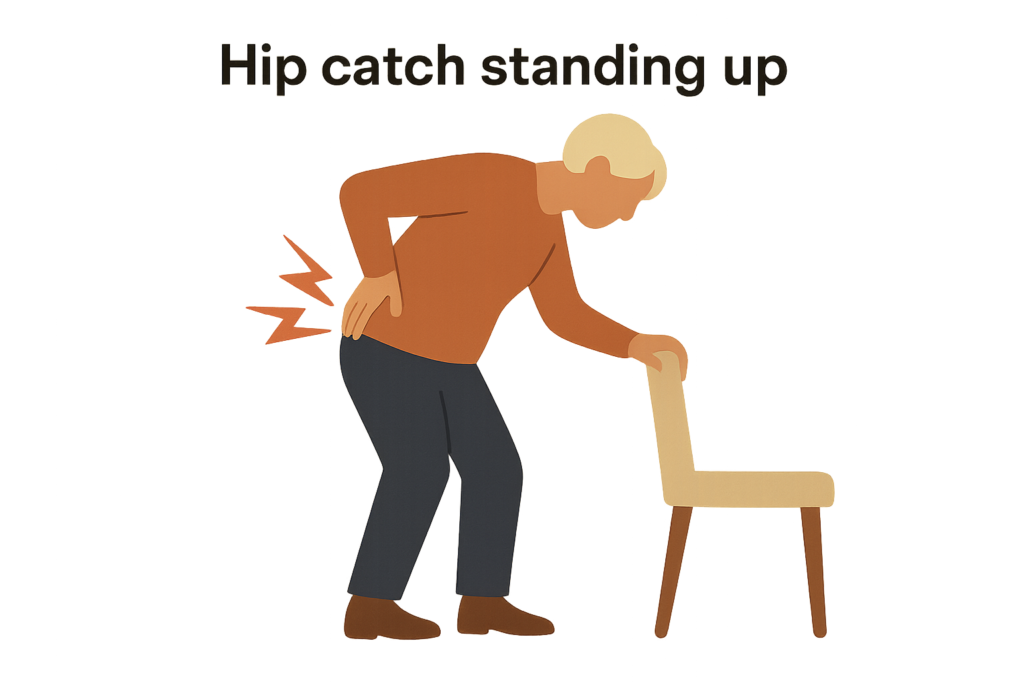
The hip catch standing up seniors describe is usually a loading signal, not a damage event: the hip and low back are being asked to produce force at the very edge of the range they currently own, and they hesitate before they produce it. The catch comes first because it is mechanical and immediate; the ache that shows up days later is the tissue's response to that loading, which is why most people connect the two backwards. That hesitation is the most useful information your body will give you all month, because it arrives while the problem is still a movement problem and before it becomes a pain problem.
What Is Actually Happening in the Hip When You Catch Rising From a Low Chair?
The catch is a demand problem. Your hip is being asked for a large amount of force at the exact end of the range it currently has available, and for a fraction of a second the system hesitates rather than delivers. That hesitation is what you feel as a grab, a hitch, or the sense that you have to rock twice to get out of the seat. Nothing has torn. Something has been asked for that was not ready.
Rising from a seat is the most mechanically demanding thing most adults do all day, and the lower the seat, the more the hip has to give. In a laboratory study of sit-to-stand across six seat heights, peak hip and knee joint moments rose as the seat dropped from 60 cm toward 40 cm, with the load leveling off only at very low seats where people change strategy entirely (BioMedical Engineering OnLine, 2014). A bucket car seat, a deep recliner, a boat seat down in the cockpit and a low patio chair all sit in that demanding band.
Now add what the seat did to you while you were in it. Sitting holds the hip flexors and the front of the joint capsule short, quiets the glutes, and parks the pelvis in one position. Then you stand, and the same tissues that were switched off have to generate the momentum that carries your chest forward and your hips up in one continuous motion. The catch is the seam between those two states. It is not the injury; it is the message.
Why Does the Pain Show Up Days Later Instead of at the Moment You Stand?
Because the catch is the loading event and the soreness is the response to it. Mechanical hesitation is instant. Tissue irritation is not. You get out of the boat, you feel the grab, you walk the dock fine, you drive home fine, and then the second morning you cannot get your sock on that side. That sequence fools almost everyone into blaming the morning instead of the seat.
Here is the real problem with waiting for the pain. Pain is a late, blunt, unreliable reporter of mechanical trouble, and mechanical sensations are not much better on their own. In patients with labral pathology, reported clicking, catching, or locking of the hip is common, yet the diagnostic value of those sensations by themselves has been questioned in the clinical literature (North American Journal of Sports Physical Therapy, 2009). A review of hip labral tears describes those same mechanical symptoms arising when tissue is pinched between the femoral head and the socket during motion (Sports Medicine and Arthroscopy Review literature summary, PMC).
So the sensation tells you something is being loaded badly. It does not tell you what. That is the whole argument for testing rather than guessing: the catch narrows the question down to a moment you can reproduce in a room, on purpose, with someone watching, instead of a vague ache you try to describe three days after the fact. If you aren’t testing, you’re guessing about your own hip.
Is the Hip Catch Standing Up Seniors Feel Just Part of Getting Older?
No. Age changes how much margin you have; it does not create a catch out of nothing. The catch marks a specific position where range, strength and timing no longer meet the demand, and position-specific problems respond to position-specific work. Calling it age is the fastest way to stop looking.
This is not a small habit. Researchers studying chronic pain in community-dwelling older adults note that stoicism and the myth that pain is a natural element of aging contribute to pain being underreported and undertreated in this group (Pain Medicine, PMC). The CDC makes the same point about falls: more than one out of four older adults falls each year, but less than half tell their doctor (CDC, Facts About Older Adult Falls). Silence is the pattern, not the exception.
Sit with that for a moment. The event most worth reporting is the one people are most likely to explain away, and a hip that hesitates under load is exactly the kind of quiet event that gets explained away first. We have written before about why pain is a poor place to start looking for a cause in our piece on where pain really comes from. The catch is an earlier, cleaner signal than the pain that follows it.
What Should You Do the Same Day the Catch Happens?
Change the height, keep moving, and do not stretch into the position that produced it. Those three decisions cover most of what is useful in the first twenty-four hours, and none of them require equipment. The goal on day one is to stop re-loading the exact position that hesitated while keeping blood and motion in the area.
- Raise the seat. A firm cushion in the recliner, the car seat moved up and back, a higher cockpit seat instead of the low bench: the lower the seat, the higher the hip demand, per the seat-height data above.
- Lead with your nose. Slide to the front edge, get both feet behind your knees, bring your chest over your toes, then stand. Fewer people catch when the momentum is organized.
- Walk on flat ground. Short and frequent beats long and heroic.
- Skip the aggressive stretch. Pulling hard into the angle that grabbed usually adds irritation to a tissue that is already complaining.
Terrain is where a local detail changes the advice. Holmdel Park offers a half-mile paved loop linking the Pond View and Forest Edge areas, alongside ten miles of trails on rolling terrain that the Monmouth County Park System itself notes will challenge some hikers (Monmouth County Park System, Holmdel Park). On the day of a catch, the paved loop is the right choice and the hill trails are not, because downhill walking loads the hip and thigh eccentrically in the same way that rising from a low seat does. For gentler ranges to work through once things settle, our mobility exercises for stiff joints cover the movements that suit a hip catch standing up seniors keep noticing.
When Does a Catch Warrant a Visit Rather Than Waiting It Out?
When it repeats, when it spreads, or when the leg stops being trustworthy. A single hesitation after a long car ride is information. The same hesitation on most days of the week is a pattern, and patterns are what assessments are built to find.
- The catch happens on most days, or you have started planning which chairs you sit in.
- The hip gives way, buckles, or you grab furniture to finish standing.
- Groin or deep-buttock pain limits putting on a sock, a shoe, or getting into the car.
- Numbness, pins and needles, or weakness travels down the leg.
- You have already had a fall, near-fall, or a stumble you have not mentioned to anyone.
That last one matters more than people think. The CDC reports that over 14 million, or 1 in 4, older adults report falling every year, and that falling once doubles your chances of falling again (CDC, Older Adult Falls Data; CDC, Facts About Older Adult Falls). A hip that hesitates under load and a body that has already been to the floor once are two facts that belong in the same conversation, on the same day, with someone who will examine the hip rather than reassure you about it.
What Does a Mobility Assessment Look For?
It watches you produce force, from the seat, on both sides, and measures what it sees. A short medical visit is built to rule out serious disease and to relieve symptoms, which is a different job from finding out why the left hip hesitates at the bottom of a boat seat and the right one does not. Both jobs are legitimate. They are not the same job.
Time is part of it. An analysis of more than 21 million primary care visits found the average exam ran about 18 minutes, with a median of 15 (Healio, reporting Neprash et al. in Medical Care). That is enough time to check for red flags. It is rarely enough to test hip rotation side to side, hip abduction strength, ankle and mid-back contribution, and the actual rising strategy under a stopwatch. Standardized tools exist for exactly this: the 30-second chair stand is performed from an armless chair with a 17-inch seat height and scores how many full stands you complete (Shirley Ryan AbilityLab, Rehabilitation Measures Database).
At Functionised, our clinical team uses that kind of repeatable testing so there is a number to come back to, rather than an impression. Quantify literally everything, then retest. It is the same reasoning we apply to recovery data in what HRV tracking never tells you about recovery, and the same scope of training we describe in our piece on what a Doctor of Chiropractic actually is. Care may help some people move with less hesitation; no honest clinician will promise you a result before examining you.
Frequently asked questions
Is a hip catch when standing up a sign of arthritis?
Not necessarily. A catch is a mechanical event, and mechanical events have several possible sources, including stiff hip capsule tissue, quiet gluteal muscles, an irritated joint surface or a spine that is not sharing the load. Arthritis is one possibility among many. A mobility assessment sorts them by testing movement and strength, not by guessing from the sensation alone.
Should I stretch my hip after it catches?
Not into the catch. Stretching hard into the exact position that produced the hesitation tends to irritate the tissue that is already complaining. Gentle movement through ranges that feel easy, short walks on flat ground, and raising the height of the seat you are rising from are lower-risk same-day choices. If the catch keeps repeating, have the hip and low back examined.
Why does my hip hurt days after standing up from a boat seat, not at the time?
Because the catch is a loading event and the soreness that follows is a response to it. Tissue that was loaded at the end of its range can become irritated and swollen over the hours and days that follow, which is why the drive home feels fine and the second morning does not. The catch is the earlier, more useful signal.
What does a chiropractic mobility assessment check?
It watches you move under load. A short visit usually checks for red flags and addresses symptoms; an assessment measures hip rotation side to side, hip and trunk strength, how your ankles and mid-back contribute, and how you actually rise from a standardized seat. Those measurements give a baseline that can be retested later.
Can I still walk, golf or boat while I have this catch?
Often yes, with changes to how you load the hip. Flat, even surfaces are usually easier than rolling trails, higher seats are easier than low ones, and pushing through a position that reliably produces the catch is the part worth avoiding. If the hip gives way, or the leg feels numb or weak, stop and get it looked at.
The Bottom Line
A catch is not the beginning of decline. It is a measurement your body took for free, at the bottom of a car seat or a recliner or a boat seat near the water, and handed to you before anything hurt. Treat it as data. Raise the seat, organize the rise, keep walking on flat ground, and stop explaining it away as age, because age is a description and not a mechanism.
If the catch is repeating, if the hip gives way, or if you have already had a stumble you have not mentioned to anybody, have it examined while it is still only a movement problem. Our clinical team at FIT Clinic, part of Functionised, assesses hip and low-back mobility at our Colts Neck office and at Seabrook; Seabrook is an Erickson active-adult community for residents aged 62 and over, so the assessment can happen where you already live. The treating clinician is Dr. Michael Brandon, DC. New patients: call or text 848-301-1515.
Book Your First Visit · Call or Text 848-301-1515
FIT Clinic at Functionised — 8 Merchants Way, Colts Neck, NJ 07722.
Sources
- Peak hip and knee joint moments during a sit-to-stand movement are invariant to the change of seat height within the range of low to normal seat height — BioMedical Engineering OnLine
- Acetabular Labral Tears: Diagnostic Accuracy of Clinical Examination — North American Journal of Sports Physical Therapy
- A comprehensive review of hip labral tears — PMC
- Persistence of Pain Quality in Community-Dwelling Older Adults with Chronic Non-cancer Pain — PMC
- Older Adult Falls Data — Centers for Disease Control and Prevention
- Facts About Older Adult Falls — Centers for Disease Control and Prevention
- Average primary care exam lasts less than 20 minutes — Healio, reporting Neprash et al., Medical Care
- 30 Second Sit to Stand Test — Shirley Ryan AbilityLab, Rehabilitation Measures Database
- Holmdel Park — Monmouth County Park System