Sports and activity-related pain
“Dr. Mike at FIT Clinic is hands-down the best chiropractor I’ve seen.”
Individual experiences shared by patients; results vary.
If you train, play, or compete, the question isn't "can you make it go away" — it's "can I keep going while we sort this out." Usually, yes, with the right modifications. FIT Clinic sits inside the Functionised building alongside FIT Lab, and a large share of our patients are CrossFitters, golfers, runners, kickboxers, pickleball and softball players, and people who simply refuse to stop moving. Here's how we think about activity-related pain and what an evaluation gives you.
You're in the right place if…
- Something has been nagging for weeks and you've been training around it.
- Your low back tightens up on deadlifts, squats, or the back nine.
- A shoulder, elbow, hip, knee, or ankle is limiting a movement you need.
- You're coming back from a layoff and everything feels stiff and slow.
- You've been told to "just rest" and that hasn't worked or isn't acceptable.
How we think about it
Most training-related pain is a mismatch between load and capacity: the tissue was asked to do more, more often, or with less recovery than it could handle. The joint or muscle that hurts is often not the one that started the problem — a stiff mid-back shows up as shoulder pain, tight hips show up as low-back pain, an old ankle sprain shows up as a knee that won’t behave. The evaluation looks at the whole chain, the training week, sleep, and what changed before the pain started. The plan is usually modify-and-build, not stop.
What we commonly see
- CrossFit and lifting: low-back tightness with loaded hinges and squats, shoulder pain overhead, elbow pain from pulling volume.
- Golf: low-back pain from rotation without hip and mid-back mobility; lead-side hip and elbow complaints.
- Running: hip and knee pain, foot and ankle overuse, and low-back stiffness from mileage jumps.
- Kickboxing and combat sports: neck and shoulder strain, hip and rib complaints.
- Pickleball and racquet sports: shoulder, elbow, and Achilles/calf issues, especially in players over 50.
- Knee, foot, and ankle pain: we evaluate and provide manual care and loading guidance; ligament injuries with instability or a knee that locks or gives way go to an orthopedist first.
“I can’t say enough great things bout Dr.”
Individual experiences shared by patients; results vary.
What you can try this week
- Cut volume before intensity: fewer sets or shorter sessions, same movements where they don’t hurt.
- Swap the one movement that reproduces the pain for a close cousin; keep everything else.
- Warm up the joint above and below the sore one — hips and mid-back for the low back, mid-back and neck for the shoulder.
- Sleep and protein are recovery tools; two short nights in a row show up as pain.
When to see a physician or orthopedist first
A pop with immediate swelling; a joint that locks, gives way, or won't bear weight; numbness or weakness after an injury; a suspected fracture or concussion. For everything else, an evaluation here is a reasonable first step, and we refer when the exam says so.
What an evaluation at FIT Clinic looks like
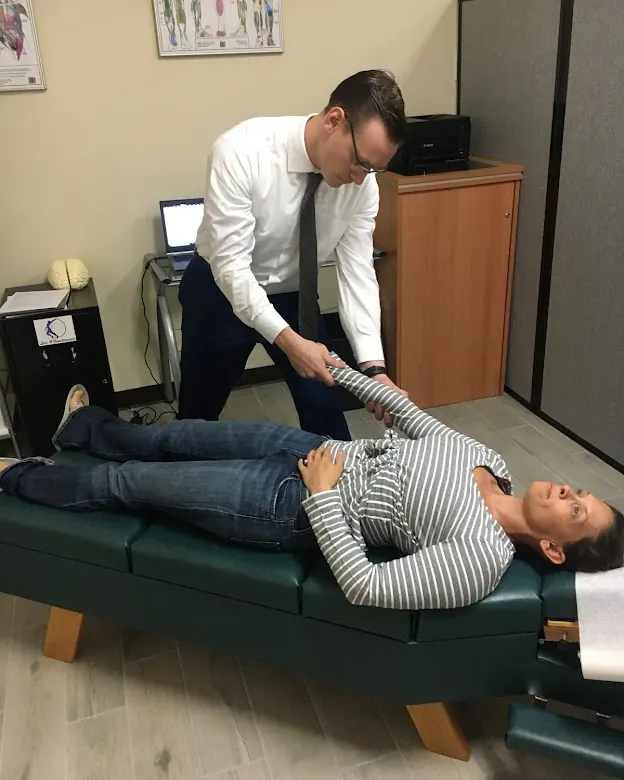
Dr. Brandon will ask about your sport, your training week, what changed, and what event or goal you’re working toward. He’ll assess the painful area and the joints around it, watch the movements that matter for your sport — a hinge, a squat, an overhead reach, a rotation — and test strength and control. You’ll leave with what he found, what to modify, what to keep, and what care could add. About 60 minutes.
No treatment plan to sign on day one.
“Dr. Mike at FIT Clinic is hands-down the best chiropractor I’ve seen.”
Individual experiences shared by patients; results vary.
“I can’t say enough great things bout Dr.”
Individual experiences shared by patients; results vary.
What care may include, and what the evidence says
Hands-on joint and soft-tissue work to restore movement, specific mobility and strength work to build capacity, and load management so you keep training. Manual therapy has the best support for spine-related pain and short-term relief in several joint problems; the durable gains come from progressive loading, which is why the plan always includes it. For anything that needs imaging, bracing, or surgical opinion, we say so early.
What athletes tell us
“I can’t say enough great things bout Dr. Brandon. As a competitive athlete with Spartan races and CrossFit, I’m constantly challenging my body and Dr. Brandon has been able to “fix” me on several occasions so I could compete. His knowledge and experience never cease to amaze me and I recommend him to my gym and friends.”
“Dr. Mike at FIT Clinic is hands-down the best chiropractor I’ve seen. He’s incredibly knowledgeable, thorough, and truly cares about long-term wellness. I’ve seen real improvements thanks to his personalized care. Highly recommend!”
Google rating 4.7 out of 5 from 39 reviews. Read them all on Google
Individual experiences shared by patients; results vary.
Healthy and want more range?
If you’re not hurt and want more range for your sport, see assisted stretching for athletes.
“Dr. Mike at FIT Clinic is hands-down the best chiropractor I’ve seen.”
Individual experiences shared by patients; results vary.
Questions
Will you tell me to stop training?
Rarely entirely. We'll tell you what to change and for how long, and when to build back.
Do you work with youth athletes?
Yes. Youth athletes of all ages are seen.
Can I come in the same week as a competition?
Yes; tell us the date when you book and we'll plan around it.
Related reading
Why Old Injury Pain Winter Flare-Ups Happen, and What Helps
Key takeawaysOld injury pain winter flare-ups are real, and they are explainable.Cold stiffens the tissue around an old injury.
How long does a sports injury take to recover, and what slows it down?
Last updated September 20, 2026 A sports injury recovery timeline is set by tissue healing stages and movement testing, not by the day your pain stops.…
Pickleball Injury Colts Neck: What Falls and Lunges Do
Key takeawaysA pickleball injury Colts Neck players bring in usually fits a short list.Sprains and strains, fractures, and Achilles tendon ruptures lead it.
Cost
First visit: $0 consultation and exam for new self-pay patients. Free benefits check by text: 848-301-1515.
The no-charge consultation and exam is for new self-pay patients. If you have Medicare, NJ FamilyCare/Medicaid, or another federal or state health program, your visit is billed under that program's rules, and you'll know your cost before anything happens. If you have private insurance, the exam is billed to your plan and normal copays apply — text us a photo of your card with the word BENEFITS for a free benefits check first.
“I can’t say enough great things bout Dr.”
Individual experiences shared by patients; results vary.