Marathon Training Injury: When a Niggle Needs a Real Look
Key takeaways
- Most marathon training injury cases are overuse problems that build gradually, typically after weekly mileage climbs faster than the body has adapted.
- Pain that stops you mid-run, or lingers after a few days of rest, deserves an evaluation.
Most marathon training injury cases are overuse problems that build gradually, typically after weekly mileage climbs faster than the body has adapted. Pain that stops you mid-run, or lingers after a few days of rest, deserves an evaluation. A mild ache that does neither can usually be watched while you hold or reduce your training load, and the taper is often when a slow-building problem finally makes itself heard.
What does a marathon training injury usually look like?
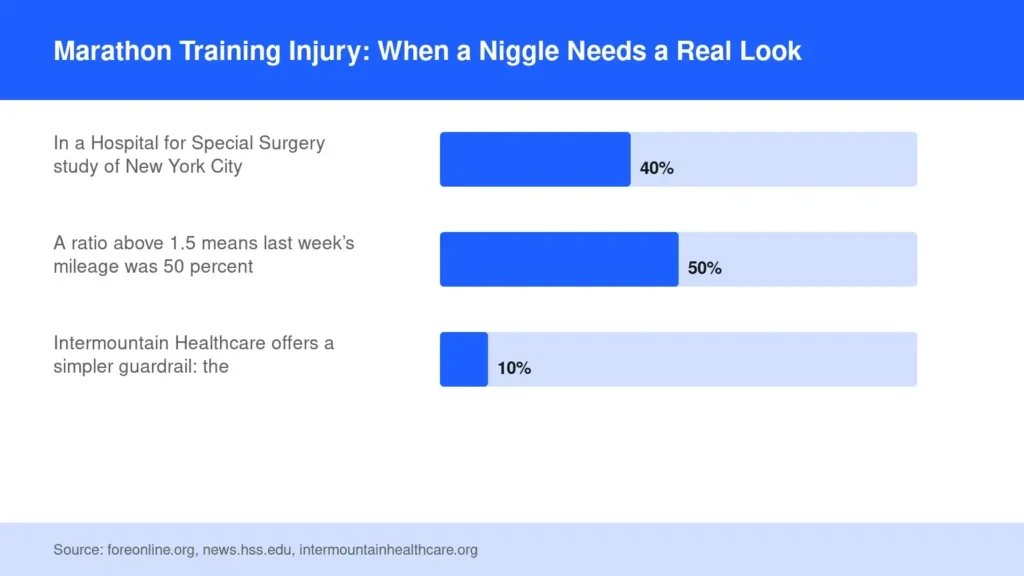
A marathon training injury is usually a slow build, not a sudden snap. In a Hospital for Special Surgery study of New York City Marathon trainees, 40% of runners reported an injury over 16 weeks of training tracked by Strava. That is not a fringe outcome. It is a large share of any starting line.
The type matters as much as the count. The National Institute of Arthritis and Musculoskeletal and Skin Diseases splits sports injuries into two groups. Acute injuries happen in a moment: a fall, a blow, a twisted joint. Chronic injuries come from repetitive overload of one area and develop gradually over time. Running is the same motion repeated over and over, so most running injuries land in the second group.
Here is the real problem. A gradual injury gives you a long window to ignore it. The ache is mild, so you keep going. The miles stack. By the time it hurts enough to stop you, it has had weeks to build.
Why am I getting injured all of a sudden?
Usually because the load climbed faster than the tissue adapted, even if the pain itself felt sudden. The HSS team found that runners who avoided rapid increases in weekly mileage were less likely to become injured in the lead-up to the race. They measured this with the acute:chronic workload ratio, which compares your recent week with your longer average.
The threshold is specific. A ratio above 1.5 means last week’s mileage was 50 percent higher than your average week over the past 28 days. Runners injured during the first 4 weeks of training spent more days at or above 1.5 than uninjured runners. Intermountain Healthcare offers a simpler guardrail: the 10% Rule, raising long runs and weekly mileage by no more than 10 percent each week. NIAMS lists the broader risk factors as poor technique, overtraining and increasing your intensity of physical activity too quickly.
This is the lesson I carry from my time as a strength and conditioning coach for the Toronto Blue Jays, the Tampa Bay Buccaneers and the University of South Florida. Load is counted, not felt. We made the same argument about young throwers in why pitch counts alone fall short. If you aren’t testing, you’re guessing.
Why does overuse pain show up during the taper?
The taper is often the first time the background noise drops enough for a local problem to stand out. This is a reading of the mechanism, not a measured finding. During peak weeks, general fatigue hides a lot. When the volume comes down, that fog lifts, and a sore tendon or a tender shin has nothing left to hide behind.
The taper also gives you time to think. Every twinge gets attention. And small changes still count as load: a new pair of shoes, a sharper session, a race-pace rehearsal on a different surface. None of these is dramatic. Each one is a change the body has to absorb.
The taper did not cause the injury. It revealed it.
Volume is relative, too. One former elite marathoner wrote that running just over half her old volume was enough to bring her training to a halt. What matters is not the mileage on paper. It is what your body is ready for right now.
Can I run through this niggle, or does it need a look?
Here is the test. Intermountain Healthcare advises that pain that forces you to stop in the middle of a run, or persists despite a few days of rest, ought to be evaluated by someone skilled in musculoskeletal diagnosis.
- Watch it: mild, doesn’t stop the run, and settles after a couple of easy days.
- Get it looked at: stops you mid-run, lingers past a few days of rest, or keeps coming back in the same spot.
- Treat it as a different injury: anything that started with a fall, a blow or a twist.
Acting early may help. The same source notes that a little rest and rehab early on gives you the best chance for a quick recovery. NIAMS says many sports injuries can be treated at home with rest, ice, compression and elevation. But rest is not one instruction. Bone injuries need rest until the bone is healed, while full rest isn’t always a good idea for tendons. That is the honest answer to why somebody needs to tell the two apart.
What happens in a running evaluation at FIT Clinic?
It starts with questions and an exam, not a treatment. Our sports injury and recovery evaluation looks at the whole chain, the training week, sleep, and what changed before the pain started.
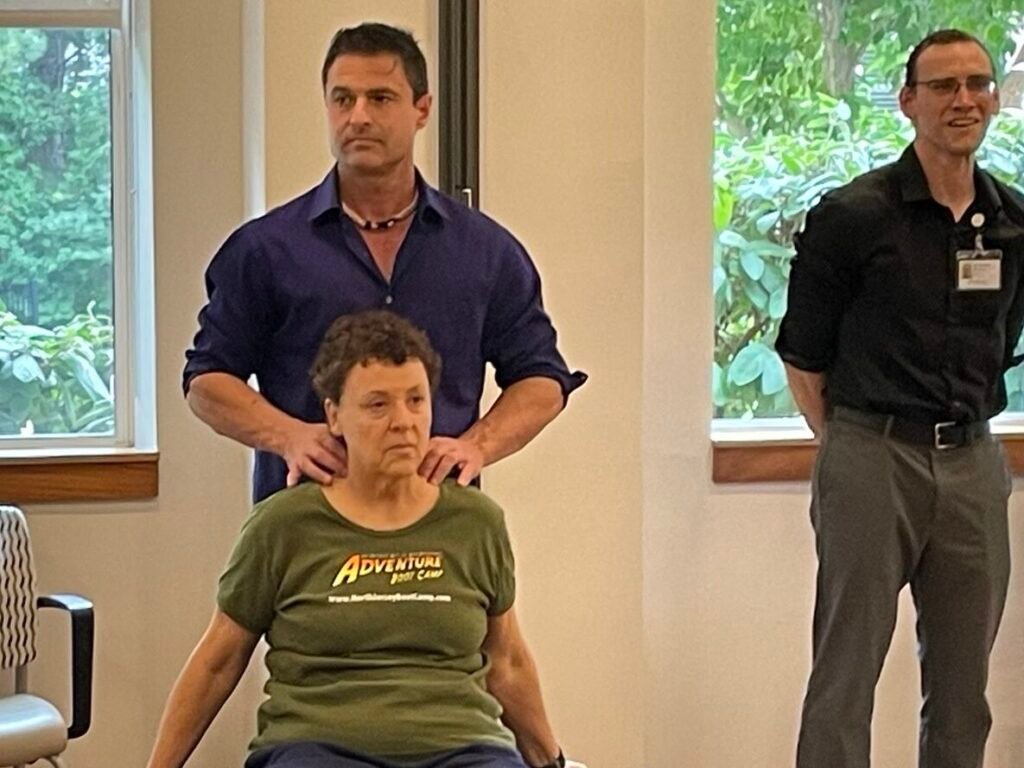
Dr. Michael Brandon, DC, frames the first job this way: “What is their pain, where is their pain, and what motions or activities cause it.” For a runner, that may mean stairs, hills, the first mile, or walking down a slope. From there, in his words, “I explain the options and tell them I don’t actually know what they need yet — I need to go over the exam first.”
Athletes can also book the FIT Sports Evaluation, a 20-minute appointment with Dr. Brandon or with me. Nothing happens without your OK, and everything gets explained in plain English. If the problem belongs with someone else, Dr. Brandon is plain about that too: “If I can’t be the one to help them, I want to at least put them in the right direction to find someone who can.”
How do you get past the fear of getting hurt again?
Name the fear, then give your downtime a job. Sports psychology writers describe fear of re-injury as a real source of anxiety on return, alongside loss of identity and disconnection from teammates. For a runner whose training group is the social week, that loss is not small.
Time off does not have to be dead time. The same source suggests using it to strengthen a weaker body part and work on your mental game. If you’re the partner or friend trying to make an injured runner feel better, Aptiva Health points to healthy stress management such as journaling or meditating, and to accepting help with tasks that are hard for now.
Getting hurt is not a verdict on you. A former elite marathoner wrote that she was used to dancing along the line of doing enough without doing too much, and like many runners, still often ended up injured. If an old injury tends to wake up when the weather turns, our piece on winter flare-ups of old injuries covers that pattern.
Frequently asked questions
What does it mean to be injury-prone as a runner?
It usually means a pattern keeps repeating, not that your body is fragile. Runners who get hurt every build often share a habit: mileage that jumps, a weak link that never gets trained, or a niggle run on too long. The useful question is what changed before each injury, because that pattern tends to return unless something in the plan changes.
It usually means a pattern keeps repeating, not that your body is fragile. Runners who get hurt every build often share a habit: mileage that jumps, a weak link that never gets trained, or a niggle run on too long. The useful question is what changed before each injury, because that pattern tends to return unless something in the plan changes.
Should I run the race if something still hurts?
That depends on what it is, and nobody can tell from a description alone. A mild ache that has stayed level through the taper is a different decision from pain that is getting worse or changing how you move. Get it examined before race week ends, so the call rests on an exam rather than a hope.
That depends on what it is, and nobody can tell from a description alone. A mild ache that has stayed level through the taper is a different decision from pain that is getting worse or changing how you move. Get it examined before race week ends, so the call rests on an exam rather than a hope.
Does a running evaluation mean getting an adjustment?
No. Treatment is a separate decision that comes after the exam, and only with your agreement. Dr. Brandon put it this way: “You don’t need to ‘crack’ or give that large adjustment to people.” Depending on what the exam finds, care for a runner may include hands-on work, mobility and strength training rather than any single technique.
No. Treatment is a separate decision that comes after the exam, and only with your agreement. Dr. Brandon put it this way: “You don’t need to ‘crack’ or give that large adjustment to people.” Depending on what the exam finds, care for a runner may include hands-on work, mobility and strength training rather than any single technique.
Where is FIT Clinic for runners in Monmouth County?
FIT Clinic is at 8 Merchants Way in Colts Neck, by the corner of Route 34 and County Route 537. Parking is free in front of and behind the building, which helps if you come straight from a run. The practice sees runners from Freehold, Manalapan, Holmdel, Middletown, Red Bank and nearby towns.
FIT Clinic is at 8 Merchants Way in Colts Neck, by the corner of Route 34 and County Route 537. Parking is free in front of and behind the building, which helps if you come straight from a run. The practice sees runners from Freehold, Manalapan, Holmdel, Middletown, Red Bank and nearby towns.
What should I track before a running evaluation?
Bring your training log or your watch data. Weekly mileage, long-run distance, new shoes, sleep and the day the pain started all give the exam a clearer picture. Note which movements make it painful, such as stairs, hills or the first steps of a run, because what provokes the pain can be more telling than where it sits.
Bring your training log or your watch data. Weekly mileage, long-run distance, new shoes, sleep and the day the pain started all give the exam a clearer picture. Note which movements make it painful, such as stairs, hills or the first steps of a run, because what provokes the pain can be more telling than where it sits.
The Bottom Line
Count your miles, not your toughness. Keep weekly mileage steady through the last block, respect pain that stops a run or lingers past a few days of rest, and treat the taper as a check-in rather than a scare. The race is one day. Your body is the one vehicle you get for every run after it.
If something keeps nagging, get an honest look before you decide anything. Book an evaluation at FIT Clinic in Colts Neck, and you will leave knowing what is going on and what your options are.
Book your first visit at https://fitclinic.co/book/ — or call or text 848-301-1515.
FIT Clinic at Functionised — 8 Merchants Way, Colts Neck, NJ 07722.
Sources
- HSS Study Finds Training Patterns Associated with Injuries in Marathon Runners
- Study Identifies Training Patterns Associated with Injuries in Marathon Runners
- 10 Tips for Marathon Training and Injury Prevention
- NIAMS Health Information on Sports Injuries
- 5 Ways to Support Your Mental Health after an Injury
- The Psychology of Sports Injury | Sports Psychology
- An elite marathon runner's 5 lessons from injury rehab
- An elite marathon runner's 5 lessons from injury rehab