Why Old Injury Pain Winter Flare-Ups Happen, and What Helps
Key takeaways
- Old injury pain winter flare-ups are real, and they are explainable.
- Cold stiffens the tissue around an old injury.
Old injury pain winter flare-ups are real, and they are explainable. Cold stiffens the tissue around an old injury. Falling barometric pressure changes how a sensitive joint feels. Blood flow shifts inward. The muscles guarding an old shoulder, knee or back tighten harder. This is measurable physiology, not superstition. A flare does not mean the original damage is spreading. It usually means strength, control or mobility was never fully rebuilt after the injury. That is worth having assessed rather than waited out for another season.
Why does an old injury start aching again when it gets cold?
Old injury pain winter flare-ups happen because cold changes the tissue around the old injury, not the old damage itself. You know the moment. The first step out of bed on a December morning. A cold floor. The shoulder you hurt years ago speaks before you do. Most people file that under weather and assume nothing can be done about it.
Three things shift as temperatures drop. Cooler tissue is stiffer tissue — in a study of superficial cooling, muscle stiffness rose as muscle temperature fell. Blood flow moves inward, away from the skin and the ends of your limbs. And the muscles around a joint you once injured tighten a little harder, because guarding is what a nervous system does when it expects trouble. Stack those three on a knee, a shoulder or a low back that already has wear or scar tissue in it. The same load you carried in September now registers as pain.
Stiffness is not the injury. It is the message.
Is old injury pain winter flare-up real, or is it in your head?
It is real, and it has been measured. In a study of adults with knee osteoarthritis, changes in barometric pressure and ambient temperature were associated with the severity of joint pain, with the authors pointing to joint fluid viscosity, the compliance of the tissue around the joint, and pressure effects inside the joint as plausible mechanisms.
Then there is the biggest dataset anyone has gathered on this question. In Cloudy with a Chance of Pain, 2,658 people with long-term pain logged their symptoms daily for fifteen months. The researchers reported that participants were about 20 per cent more likely to report pain on humid, windy days with low atmospheric pressure. The associations were real and modest. Weather explains part of a bad week, not all of it.
So the pattern people search for as old injury pain winter is, mechanically, a stiffness and guarding story more than a damage story. That distinction changes what is worth doing about it.
What does cold weather actually do to muscles, joints and blood flow?
Four things drive old injury pain winter aches, and all of them are ordinary physiology. None of them require anything mystical. Once you understand the four, the pattern stops feeling random.
Tissue cools and stiffens. Cold can leave muscles, ligaments and joints stiffer and more painful to move. Pressure falls too. Less air pressure around the body may allow tissues around a joint to expand slightly, and an already sensitive joint can feel that. Blood flow moves to the core, so hands, feet and superficial tissue all run cooler. And you move less. In a year-long study of older adults, the fewest daily steps were recorded in winter, rising again in spring.
That last one is the quiet one. New Jersey winters are not theoretical. The state climatologist recorded a January 2026 statewide average high of 36.4°F and average low of 19.6°F, the coldest January since 2014. Cold like that shortens the dog walk, cancels the round, moves the workout indoors or nowhere. A joint that loses its daily movement gets stiffer, and a stiffer joint hurts more. That is the loop most people are actually stuck in by February.
Does a winter flare-up mean the old injury is getting worse?
Old injury pain winter flares usually do not mean the old damage is spreading. The mechanisms that have been studied — fluid viscosity, tissue compliance, pressure inside the joint, protective muscle tone — are changes in sensitivity. They move with the weather in both directions, especially in a joint that already carries wear.
Here is the real problem. Pain intensity and tissue damage are not the same measurement, and it is easy to treat them as if they were. A flare that arrives with the first hard cold snap and eases during a mild week is behaving like a sensitivity problem. A flare that lasts longer each winter, spreads, wakes you at night, or takes away a movement you had in the autumn is behaving like something else. Neither of those can be sorted out from a description. That is exactly why guessing is the expensive option.
If you aren’t testing, you’re guessing. The same logic applies to the timeline of any sports injury and what slows it down: what the tissue is doing and what the pain says can drift apart for months.
Why do some old injuries never fully settle without follow-up?
The pain leaves before the function comes back, and most people stop at the pain. It is the most common reason an old knee or shoulder still has a voice in January.
Joint injury does not only damage tissue. It changes how the muscles around that joint are allowed to switch on. After knee trauma there is a documented reflex inhibition of the surrounding musculature, known as arthrogenic muscle inhibition, which can hold strength down well past the point where the injury stops hurting. In the back, recurrence is the norm rather than the exception. A systematic review and meta-analysis notes that about 69% of people have a recurrence within 12 months of recovering from an episode of low back pain. Strength, control and confidence have to be rebuilt deliberately. Weather then finds whatever was left undone.
Our clinical team starts where Dr. Michael Brandon, DC, starts, and it is not with a treatment plan. In his words: “What is their pain, where is their pain, and what motions or activities cause it.” Then the exam. Then the options.
What can you do about it before another winter passes?
If old injury pain winter flares arrive every year, get it assessed while it is talking to you. Keep moving in the meantime. A flare is diagnostic information; a quiet July joint tells you much less.
Practical things that may help in the cold months:
- Warm up indoors before you go out.
- Lengthen the warm-up rather than shortening the session.
- Schedule the walk for the warmest part of the day, and keep the joint moving daily even on colder weeks.
- Dress the limb that flares, not only the torso.
- Use heat on the stiff areas before activity rather than after.
None of that replaces knowing what is actually going on. It buys you a better winter while you find out. If your neck or upper back is the part that flares, the indoor months add a second factor worth reading about — why necks get worse with desk and commuting hours.
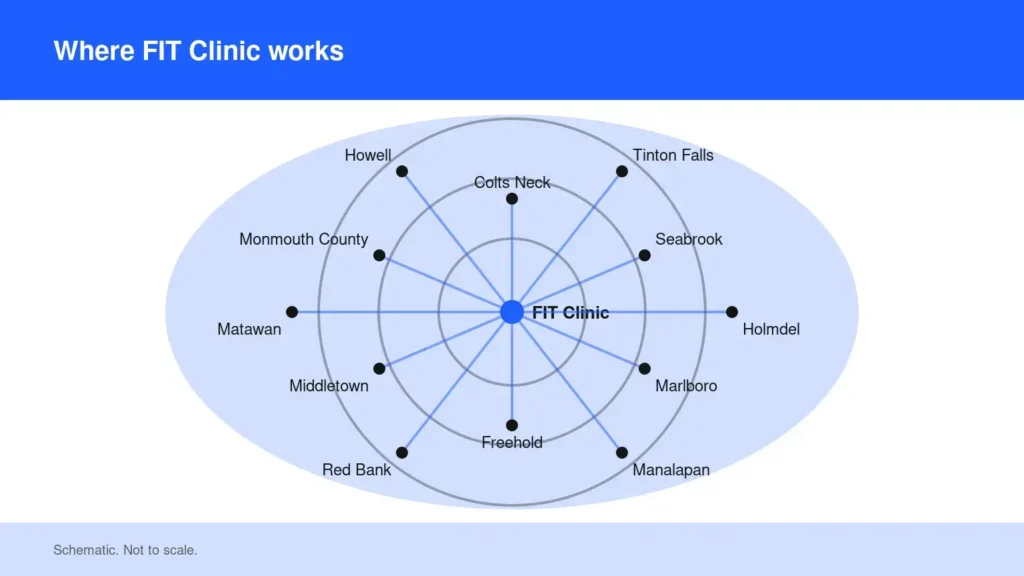
For readers in Colts Neck, Manalapan, Freehold and Marlboro, FIT Clinic is at 8 Merchants Way in Colts Neck, by the corner of Route 34 and County Route 537. Parking is free in front of and behind the building. If a large, forceful adjustment is the thing keeping you from calling, Dr. Brandon is direct about it: “You don’t need to ‘crack’ or give that large adjustment to people.”
Frequently asked questions
Why do my joints ache more when it is cold outside?
Cold tissue is stiffer tissue, and stiffer tissue is more sensitive to load. Cooler muscle behaves stiffer. Blood flow shifts away from the limbs. The muscles around an old injury guard a little harder against a load they used to accept without comment. Falling barometric pressure appears to add to the effect. None of that means the cold is damaging the joint.
Cold tissue is stiffer tissue, and stiffer tissue is more sensitive to load. Cooler muscle behaves stiffer. Blood flow shifts away from the limbs. The muscles around an old injury guard a little harder against a load they used to accept without comment. Falling barometric pressure appears to add to the effect. None of that means the cold is damaging the joint.
Can cold weather make an old injury worse?
Cold weather changes how an old injury feels far more than what it is. The mechanisms studied so far, such as joint fluid viscosity, tissue compliance and protective muscle guarding, are reversible, and they track the weather in both directions. A flare that repeats every winter still deserves an assessment. Repeating flares usually mean something was never fully rebuilt.
Cold weather changes how an old injury feels far more than what it is. The mechanisms studied so far, such as joint fluid viscosity, tissue compliance and protective muscle guarding, are reversible, and they track the weather in both directions. A flare that repeats every winter still deserves an assessment. Repeating flares usually mean something was never fully rebuilt.
Does heat help old injury pain in winter?
Warmth may help, and it is a reasonable first thing to try. Clinicians commonly suggest staying active, stretching regularly and using heat for cold-weather aches. Warming up indoors before you go outside is the same idea applied a little earlier. Heat manages the symptom. It does not restore the strength or control that an old injury may have taken from you.
Warmth may help, and it is a reasonable first thing to try. Clinicians commonly suggest staying active, stretching regularly and using heat for cold-weather aches. Warming up indoors before you go outside is the same idea applied a little earlier. Heat manages the symptom. It does not restore the strength or control that an old injury may have taken from you.
How long does a winter flare-up in an old injury last?
Most weather-related discomfort settles as the weather settles, which is why people describe these flares in days rather than months. The pattern matters more than the length. If the same shoulder, knee, hip or back flares with every cold spell, and the flare lasts longer each winter, that is information worth having assessed rather than waited out for another season.
Most weather-related discomfort settles as the weather settles, which is why people describe these flares in days rather than months. The pattern matters more than the length. If the same shoulder, knee, hip or back flares with every cold spell, and the flare lasts longer each winter, that is information worth having assessed rather than waited out for another season.
Should I keep exercising outdoors through a Monmouth County winter?
Old injury pain winter flares are not a reason to stop moving outdoors. Keep going, with a longer warm-up and a shorter first session. Daily steps tend to fall in winter, and losing movement is its own problem for a stiff joint. Warm up indoors, start slower than you think you need to, and build back from there. If one specific movement keeps provoking pain, get it looked at rather than trained through.
Old injury pain winter flares are not a reason to stop moving outdoors. Keep going, with a longer warm-up and a shorter first session. Daily steps tend to fall in winter, and losing movement is its own problem for a stiff joint. Warm up indoors, start slower than you think you need to, and build back from there. If one specific movement keeps provoking pain, get it looked at rather than trained through.
The Bottom Line
Old injury pain winter flare-ups are not a character flaw, a weather superstition or a sentence. They are a joint with wear, scar tissue or unfinished rehabilitation behind it, meeting stiffer tissue, lower pressure and less daily movement at the same time. The flare is not proof that the damage is spreading. It is proof that something was never completely rebuilt, and that a cold Monmouth County winter is very good at finding it.
So do the thing you have put off. Come in, get examined, and hear a straight answer about what is going on and what the options are — nothing happens without your say-so. Book at fitclinic.co/book, or call or text 848-301-1515 and tell us which joint has started talking again.
Book your first visit at https://fitclinic.co/book/ — or call or text 848-301-1515.
FIT Clinic at Functionised — 8 Merchants Way, Colts Neck, NJ 07722.
Sources
- Changes in Barometric Pressure and Ambient Temperature Influence Osteoarthritis Pain (The American Journal of Medicine)
- How the weather affects the pain of citizen scientists using a smartphone app (npj Digital Medicine)
- Cloudy with a Chance of Pain? Smartphone study shows pain more likely on humid, windy days (University of Manchester)
- How Changes in Weather Affect Joint Pain (Cleveland Clinic)
- What triggers weather-related joint pain? (Harvard Health Publishing)
- Time course of changes in range of motion, muscle shear elastic modulus, spinal excitability, and muscle temperature during superficial icing (Sport Sciences for Health)
- January 2026 monthly summary, Office of the New Jersey State Climatologist, Rutgers University
- Arthrogenic muscle inhibition after anterior cruciate ligament injury: Injured and uninjured limb recovery over time
- The clinical course of acute, subacute and persistent low back pain: a systematic review and meta-analysis (CMAJ)
- Influence of seasonal variations on physical activity in older people living in mountainous agricultural areas