Return to Sport Evaluation: Why Strength Is Not Enough
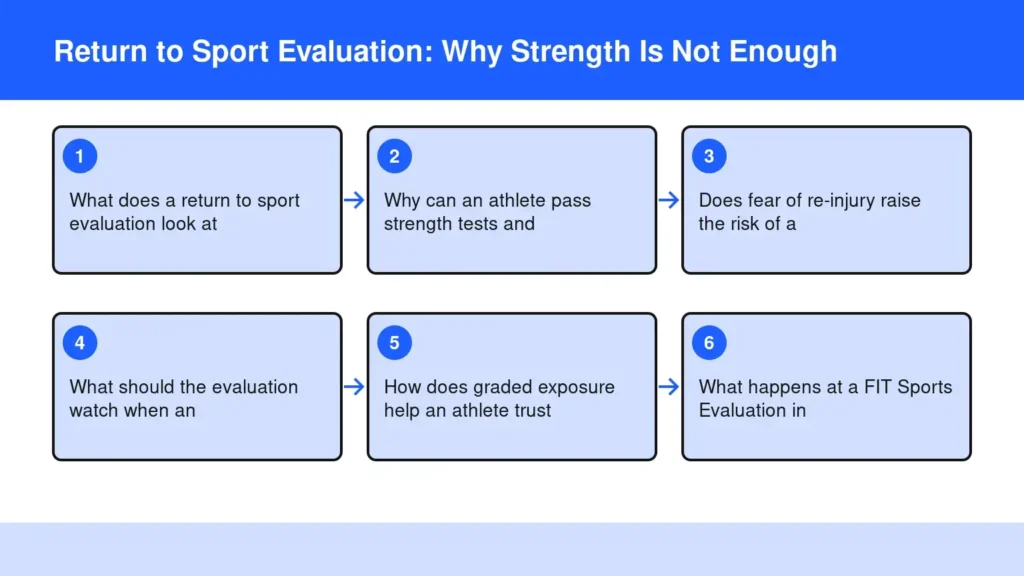
Key takeaways
- A return to sport evaluation after ACL surgery should check more than strength.
- It should also look at how the athlete lands, how they move when the play speeds up, and whether they trust the knee.
A return to sport evaluation after ACL surgery should check more than strength. It should also look at how the athlete lands, how they move when the play speeds up, and whether they trust the knee. Passing strength tests and feeling ready to play are separate checkpoints. If your teen, or you, is cleared but still afraid to cut, that fear is worth testing, not pushing through.
What does a return to sport evaluation look at beyond strength?
A return to sport evaluation should look at strength first. One clinic guide describes return-to-sport testing as a series of objective assessments of strength, balance, power and movement quality.
Here is what the research shows. In a study of patients after ACL reconstruction, only 13 (3%) met all 6 test criteria at 6 months, and 83 (18%) passed none. In the same study, a passing quadriceps strength or hop test at 6 months showed no link with playing competitive sport at 12 months. Patients who cleared two questionnaire thresholds, one for self-reported knee function and one for psychological readiness, had 4 times the odds of returning to competition.
Sit with that for a moment. A strength test provides one number. It does not tell you whether the athlete will plant and go when a defender closes in. That is the athletic question.
Why can an athlete pass strength tests and still be afraid to cut?
Strength and trust can recover on different timelines. The leg may test well while the athlete still treats a hard cut as a risk. The same clinic guide notes that an athlete months out from ACL reconstruction may feel little or no pain yet still show strength deficits, poor landing mechanics or reduced power.
Parents, this part is for you. In a study in the American Journal of Sports Medicine, injured patients aged 20 or younger scored lower on psychological readiness than young uninjured peers, 60.8 versus 71.5 points. Yet a prospective study linked younger age with a faster, more frequent return to sport. Put those together. The athletes who tend to get back soonest may also be the ones whose confidence lags behind their legs. A single number rarely tells the whole story, which is also why pitch counts fall short for young throwers.
Weekend players are not exempt. The authors of the first study suggest patients may base the decision to return more on how they feel and how ready they are mentally than on physical performance. That is not weakness. It is how people decide about their own athletic life.
Does fear of re-injury raise the risk of a second ACL injury?
It may. In studies of athletes after ACL reconstruction, lower psychological readiness goes with higher second-injury risk, especially in younger players. In one cohort of 329 patients who returned to sport, 52 (16%) sustained a second ACL injury, and younger patients with lower readiness carried the higher risk.
Other research points the same way. One summary of the evidence puts re-injury rates at around 20-25% in young athletes returning to pivoting sports. It flags athletes who look physically ready but report high fear or avoid aggressive movements during testing. Another guide reports that athletes who return before reaching adequate strength face 2-7x higher second ACL injury risk.
Fear is not the injury. It is the message.
What should the evaluation watch when an athlete lands and cuts?
It should watch the athlete move the way the sport demands: fast, reactive and a little tired. Standing still and pushing against a machine is only the start. One physical therapy practice describes functional training that simulates sports-specific movements to prepare athletes for a safe return.
Here is the test. Questions worth asking at any evaluation:
- Landing. Does the athlete land softer on one leg, or let the knee drift inward on the surgical side?
- Cutting under pressure. Do they slow down, shorten the step or hesitate before planting when the drill turns reactive?
- Fatigue. Does the movement hold up late in the session, the way it has to late in a game?
- Confidence. What does the athlete say, and what does their body do, when the drill reaches top speed?
Dr. Michael Brandon, DC, puts the first questions this way: “What is their pain, where is their pain, and what motions or activities cause it.” For a cleared athlete with little pain left, the third question does most of the work.
How does graded exposure help an athlete trust the knee again?
Graded exposure rebuilds trust in planned steps. The athlete practises the feared movement at a level they can handle. They raise the difficulty only when the movement and the confidence both hold. That mirrors the structured protocols physical therapists describe, built on functional milestones and the demands of each sport, with sports-specific work reintroduced gradually while the team watches for pain or dysfunction.
Time alone is a weak signal. One guide reports that only 9% of clinicians use objective return-to-sport criteria before clearing athletes, with the rest relying mainly on time from surgery. A calendar date is not a test. If you aren’t testing, you’re guessing.
I worked as a strength and conditioning coach for the Toronto Blue Jays, the Tampa Bay Buccaneers and the University of South Florida. I was also performance coach to the boxers Antonio Tarver and Antonio Tarver Jr. The tools change from sport to sport. The principle does not: earn the next level before you load it.
What happens at a FIT Sports Evaluation in Colts Neck?
It is a 20-minute appointment with Dr. Michael Brandon, DC, or me, Jim Goetz, CSCS, at FIT Clinic. Our clinical team looks at the whole chain, the training week, sleep, and what changed before the pain started. The details sit on the FIT Sports Evaluation page.
Nothing happens without your OK. Dr. Brandon says it plainly: “I explain the options and tell them I don’t actually know what they need yet — I need to go over the exam first.” Your surgeon and physical therapist still own the ACL rehabilitation plan. The evaluation provides a second set of eyes on how the athlete moves. Dr. Brandon also says: “Athletes are usually much more motivated than the average person to get better.” Motivation is the fuel. The plan has to aim it.
FIT Clinic sits at 8 Merchants Way, by the corner of Route 34 and County Route 537, with free parking in front of and behind the building. For a parent driving in from Freehold, Holmdel or Marlboro after practice, that means no hunting for a spot with a tired athlete in the back seat. If an older injury also speaks up when the weather turns, see why old injury pain flares in winter.
Frequently asked questions
Does pain going away mean the knee is ready to play?
Not on its own. A clinic guide on return-to-sport assessment notes that pain often eases before muscles, tendons, ligaments and the nervous system have fully recovered. Low pain is a good sign. Readiness still needs checking for strength, landing and movement under load, with your surgeon or rehab team involved.
Not on its own. A clinic guide on return-to-sport assessment notes that pain often eases before muscles, tendons, ligaments and the nervous system have fully recovered. Low pain is a good sign. Readiness still needs checking for strength, landing and movement under load, with your surgeon or rehab team involved.
How long does it usually take to return to competition after ACL surgery?
In one prospective study, the mean time was 9.5 months to return to competition and 10.5 months to return to the same level. In that study, 74.3% returned to competition and 63.4% to the same level. Every athlete differs, so treat these averages as context, not a deadline.
In one prospective study, the mean time was 9.5 months to return to competition and 10.5 months to return to the same level. In that study, 74.3% returned to competition and 63.4% to the same level. Every athlete differs, so treat these averages as context, not a deadline.
Do women take longer than men to return to sport after ACL reconstruction?
In one prospective study, men returned more quickly than women for both training and competition. That is a group average, not a forecast for your daughter or for you. It is one more reason to judge readiness by how the athlete actually moves and feels rather than by a date.
In one prospective study, men returned more quickly than women for both training and competition. That is a group average, not a forecast for your daughter or for you. It is one more reason to judge readiness by how the athlete actually moves and feels rather than by a date.
What is limb symmetry after ACL reconstruction?
Limb symmetry compares the surgical leg with the other leg on measures such as strength and hopping. A clinic guide notes that many evidence-based programs aim for at least 90% limb symmetry before unrestricted return for certain lower extremity injuries. It measures the leg, not the athlete’s confidence.
Limb symmetry compares the surgical leg with the other leg on measures such as strength and hopping. A clinic guide notes that many evidence-based programs aim for at least 90% limb symmetry before unrestricted return for certain lower extremity injuries. It measures the leg, not the athlete’s confidence.
Should I see someone new if my ACL rehab team is already involved?
A second look can sit alongside the plan your surgeon and rehab team are running; it does not replace it. Dr. Michael Brandon, DC, says: “If I can’t be the one to help them, I want to at least put them in the right direction to find someone who can.” The aim is a clearer answer, not a competing one.
A second look can sit alongside the plan your surgeon and rehab team are running; it does not replace it. Dr. Michael Brandon, DC, says: “If I can’t be the one to help them, I want to at least put them in the right direction to find someone who can.” The aim is a clearer answer, not a competing one.
The Bottom Line
Cleared is one checkpoint. Ready is another. If your teen, or you, passed the strength numbers but still hesitates on a hard cut, that hesitation deserves its own look. Keep the people already running the rehabilitation plan in the loop.
Our clinical team will look at the whole chain and tell you in plain English what we see and what we don’t know yet. You decide what happens next. Book a FIT Sports Evaluation, or call or text 848-301-1515.
Book your first visit at https://fitclinic.co/book/ — or call or text 848-301-1515.
FIT Clinic at Functionised — 8 Merchants Way, Colts Neck, NJ 07722.
Sources
- Who passes return to sport tests and which tests are most associated with a return to play after anterior cruciate ligament reconstruction?
- Prospective study of functional outcomes and return to sports after anterior cruciate ligament reconstruction in the knee
- Return-to-Sport Testing: Complete Guide to Criterion-Based Clearance
- ACL Return-to-Sport Testing: Which Criteria Actually Predict Re-Injury Risk
- Psychological Readiness to Return to Sport Is… : American Journal of Sports Medicine
- Ensuring a Strong Comeback: Return-to-Sport Criteria for Athletes in Physical Therapy
- Return-to-Sport Criteria for Athletes | Darien PT & Fitness
- The Science Behind Return-to-Sport Testing: Why Feeling Better Doesn't Always Mean You're Ready to Play