Youth Baseball Elbow Pain: Why Pitch Counts Fall Short
Key takeaways
- A new screening study found suspected youth baseball elbow pain findings fell by about half after rule changes, and pitch count limits did most of that work.
- The later inning and time limits added less.
A new screening study found suspected youth baseball elbow pain findings fell by about half after rule changes, and pitch count limits did most of that work. The later inning and time limits added less. Here is what the data showed, which signs matter, and when to see an orthopedist.
What did the new study on youth baseball elbow pain find?
His son had never once said his elbow hurt. That is the version of this story I hear most.
Suspected cases fell by about half, and pitch counts did most of the work. Researchers ultrasound screened the throwing elbow of 3,057 youth baseball players aged 9 to 12, grouped by when they were screened against a stepwise set of rule changes.
Read that second step carefully. The authors call the pitch count rules particularly effective, with the later restrictions producing less dramatic effects. Rules helped, and then the curve flattened. So here is the reframe worth taking home: a rule is a ceiling on one league's paperwork, not a cap on a child's year.
What is osteochondritis dissecans of the capitellum?
It is an overuse injury to bone and cartilage on the outside of the elbow joint. The capitellum is the knob the forearm meets during the throwing motion.
Here is the mechanism. Repetitive stress compresses that outer surface, and the condition usually begins with vague lateral pain, sometimes swelling, stiffness and reduced range of motion, then catching, and loose bodies can occur.
The name parents know is little league elbow. This is different. Baseball elbow injuries are grouped as medial, lateral and posterior, and OCD is the lateral type, most common in schoolchildren aged 9 to 12.
Why do pitch count rules not protect an arm in Howell or Marlboro?
Because one league keeps the count, and a young arm throws for several, including school, travel and showcase teams. The ledger is split, so nobody holds the whole year. Counting does work when somebody actually counts: youth pitchers held to a pitch count reported less elbow pain than those who were not.
School baseball here runs on a real rule. The NJSIAA caps a pitcher at 110 pitches per game and requires up to four calendar days of rest. It governs school competition only. It does not count a Sunday travel game in Marlboro or an indoor throwing program in Howell in February.
The guidelines run on the calendar. Pitch Smart asks players aged 9 to 12 to take four months off throwing each year and avoid multiple teams at once. Pitchers aged 9 to 14 who pitched more than 8 months per year carried 5 times the risk of surgery.
Which signs in a young thrower should parents take seriously?
Five things, and only one is pain during a game. Run this checklist after fall ball, before any winter program.
- Pain on the outside of the elbow. The lateral side is the capitellum side, and that is where this pain typically sits.
- Losing velocity or accuracy. Signs of fatigue that should end throwing for the day.
- Losing full extension. Screening found limited range of motion and pain on extension were significant risk factors for OCD.
- Clicking, catching or locking. Mechanical symptoms that can mean loose bodies.
- He only says it hurts after. In one on-field screen, 10 players were diagnosed with OCD and 7 had no symptoms.
Sit with that last one. A quiet elbow is not a healthy elbow in a child who throws year round. Coaches in Colts Neck and Holmdel, treat lost extension as information.
What does a 20-minute FIT Sports Evaluation check?
It is a 20-minute appointment: a history and a movement exam, with Dr. Michael Brandon, DC or me, Jim Goetz, CSCS, at FIT Clinic in Colts Neck. As Dr. Brandon puts it, "What is their pain, where is their pain, and what motions or activities cause it."
Our clinical team compares the throwing side with the other: elbow extension and flexion, forearm rotation, shoulder motion, grip, and muscle control at the trunk and hip. We ask what the year actually looked like, team by team, because workload is the exposure. In Dr. Brandon's words, "I explain the options and tell them I don't actually know what they need yet — I need to go over the exam first."
We are at 8 Merchants Way, at the corner of Route 34 and County Route 537, parking free front and back. Our page on sports and activity pain covers the wider picture.
When should a young thrower see an orthopedist instead?
When the elbow locks, catches or will not straighten, and when lateral pain keeps returning despite rest. Those findings need medical imaging and a physician's decision.
An advanced lesion gets loud. The joint starts working like a hinge with a pebble in it, and that is not a problem rest talks out of. In a surgical review, pitchers returned to prior performance less often than non-pitchers after capitellar OCD surgery.
Referral is not a failure of care. It is the job. Dr. Brandon says it this way: "If I can't be the one to help them, I want to at least put them in the right direction to find someone who can." If the plan stays conservative, the timeline matters, which we cover in sports injury recovery, and old injuries speak up indoors in winter, covered in winter flare-ups.
Frequently asked questions
Is catching harder on a young elbow than pitching?
Both carry raised risk, which is why the study looked closely at pitchers and catchers. Pitch Smart guidelines for ages 9 to 12 say to avoid playing catcher while not pitching, and never to pitch in multiple games on one day. A child who catches between outings throws more than his count shows.
Both carry raised risk, which is why the study looked closely at pitchers and catchers. Pitch Smart guidelines for ages 9 to 12 say to avoid playing catcher while not pitching, and never to pitch in multiple games on one day. A child who catches between outings throws more than his count shows.
Do curveballs cause elbow injuries in young baseball players?
Volume matters more than pitch type. The American Sports Medicine Institute states that curveballs have been suggested as a risk factor, that existing research does not support it, and that overuse is the principal risk factor. Poor pitching mechanics and poor fitness are also named.
Volume matters more than pitch type. The American Sports Medicine Institute states that curveballs have been suggested as a risk factor, that existing research does not support it, and that overuse is the principal risk factor. Poor pitching mechanics and poor fitness are also named.
What age is capitellar OCD most common in baseball players?
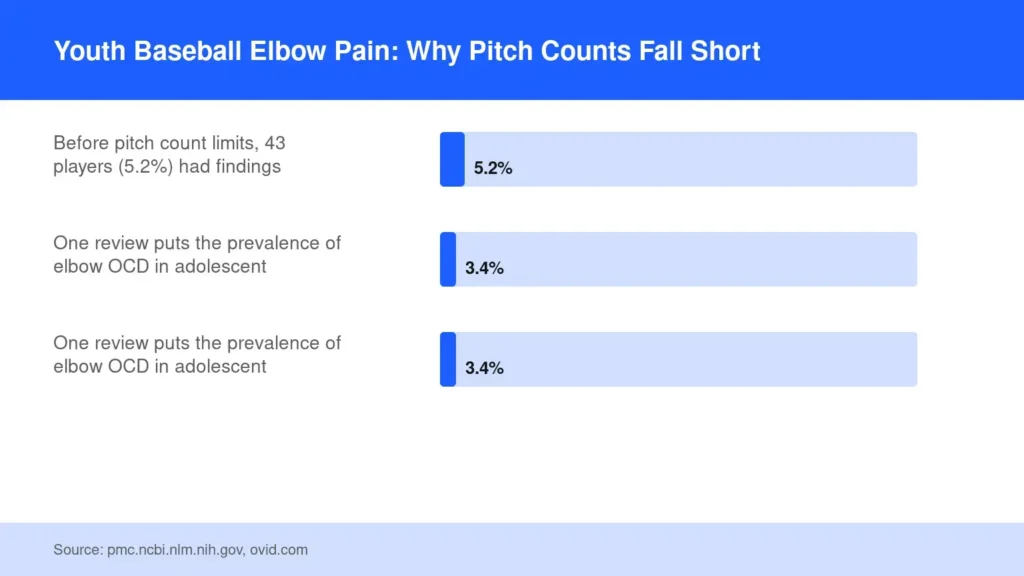
It occurs most in schoolchildren aged 9 to 12, which is why mass screening targets that age band. One review puts the prevalence of elbow OCD in adolescent baseball players at around 3.4%. Rare for one coach, common across a travel program.
It occurs most in schoolchildren aged 9 to 12, which is why mass screening targets that age band. One review puts the prevalence of elbow OCD in adolescent baseball players at around 3.4%. Rare for one coach, common across a travel program.
What happens if a kid keeps pitching through elbow pain?
Risk climbs steeply. A review of adolescent pitchers reports that pitching with pain or fatigue carried 4 to 36 times greater risk of an overuse injury, and that minor problems can progress into more serious ones when young athletes play through symptoms.
Risk climbs steeply. A review of adolescent pitchers reports that pitching with pain or fatigue carried 4 to 36 times greater risk of an overuse injury, and that minor problems can progress into more serious ones when young athletes play through symptoms.
Can OCD of the elbow heal without surgery?
Sometimes. In a review of the literature, stable lesions were treated with rest, while unstable lesions and stable ones that failed conservative treatment may require surgery, with MRI used to judge stability. That call belongs to an orthopedic physician.
Sometimes. In a review of the literature, stable lesions were treated with rest, while unstable lesions and stable ones that failed conservative treatment may require surgery, with MRI used to judge stability. That call belongs to an orthopedic physician.
The Bottom Line
Rules helped. Rules are not enough. No rule counts the innings your child throws for three programs in one calendar, and arm health is a 12-month ledger. Run the checklist above before the first indoor session, not after it.
If your young thrower ticked any box on that list during fall ball, book a FIT Sports Evaluation at fitclinic.co/book, or call or text 848-301-1515. We are at 8 Merchants Way, Colts Neck, NJ 07722, and see families from Howell, Marlboro, Holmdel and Freehold. Bring the season: teams, innings, showcases, and how his arm felt.
Book your first visit at https://fitclinic.co/book/ — or call or text 848-301-1515.
FIT Clinic at Functionised — 8 Merchants Way, Colts Neck, NJ 07722.
Sources
- Paper 56. Impact of Youth Baseball Rule Changes on Elbow Screening for Osteochondritis Dissecans of the Humeral Capitellum during Annual Elbow Examinations
- Detection of Factors Related to the Development of Osteochondritis Dissecans in Youth Baseball Players Screening
- Osteochondritis Dissecans of the Elbow: A Review of Presentation, Diagnosis, Treatment and Complications (AOAO)
- NJSIAA Baseball Pitch Count Rule (2025-26)
- Pitch Smart Pitching Guidelines, Ages 9-12 (MLB and USA Baseball)
- Sport Specialization and Overuse Injuries in Adolescent Athletes (University of Florida PM&R)
- Prevention of Elbow Injuries in Youth Baseball Pitchers
- Limiting the Pitch Count in Youth Baseball Pitchers Decreases Elbow Pain
- Rate of Return to Prior Performance between Pitchers and Nonpitchers after Surgical Management for Capitellar Osteochondritis Dissecans
- Osteochondritis Dissecans of the Capitellum: A Review of the Literature and a Distal Ulnar Portal
- Position Statement for Adolescent Baseball Pitchers (American Sports Medicine Institute)