Rotator cuff shoulder pain exercise and why consistency wins
Key takeaways
- Rotator cuff shoulder pain exercise may help many adults reach, lift and sleep better, and it sits at the centre of most published non-surgical care.
- It tends to help only when you keep doing it for weeks.
Rotator cuff shoulder pain exercise may help many adults reach, lift and sleep better, and it sits at the centre of most published non-surgical care. It tends to help only when you keep doing it for weeks. It also depends on an exam that first confirms the problem is the cuff, not the neck or a stiff joint. That is why FIT Clinic starts with a hands-on exam before any plan.
Does rotator cuff shoulder pain exercise actually help?
For many adults, yes. In studies of resistance training, people with rotator cuff problems reported less pain and better use of the arm. Rotator cuff shoulder pain exercise is not something you try while waiting for the real treatment. In much of the published research, it is the main treatment. One physiotherapy group calls exercise a crucial part of both conservative care and rehab after surgery.
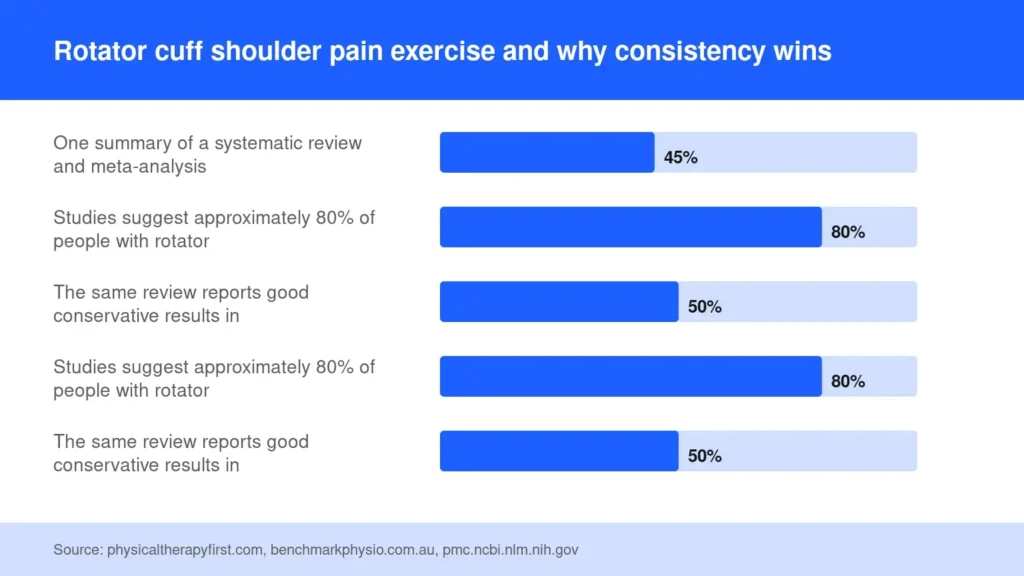
The figures come from pooled trials. One summary of a systematic review and meta-analysis reported that pain intensity scores improved by 35-45% after 6-12 weeks of resistance training. The same summary reported a 20-30% improvement in shoulder strength and range of motion on standard function scores. Those are group averages. They are not a forecast for your shoulder.
Here is the mechanism. Some cuff muscles pull the upper arm bone down as they work, widening the space the tendons travel through. Stronger muscles around the joint may also steady it and take strain off the tendons. Stiffness is not the injury. It is the message that the joint has lost some control.
What is the rotator cuff, and what does an injury feel like?
The rotator cuff is four small muscles and their tendons coming off the shoulder blade, and its job is to keep the shoulder stable. They are the supraspinatus, infraspinatus, subscapularis and teres minor. Together they hold the shoulder in place so you can lift your arm and reach up.
Injuries usually fall into two groups. The tendons can get irritated by injury or overuse, a problem called rotator cuff tendinitis. Repetitive motion, ageing and poor posture all appear among the common contributors. Or the tendons can tear, from natural ageing wear and tear or from trauma such as a fall.
The symptoms are familiar. A tear can make it difficult or painful to lift your arm overhead, even to brush your hair or get dressed. Tears often cause weakness with lifting and pain at night. That is the person who stops reaching for the top shelf. It is the person who rolls off one side every night without thinking about it.
What can be mistaken for rotator cuff pain?
Frozen shoulder is the classic look-alike, and the neck is the other question worth asking. Frozen shoulder often gets mistaken for a tear because both involve pain and difficulty moving the arm. The pattern differs. Frozen shoulder shows up more as stiffness and a steady loss of motion in every direction.
Here is the test. A physical exam of strength, range of motion and specific movement patterns can often narrow down the likely cause before anyone orders imaging. At FIT Clinic, the shoulder exam asks a plain question: is it the shoulder, the cuff or the neck? The neck gets checked by hand, so it is ruled in or out rather than assumed. Our piece on what matters with neck pain before any treatment covers that side of the exam.
Dr. Michael Brandon, DC, builds every exam from three questions. In his words: “What is their pain, where is their pain, and what motions or activities cause it.” Those answers decide which structure gets the attention. A program aimed at the wrong structure is effort spent in the wrong place.
How can you tell if a rotator cuff is torn or strained?
You usually cannot tell at home; a hands-on exam is the honest way to sort it. One clue is useful. A tear usually still allows a fairly normal passive range of motion, with pain and weakness showing up mainly when you lift the arm yourself.
Weakness tells you more than soreness. Tears that affect a significant portion of the tendon weaken the shoulder, limiting your ability to hold your arm out to one side or lift an object. The same source adds that trouble using a sore shoulder does not always mean there is a tear. Pain says something is wrong. Strength testing says more about what.
The answer changes the plan. Once the cuff tears, the tendons do not heal, but strengthening the deltoid can help get movement back. For tears that cannot heal, one review describes rehab that aims to compensate for the missing part of the cuff. This is why Dr. Brandon refuses to guess. He tells new patients: “I explain the options and tell them I don’t actually know what they need yet — I need to go over the exam first.”
Why does a shoulder program only work if you keep doing it?
Because the benefit in the research came from people who did the work for weeks, not days. The trials measured training blocks, not single good sessions. A program you quit after one good week never reaches the stage where those gains showed up.
One well-known rehab approach, the Rockwood program, rests on four goals:
- Pain control
- Mobility recovery
- Building muscular strength
- Long-term maintenance
Sit with that last one for a moment. Maintenance sits on the list beside pain control, not after it. The usual pattern is simple: the shoulder feels better, the band goes in a drawer, and the work stops. What actually matters is a routine short enough to fit your real week, so it survives the good weeks as well as the bad ones.
Measure it, don’t hope
The working rule in our building is blunt: if you aren’t testing, you’re guessing. FIT Clinic shares the building with FIT Lab, where an ARX strength baseline and grip strength are measured rather than estimated. A baseline lets you see whether the arm is actually getting stronger. That is skin in the game you can read, instead of a feeling you have to trust.
How do you deal with shoulder pain while working out?
Keep training, but change what loads the sore shoulder and break up long stretches of shoulder work. Strengthening the shoulder, keeping the tendons flexible and taking frequent breaks from heavy shoulder use all appear in prevention advice. For irritated tendons, one orthopedic group advises rest and avoiding activities that stress the cuff tendons, including sports or work tasks.
I coached strength and conditioning for the Toronto Blue Jays, the Tampa Bay Buccaneers and the University of South Florida. I have worked with force plates, motion capture and wearables. That work built one habit: change the variable you can measure, then check what happened. Swapping one pressing movement for another is a variable. Pushing through and hoping is not.
Dr. Brandon sees the same drive in active patients. “Athletes are usually much more motivated than the average person to get better.” That motivation may cut both ways, because the lifter who never misses a session can also keep loading a tendon that needs a change. The same logic applies further down the arm, as our piece on what a tennis elbow exam checks explains.
Frequently asked questions
What are the best rotator cuff exercises?
There is no universal list; the best rotator cuff exercises are the ones matched to what the exam finds. Research shows specific exercises can help improve shoulder strength and function. Physical therapy programs typically restore shoulder movement and strengthen the cuff muscles. A short routine you repeat will usually serve you better than a long one you abandon.
There is no universal list; the best rotator cuff exercises are the ones matched to what the exam finds. Research shows specific exercises can help improve shoulder strength and function. Physical therapy programs typically restore shoulder movement and strengthen the cuff muscles. A short routine you repeat will usually serve you better than a long one you abandon.
Does a rotator cuff tear always mean surgery?
Not usually. Studies suggest approximately 80% of people with rotator cuff tears can improve with non-surgical treatment such as physical therapy and medication. A review found that for tendinopathy without a tear, surgery and conservative treatment produce similar results. The same review reports good conservative results in partial tears less than 50% of the tendon’s thickness.
Not usually. Studies suggest approximately 80% of people with rotator cuff tears can improve with non-surgical treatment such as physical therapy and medication. A review found that for tendinopathy without a tear, surgery and conservative treatment produce similar results. The same review reports good conservative results in partial tears less than 50% of the tendon’s thickness.
Does FIT Clinic crack the shoulder or neck?
FIT Clinic does not rely on forceful cracking. Dr. Brandon puts it plainly: “You don’t need to ‘crack’ or give that large adjustment to people.” Chiropractic care here is hands-on care for how joints, muscles and nerves work together. The approach follows what the exam finds, rather than a routine applied to every shoulder that walks in.
FIT Clinic does not rely on forceful cracking. Dr. Brandon puts it plainly: “You don’t need to ‘crack’ or give that large adjustment to people.” Chiropractic care here is hands-on care for how joints, muscles and nerves work together. The approach follows what the exam finds, rather than a routine applied to every shoulder that walks in.
What if a shoulder exam shows it is not something a chiropractor treats?
Dr. Brandon refers the patient on. In his words: “If I can’t be the one to help them, I want to at least put them in the right direction to find someone who can.” Some shoulders belong with a physician or an orthopedist, and the exam is where that becomes clear. Knowing early saves weeks spent on the wrong plan.
Dr. Brandon refers the patient on. In his words: “If I can’t be the one to help them, I want to at least put them in the right direction to find someone who can.” Some shoulders belong with a physician or an orthopedist, and the exam is where that becomes clear. Knowing early saves weeks spent on the wrong plan.
The Bottom Line
It pays off when the plan targets the right structure, fits your week and gets measured along the way. Start with an exam that checks the shoulder, the cuff and the neck before anyone writes a program. Our shoulder pain page explains what that exam covers.
Book a shoulder evaluation at FIT Clinic, 8 Merchants Way, Colts Neck, by the corner of Route 34 and County Route 537. If you are driving in from Holmdel or elsewhere, parking is free in front of and behind the building. Book online, or call or text (848) 301-1515.
Book your first visit at https://fitclinic.co/book/ — or call or text 848-301-1515.
FIT Clinic at Functionised — 8 Merchants Way, Colts Neck, NJ 07722.
Sources
- Rush University Medical Center: Rotator Cuff Tear Signs & Symptoms | Rush
- National Center for Biotechnology Information (NCBI), U.S. National Library of Medicine: Current trends in rehabilitation of rotator cuff injuries
- Harvard Health Publishing: Rotator Cuff Injury
- Kingston and Richmond NHS: Shoulder exercises for rotator cuff tear
- Physical Therapy First: The Effectiveness of Resistance Exercise for Rotator Cuff Tendonitis: A Systematic Review and Meta-Analysis
- Benchmark Physio: 5 Rotator Cuff Exercises to Get Rid of Pain for Good
- Proliance Orthopedic Associates: Rotator Cuff Exercises | Stretches
- Hand to Shoulder Chicago (Dr. Mark Yaffe): Rotator Cuff Injury or Something Else? How to Tell