Fibromyalgia Chiropractor Help When Pain Runs in Families
Key takeaways
- A fibromyalgia chiropractor cannot change the genes that raise your risk, and the evidence for chiropractic care in fibromyalgia is limited.
- What an evaluation can do is find the pain drivers that still respond to change: how you move, how you sleep and how your body recovers from stress.
A fibromyalgia chiropractor cannot change the genes that raise your risk, and the evidence for chiropractic care in fibromyalgia is limited. What an evaluation can do is find the pain drivers that still respond to change: how you move, how you sleep and how your body recovers from stress. That is where care may help.
Can a fibromyalgia chiropractor help if fibromyalgia runs in your family?
A fibromyalgia chiropractor may help with the parts of the problem that still move, but not with your genes. Nobody’s hands change those. The condition does cluster in families: blood relatives of patients are eight times more likely to develop it, according to the American Fibromyalgia Syndrome Association.
Here is the real problem. Inherited risk sounds like a verdict. It is not. Family risk describes the wiring you started with. It says nothing about how sleep, stress and movement load that wiring every day. That part you still control, and that is where care may help relieve pain.
What is fibromyalgia, in plain English?
Fibromyalgia is a chronic disorder of widespread pain, tenderness, fatigue and poor day-to-day function, as researchers describe the syndrome. The CDC adds emotional and mental distress and sleep problems to that list. University Hospitals calls it a collection of painful symptoms, not a disease.
It is not rare. University Hospitals puts it at about 5 million Americans, most often women of childbearing age. One advocacy group says it affects 3 to 5 percent of the general population.
Is fibromyalgia pain all in your head?
No. The pain is real, and the nervous system is turning up its volume. It often feels musculoskeletal, like a strained muscle. Researchers now classify it as a nociplastic pain condition, characterized by heightened pain sensitivity in both the central and peripheral nerve pathways.
Western Reserve Hospital describes the central part as a process where the brain and spinal cord amplify normal pain signals. Patients feel pain and stiffness without visible inflammation or injury. So the scan comes back clean, and someone says it is in your head.
Sit with that for a moment. A clean scan does not mean nothing is wrong. It puts the nervous system at the center of the story. The tenderness is not the injury; it is the volume knob.
What does the evidence say about chiropractic care for fibromyalgia?
The honest answer is that it is limited. The American Fibromyalgia Syndrome Association notes that no treatment currently addresses all the processes that drive the condition. The CDC says nothing ends it outright, but health care providers can help treat and manage symptoms.
The best-known example of fibromyalgia chiropractic care is a single case report. A 34-year-old veteran received multimodal care, and his average pain fell from 7/10 to 3/10, with less cane use. That is encouraging. It is also one man, and it cannot predict your results.
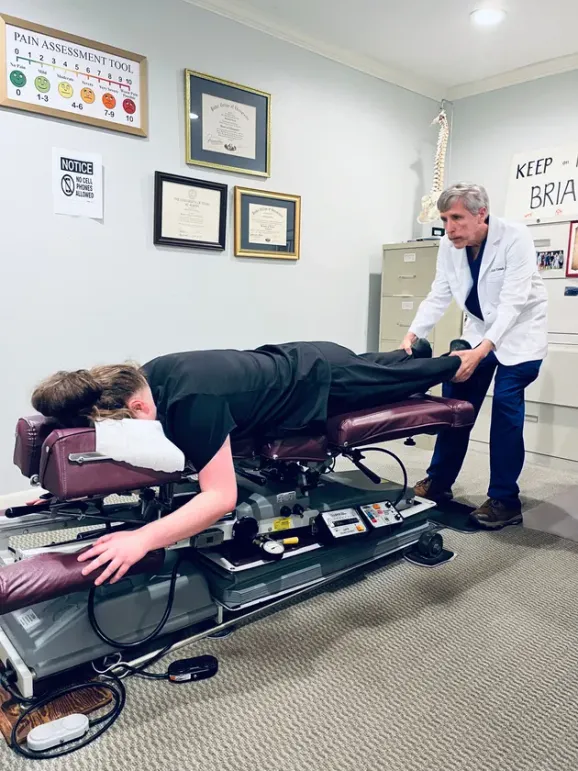
So our clinical team treats chiropractic as one tool inside an overall plan, as in our honest guide to integrative medicine for pain. Hands-on contact can be gentle. As Dr. Michael Brandon, DC, puts it: “You don’t need to ‘crack’ or give that large adjustment to people.” Here is what chiropractic care involves at FIT Clinic.
Which fibromyalgia pain drivers can still change?
Movement, sleep and stress recovery are the three you can work on. The CDC lists physical activity, a healthy weight, joint protection and good sleep habits among ways people reduce pain and improve function. University Hospitals names stress, cold and damp, and short sleep as triggers.
The mind side counts too. Cognitive-behavioral therapy has shown positive effects on coping and on feeling in control of pain. That does not make the pain psychological. Optimal is not the goal here; consistent is.
My background is strength and conditioning, and one rule from that work holds: if you aren’t testing you’re guessing. Small changes, tracked over months, may compound, much like the pattern in what actually helped prevent chronic back pain.
What happens at a FIT Clinic evaluation for widespread pain?
An evaluation maps your pain before anyone talks about treatment. Dr. Brandon starts with three questions: “What is their pain, where is their pain, and what motions or activities cause it.” The evaluation also looks at the whole chain, the training week, sleep, and what changed before the pain started.
He is direct about day one: “I explain the options and tell them I don’t actually know what they need yet — I need to go over the exam first.” If the picture points elsewhere, he says: “If I can’t be the one to help them, I want to at least put them in the right direction to find someone who can.”
For stress recovery, FIT Clinic also offers HRV biofeedback. It shows one of your body’s stress-and-recovery signals live while you practice a slow breathing pattern. Nothing happens without your OK.
Frequently asked questions
Is there a quiz that tells me if I have fibromyalgia?
No quiz can diagnose fibromyalgia. Online quizzes, such as the University Hospitals fibromyalgia quiz, test what you know about the condition, not whether you have it. A diagnosis comes from a clinician who takes a full history and examines you, so bring your questions to that appointment.
No quiz can diagnose fibromyalgia. Online quizzes, such as the University Hospitals fibromyalgia quiz, test what you know about the condition, not whether you have it. A diagnosis comes from a clinician who takes a full history and examines you, so bring your questions to that appointment.
How is fibromyalgia diagnosed?
Clinicians diagnose it mainly on pain all over the body plus other symptoms. NIAMS notes there are no specific laboratory or imaging tests for it. Doctors use blood work and scans to rule other problems out, so expect a careful history and exam rather than one test result.
Clinicians diagnose it mainly on pain all over the body plus other symptoms. NIAMS notes there are no specific laboratory or imaging tests for it. Doctors use blood work and scans to rule other problems out, so expect a careful history and exam rather than one test result.
How do you live with someone who has fibromyalgia?
Talk about it, openly and often. In research on couples, better communication between patients and spouses was linked to more positive patient outcomes. NIAMS also suggests learning about the condition and joining an online or in-person support group, which a partner can do too.
Talk about it, openly and often. In research on couples, better communication between patients and spouses was linked to more positive patient outcomes. NIAMS also suggests learning about the condition and joining an online or in-person support group, which a partner can do too.
Can fibromyalgia cause pain in the thighs and hips?
It can, because the pain is widespread by definition. In one published case, pain covered the spine, both shoulders and both hips, with intermittent tingling in all four extremities. New or worsening leg symptoms still deserve an exam, and if a nerve or joint problem looks likely, see a physician.
It can, because the pain is widespread by definition. In one published case, pain covered the spine, both shoulders and both hips, with intermittent tingling in all four extremities. New or worsening leg symptoms still deserve an exam, and if a nerve or joint problem looks likely, see a physician.
Does fibromyalgia get worse with age?
Not by itself, according to University Hospitals. It continues over time but doesn’t damage joints or muscle tissue or worsen with age, though it can be disabling at times. For adults over 60, that is a useful reframe: new stiffness may come from something else, and an exam can tell the two apart.
Not by itself, according to University Hospitals. It continues over time but doesn’t damage joints or muscle tissue or worsen with age, though it can be disabling at times. For adults over 60, that is a useful reframe: new stiffness may come from something else, and an exam can tell the two apart.
The Bottom Line
Your genes set the starting point. They do not write the whole day. Movement, sleep and stress recovery are the drivers you can still change, and an evaluation is how you find out which of them matter most for you.
FIT Clinic is at 8 Merchants Way in Colts Neck, by the corner of Route 34 and County Route 537, with free parking in front of and behind the building. Book an evaluation, or call or text 848-301-1515.
Book your first visit at https://fitclinic.co/book/ — or call or text 848-301-1515.
FIT Clinic at Functionised — 8 Merchants Way, Colts Neck, NJ 07722.
Sources
- Contemporary Chiropractic Care for a Veteran with Fibromyalgia: A Case Report | Published in Journal of Contemporary Chiropractic
- The Role of Spousal Relationships in Fibromyalgia Patients’ Quality of Life
- Fibromyalgia | CDC
- Fibromyalgia Quiz | University Hospitals
- What is Fibromyalgia? – A Serious Multi-System Disease
- Chiropractic Care for Fibromyalgia | Western Reserve Hospital
- Fibromyalgia
- Understanding Fibromyalgia and Its Related Disorders