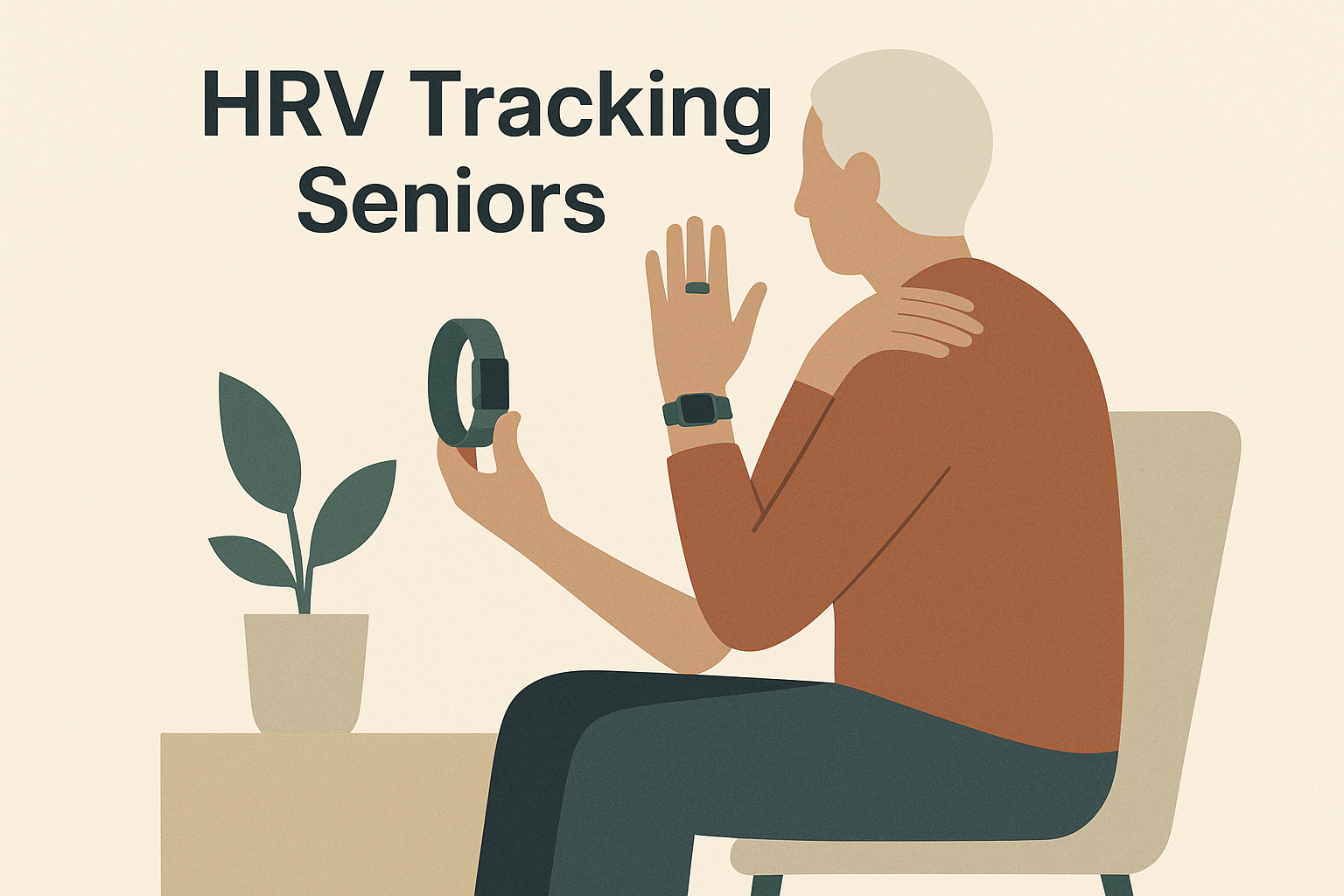
HRV tracking seniors now do on a wrist or a ring shows one thing: an estimate of how hard your autonomic nervous system is working to recover, sampled overnight and reported as a trend. It is not a diagnosis, it is not a fitness grade, and it cannot see the stiff joint, the guarded neck or the new medication that may be driving the number down. The useful move is to read the trend over weeks, log what you did, and bring the pattern to an in-person examination where a clinician can test what the sensor cannot.
What does a heart rate variability score actually measure?
It measures the tiny differences in timing between one heartbeat and the next, which is a window on how your autonomic nervous system is currently running the engine. It is not a fitness score and it is not a diagnosis. Your heart is not a metronome. Between breaths, the brake goes on and off, and that beat-to-beat modulation is produced largely by vagal outflow to the sinus node. Higher variability generally means the brake is working well. Lower variability generally means the accelerator is dominating.
Here is the real problem with reading the number on its own. HRV responds to almost everything: posture, breathing rate, sleep, alcohol, medication, illness, temperature and pain are all documented influences on heart rate variability. So the same person can produce two very different readings in the same week without anything meaningful changing about their health. And a person can produce a stable, unremarkable reading while a joint quietly stops moving and a hip starts compensating.
A low score is not the injury. It is the message.
How accurate is the HRV tracking seniors wear on the wrist?
Close enough to show a trend, not close enough to be a clinical measurement. A wrist or ring device reads blood volume changes through the skin, which gives pulse rate variability rather than the electrical signal from the heart, and agreement between pulse rate variability and ECG-derived heart rate variability is influenced by ageing and by body position. That matters more, not less, for an older reader.
Compare that with how the research was done. The mortality work most people are quoting second-hand used clinical recordings: the Atherosclerosis Risk in Communities analysis published in PLOS ONE in 2016 derived its HRV measures from 2-minute electrocardiogram recordings in 12,543 participants, and the Cardiovascular Health Study used 24-hour Holter recordings in 1,172 community-dwelling adults aged 65 to 93. Controlled position. Controlled duration. Electrical signal, not optical estimate. Your watch is doing something useful and something different, and the gap between those two things is where most misreadings live.
Wearable use among older adults in the United States is now common enough to be studied in national survey data, including an analysis of the Health Information National Trends Survey linking device use with physical activity levels in older adults. So the question is no longer whether you will have the data. You will. The question is what you do with it, and who helps you read it.
Why is my HRV declining or getting erratic as I get older?
Because autonomic control changes with age, and because load, sleep, pain and inactivity all press on the same system. Aging itself is part of it: researchers tracked heart rate variability and its changes over five years in older adults precisely because those measures do not sit still across a decade.
The reason anyone cares about the direction is that lower variability travels with worse outcomes across large populations. In the ARIC cohort, the lowest tertile of SDNN and r-MSSD was associated with an increased risk of sudden cardiac death over a median 13 years of follow-up, with 215 sudden cardiac deaths adjudicated, and in the Cardiovascular Health Study abnormal heart rate turbulence combined with a low fractal scaling exponent predicted cardiovascular death within every Framingham risk stratum, with a relative risk of 7.7 in the lowest-risk group. That is association in cohorts, not a prediction about you. It also cuts the other way: a number that moves with your behaviour is a number you can act on.
Frailty is the more honest frame for an active adult over sixty. A systematic review and three-level meta-analysis of 16 studies covering 2,365 older adults found lower HRV in pre-frail and frail people than in their non-frail counterparts, while the pooled effects did not reach statistical significance. Read that carefully. The signal is there and the certainty is not, which is exactly why the number belongs next to a physical exam rather than instead of one.
Does chiropractic care change heart rate variability?
It may shift cardiac autonomic measures in the short term, and the research is small, early and mostly measured in windows of minutes to weeks. Anyone telling you an adjustment raises your HRV for good is selling you something. A randomized placebo-controlled trial reported that one session of spinal manipulation improved cardiac autonomic control in patients with musculoskeletal pain, and a randomized controlled trial in Trials tested spinal manipulative therapy against heart rate variability and pain outcomes in people with chronic neck pain.
Let me explain the plausible mechanism, because mechanism comes before instruction. Pain is an input to the same autonomic system your watch is sampling. A neck that hurts and will not rotate is a source of continuous nociceptive traffic, and sympathetic drive rises to meet it. Reduce the mechanical irritation and improve how the segment moves, and you have removed one of the inputs that was holding the accelerator down. That is the argument. It is not a promise, and it is not a reason to treat a spine because of a smartwatch graph.
This is also where the wrong question gets asked. People want to know what raises the score. The better question is what is loading the system, which is the same question we ask about where pain actually comes from and the same reason a doctor of chiropractic is trained to examine first and treat second.
What can a Functionised assessment show that a smartwatch cannot?
A physical examination and a history. Your device cannot palpate a joint, watch you rise from a chair, test how your neck rotates, or ask what changed in the month your readings started sliding. Our clinical team works across chiropractic care, back and neck pain, sports injury and recovery, mobility for active adults, senior wellness, and HRV and longevity, and those are examined in person, not inferred from a graph.
Here is the test. Take your own data to a visit and see whether anyone asks what happened on the days the number moved. A trend line plus a stiff thoracic spine is a different conversation from a trend line plus a new medication, and neither of those is visible to an optical sensor on your wrist. The treating clinician at FIT Clinic is Dr. Michael Brandon, DC, and the examination is what turns a consumer metric into something a clinician can respond to. If your readings and your body disagree, the body is the primary document.
If you live at Seabrook, the Erickson active-adult community for residents aged 62 and over, this is practical rather than theoretical, because our clinical team sees patients on site there as well as in Colts Neck and Tinton Falls. You do not have to drive to be assessed. That single logistical fact changes how often a trend gets checked, and frequency is what makes trend data worth keeping. HRV and longevity care at FIT Clinic in Colts Neck starts with an examination, not a download.
How should I use my HRV data to decide on training, rest or an adjustment?
Use the direction over weeks, not the figure this morning, and change one input at a time. If you are not testing you are guessing, but testing means writing down what you did, not staring at an app.
A workable habit for an active adult looks like this:
- Log the inputs. Sleep, alcohol, illness, travel, and what you actually did for exercise.
- Judge the trend, not the day. One low morning is weather. A sustained slide with rising stiffness is a pattern.
- Adjust intensity before you cancel. Keep the walk. Drop the intervals. Movement is the input with the longest track record, and a systematic review of exercise interventions in older adults examined their effects on heart rate variability and cardiovascular health factors.
- Escalate on symptoms, not scores. Chest symptoms, breathlessness, fainting or new palpitations go to your physician, not to a chiropractor and not to a forum.
When the pattern is a stiff, sore, guarded body that will not recover from ordinary activity, that is a musculoskeletal question and it belongs in an examination room. Our clinical team will want to see how you move, which is the same territory covered in our work on joint stiffness and mobility for active adults. Boring is good here. The people who get somewhere with this data are the ones who keep a dull log for months and change one thing at a time.
Frequently asked questions
What is a normal HRV for someone in their sixties?
There is no single normal number. HRV falls across a wide range between healthy people of the same age, and it shifts with sleep, illness, medication, alcohol, breathing and posture. That is why the useful unit is your own trend over weeks compared with your own baseline, not a comparison against a stranger on a leaderboard. Numbers without context are noise.
Does a low HRV reading mean something is wrong with my heart?
Not on its own. A single low morning reading is a snapshot of one night, and wrist sensors estimate the signal rather than record it electrically. Population research links low variability with worse cardiovascular outcomes, but that is a statement about groups, not a diagnosis of you. Persistent changes, chest symptoms or breathlessness belong with your physician, promptly.
Can chiropractic adjustments improve heart rate variability?
Some randomized trials have measured short-term shifts in cardiac autonomic control after spinal manipulation in people with musculoskeletal pain, so it may help in those windows. What that research does not show is a lasting HRV gain from adjustment alone. Treat it as one input alongside sleep, training load, breathing and pain control, not a lever for your score.
Should I stop exercising on a day my HRV score is low?
Usually no. One low reading is more often a reason to lower intensity than to sit still, because movement is the input with the strongest track record in older adults. Walk, mobilise, keep the session easy. A week of low readings with rising stiffness or pain is different, and that pattern is worth an in-person assessment.
Which HRV number should I actually watch on my device?
Watch the trend and its stability, not the morning figure. Most consumer devices report a nightly average derived from beat-to-beat intervals during sleep, so day-to-day swings are expected. Record what you did the day before, note sleep and alcohol, and look at the rolling direction over weeks. Direction and consistency carry the information.
The Bottom Line
Your wearable is measuring a real thing and reporting it with real limits. It sees an estimate of autonomic tone while you sleep. It does not see a rib that stopped moving, a hip that gave up rotation, a new prescription, or the reason you have stopped walking the long loop. Population research tells us the direction of variability matters; it does not tell you what is driving yours. That gap is clinical work, and it is the work our clinical team does in person.
So here is the next step, and it is a small one. Keep logging for a few weeks so you arrive with a trend rather than a screenshot, then bring it to an examination and let someone put hands on the joints the sensor cannot see. New patients call 848-301-1515; we do not book online. FIT Clinic is part of Functionised at 8 Merchants Way, Colts Neck, NJ 07722, with care also at Tinton Falls and at Seabrook. You have the data. What will you do with it?
New patients should call 848-301-1515 — we book new patients by phone rather than online.
FIT Clinic at Functionised — 8 Merchants Way, Colts Neck, NJ 07722.
Also in Tinton Falls and at Seabrook.
Sources
- Novel measures of heart rate variability predict cardiovascular mortality in older adults independent of traditional cardiovascular risk factors: the Cardiovascular Health Study (CHS)
- Low Heart Rate Variability in a 2-Minute Electrocardiogram Recording Is Associated with an Increased Risk of Sudden Cardiac Death in the General Population: The Atherosclerosis Risk in Communities Study
- The relationship between heart rate variability and frailty in older adults: Systematic review and three-level meta-analysis
- Aging and Postural Changes Influence the Agreement Between Pulse Rate Variability and Heart Rate Variability
- How the vagus nerve produces beat-to-beat heart rate variability
- Analysis of Heart Rate Variability and Implication of Different Factors on Heart Rate Variability
- One Session of Spinal Manipulation Improves the Cardiac Autonomic Control in Patients with Musculoskeletal Pain: A Randomized Placebo-Controlled Trial
- The effect of spinal manipulative therapy on heart rate variability and pain in patients with chronic neck pain: a randomized controlled trial
- Effects of different exercise interventions on heart rate variability and cardiovascular health factors in older adults: a systematic review
- Association Between Wearable Device Use and Levels of Physical Activity Among Older Adults in the US: Evidence From the 2019-2020 Health Information National Trends Survey
- Heart rate variability and its changes over 5 years in older adults
This article is for information only and is not medical advice. It is not a diagnosis and does not replace a consultation. Speak to a qualified clinician about your own situation.