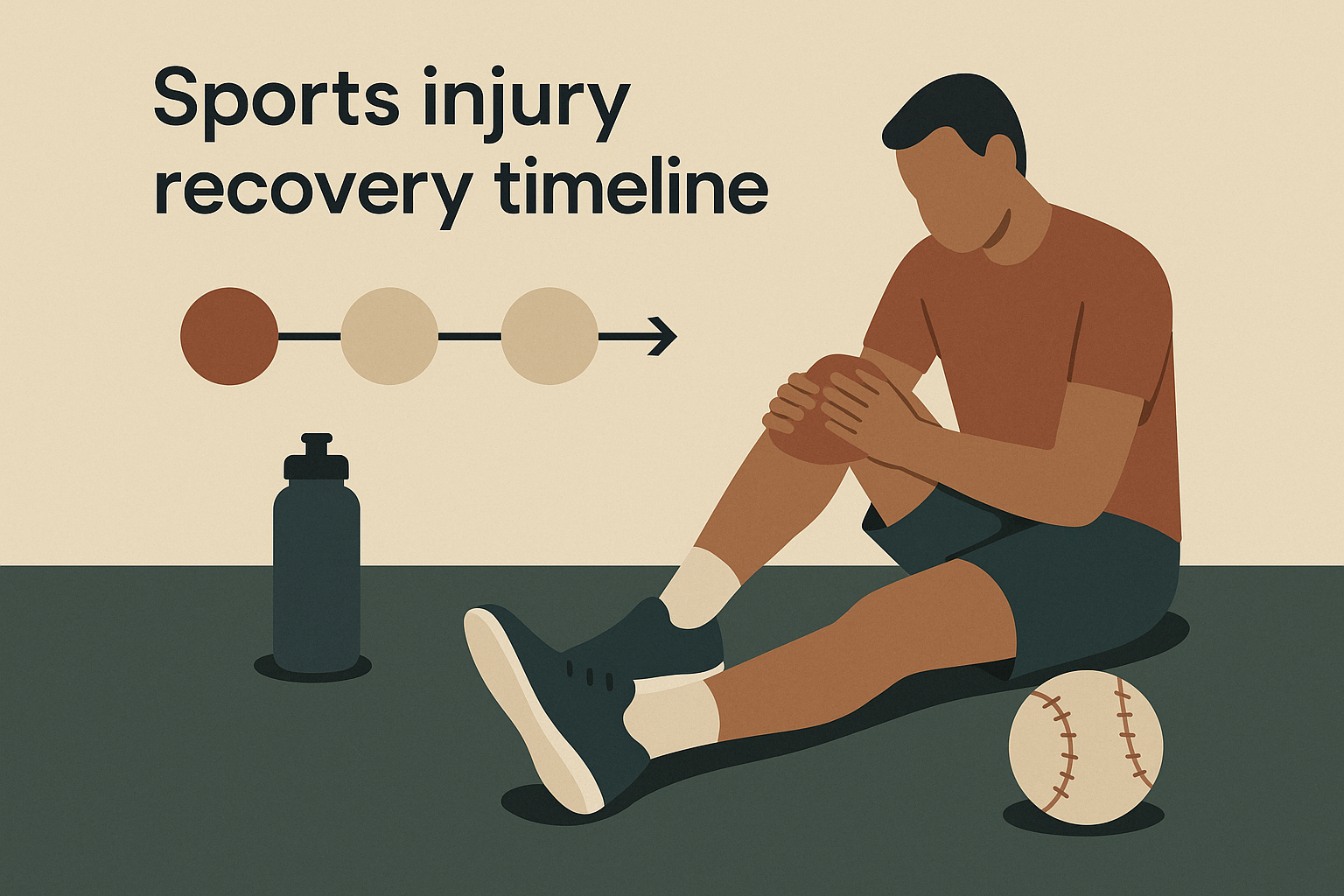
A sports injury recovery timeline is set by tissue healing stages and movement testing, not by the day your pain stops. Pain usually fades in the first stage of repair, while the collagen that gives a sprain, strain or tendon flare-up its strength is still being built and reorganised for weeks to months afterwards. That gap between comfortable and capable is where most Monmouth County weekend athletes get hurt a second time, and it is the gap an objective assessment is built to find before you step back on the court, the tee box or the road.
Why does a sports injury recovery timeline beat going by how you feel?
Because comfort and capacity run on two different clocks. Pain is your nervous system’s alarm about threat. Repair is a separate biological process with stages you cannot feel, and a review of tendon and ligament healing describes those stages as an inflammatory phase lasting days, a proliferative phase lasting weeks, and a remodelling phase lasting months, during which weaker type III collagen is gradually replaced by stronger type I collagen aligned along the direction of loading. Your alarm usually switches off somewhere in that first phase. Your tissue strength arrives much later.
The drive home from the courts. Ice bag on the ankle, paddle in the back seat. Two days of ibuprofen and a pass on the Thursday league. The following Tuesday it feels fine, so you play, and on the third game it goes again — worse this time, and now it is a month instead of a week.
Here is the real problem. Almost nobody uses a sports injury recovery timeline at all; they use a feeling, and a feeling is the one variable that recovers first. Our clinical team sees this pattern in active adults across Colts Neck, Tinton Falls and Seabrook, and it is the same story every season: a good outcome interrupted by an early return. If you aren’t testing, you’re guessing.
What actually happens week to week after a sprain, strain or tendon flare-up?
Three overlapping stages happen, in order, whether you cooperate or not. First bleeding and swelling with immune cells clearing damaged matrix, then fibroblasts laying down fast, disorganised collagen, then a long reorganisation where that collagen matures and lines up along the forces you put through it. The StatPearls review of healing notes that the proliferative phase can last several weeks and that maximum tissue strength is only achieved in the later maturation and remodelling phase.
Read that order again, because it decides everything about what you should be doing. In the first stage the job is protection and gentle motion. In the second the job is graded load, because the new collagen is being built and it has no instructions about direction until you give it some. In the third the job is progressive exposure to the actual demands of your sport — speed, rotation, landing, deceleration — which is the only thing that tells the tissue what shape to mature into.
What you get when you skip the load is scar tissue that is present but not organised. Stiff, weak, and quietly asymmetrical. It is why stiffness weeks after a strain is not the injury itself; it is the message that remodelling happened without a reason to align. If you want a sense of how load and range of motion interact once you are past the acute stage, we cover the mechanics of that in our piece on mobility and stiff joints.
Why doesn't pain-free mean ready to return to play?
Because pain-free at rest is a very low bar, and the studies that track re-injury use tests instead. In a two-year prospective cohort, patients scoring under eight points on the Ankle-GO composite score at two months after a lateral ankle sprain had a nine-fold greater risk of recurrence within two years — and those were people who had already returned to sport. The score is built from questionnaires and functional tests, not from how the ankle felt that morning.
The same signal shows up when the criteria are stricter. Among 158 male professional athletes tracked after ACL reconstruction, those who failed to meet all six objective discharge criteria before returning had a four times greater risk of graft rupture, and the 26 athletes who did rupture did so an average of 105 days after their return. And in a multicentre cohort of 330 acute hamstring injuries, 31 of 330 athletes (9%) were re-injured within two months and 52 of 308 (17%) within twelve, with discomfort during an active knee extension test at baseline among the findings associated with early re-injury.
Pain is a message about threat, not a receipt for repair.
How do pickleball, golf and running injuries differ in what they demand before return?
They differ in the direction of the load, so they need different clearance tests. Pickleball punishes sudden deceleration and backward steps. Golf punishes rotation and side-bend under speed. Running punishes repetition and single-leg impact. Same healing stages, three different exit exams.
Pickleball first, because it dominates the local active-adult population. A ten-year analysis of US emergency department data found a significant rise in pickleball injuries between 2013 and 2022, with most arising from a fall, older players disproportionately represented, and participation in the sport up 158.6% between 2020 and 2022. That is not hyperbole, and it changes the checklist: if the mechanism is a fall, then balance, backward stepping and the ability to absorb a landing on one leg are part of readiness, not extras. That matters most at Seabrook, the Erickson active-adult community for residents aged 62 and over where we see patients, because the cost of the second event is higher than the cost of the first.
Golf and running load differently. A systematic review of 20 studies covering 9221 golfers, mean age 46.8 years, reported a lifetime injury prevalence of 56.6% in amateur golfers versus 73.5% in professionals, with soft tissue injuries most common — which is why a golfer’s clearance test has to include rotation under speed, not just a pain-free address position. For runners, a meta-analysis of injury incidence per 1000 hours of running found 17.8 injuries per 1000 hours in novice runners and 7.7 in recreational runners, and the practical reading of that gap is that unfamiliar load is the risk, so returning to your old weekly mileage after a lay-off is the same as being a novice again.
What does a chiropractic-integrative assessment catch that self-rest misses?
It catches the asymmetries and load-tolerance gaps that stop hurting long before they stop mattering. Self-rest answers one question: does it still hurt? An assessment asks a different one: can this joint, tendon and limb produce and absorb force equal to the other side, through the range your sport demands, without changing how you move to get there?
Here is the test, in principle. Compare the injured side against the uninjured side. Load it in the direction the tissue actually failed. Repeat it enough times to see whether it fades. Then check whether the joints above and below have started compensating, because that is the part rest never reveals — the ankle that stiffened, the hip that stopped rotating, the mid-back that quietly handed its job to the low back. Our clinical team at Functionised combines chiropractic assessment with movement testing and strength work for this reason: the injured tissue and the borrowed movement have to be examined together, and the research on objective discharge criteria suggests that meeting a defined set of tests before return is associated with lower re-injury risk.
Quantify literally everything you can. Then you have something to compare against in three weeks instead of a memory. If your low back is the site in question, a lot of what people believe about that is wrong, and we take it apart in our back pain myths article, while the piece on where pain really comes from explains why the sore spot and the source are often different places.
What does a realistic recovery checkpoint look like instead of guessing?
It looks like a scheduled reassessment with pass-or-fail criteria you agreed on in advance, not a Tuesday when you happen to feel good. A checkpoint has three parts: a comparison to your other side, a test in the direction the tissue failed, and a rule for what happens next depending on the result. Boring is good.
In practice that means the clinician defines the tests at the start, you load progressively between visits, and you return to be retested rather than to report. If you pass, load goes up a step — practice before play, doubles before singles, range before course, easy miles before intervals. If you fail, the plan changes and you do not lose a month finding out the hard way. The validated scores in the literature work this way, which is why the Ankle-GO score combines two self-reported questionnaires with four functional tests rather than relying on symptoms alone.
The body keeps the score whether or not you write it down. What actually matters is whether you can produce force, absorb it, and repeat it — on both sides. Our Tinton Falls location makes a mid-season recheck simple to fit around a league night, which is the whole point: the checkpoint has to be easier to attend than the re-injury is to survive.
Frequently asked questions
How long does a sprained ankle take to heal?
Ankle sprain recovery is measured in overlapping stages rather than a single number of days, with inflammation settling over days, repair tissue building over weeks and remodelling continuing for months. That is why an ankle that feels comfortable early can still fail a hop or balance test. Ask for objective retesting before you step back onto a court.
Is it safe to play pickleball again if it doesn't hurt?
Absence of pain is not the same as readiness, because pain typically resolves in the earliest stage of healing. In studies of return-to-sport decisions, athletes who failed objective functional criteria before going back were re-injured substantially more often than those who passed. Before returning, test single-leg balance, backward stepping and landing on the injured side against the other side.
Should I rest or move after a soft tissue injury?
Both, in order: protect early, then load progressively. New collagen laid down in the repair stage matures and aligns along the directions in which the tissue is loaded, so movement is the instruction that tells scar tissue what to become. Prolonged complete rest leaves tissue that is present but disorganised, stiff and weaker than it needs to be.
Why does my back only hurt when I swing a golf club?
Pain that appears only in rotation usually points to load tolerance rather than a structure that is broken, because the swing combines speed, side-bend and rotation that ordinary daily movement never asks for. A review of golfer injury data found soft tissue injuries were the most common category and diagnoses were typically non-specific. Testing rotation under speed is what separates the two.
When should I see a chiropractor after a sports injury?
Reasonable times are early, when you want a clear plan and a baseline, and again at a set checkpoint before you return to play. Severe swelling, an inability to bear weight, obvious deformity or numbness should be evaluated urgently by a medical provider first. At FIT Clinic, new patients call 848-301-1515; we do not book online.
The Bottom Line
Stop using pain as your clearance test. Use stages and tests instead. Protect the tissue while it is inflamed, load it deliberately while it is building, expose it to your sport’s real demands while it is remodelling, and put a retest on the calendar before you play again rather than after you have re-injured it. That is the entire difference between a recovery with a plan and a season spent starting over, and it costs you one appointment and a little patience.
If you are in Colts Neck, Tinton Falls or Seabrook and you are currently deciding whether to play this weekend, get assessed before you decide. Our clinical team at Functionised, 8 Merchants Way, Colts Neck, works with active adults on pain, mobility and performance, and the treating clinician is Dr. Michael Brandon, DC. New patients call 848-301-1515; we do not book online. If you want more background while you decide, start with what a Doctor of Chiropractic is actually trained to assess.
New patients should call 848-301-1515 — we book new patients by phone rather than online.
FIT Clinic at Functionised — 8 Merchants Way, Colts Neck, NJ 07722.
Also in Tinton Falls and at Seabrook.
Sources
- Rehabilitation Nutrition for Tendon and Ligament Injuries: From Collagen Remodeling to Return-to-Activity and Sport (PMC)
- Wound Healing Phases — StatPearls, NCBI Bookshelf
- Low Ankle-GO Score While Returning to Sport After Lateral Ankle Sprain Leads to a 9-fold Increased Risk of Recurrence (Sports Medicine – Open)
- Likelihood of ACL graft rupture: not meeting six clinical discharge criteria before return to sport is associated with a four times greater risk of rupture (BJSM, PubMed)
- Baseline clinical and MRI risk factors for hamstring reinjury: a multicentre, prospective cohort of 330 acute hamstring injuries (BJSM, PMC)
- Increasing Incidence of Pickleball Injuries Presenting to US Emergency Departments: A 10-year Epidemiologic Analysis (Orthopaedic Journal of Sports Medicine)
- Epidemiology of musculoskeletal injury in professional and amateur golfers: a systematic review and meta-analysis (BJSM, PubMed)
- Incidence of Running-Related Injuries Per 1000 h of Running in Different Types of Runners: A Systematic Review and Meta-Analysis (PMC)
- New Patient Special Offer | Expert Chiropractic Care at FIT Clinic, Colts Neck, NJ
- Stiff Joints? 7 Must-Try Mobility Exercises to Reverse Aging and Move Like You're 20!
- Back Pain Relief Colts Neck Myths Busted
- Where Does Pain REALLY Come From? Shocking Truth About Chronic Pain Relief
- Redefining What a Doctor Is: The Overlooked Expertise of the Doctor of Chiropractic
This article is for information only and is not medical advice. It is not a diagnosis and does not replace a consultation. Speak to a qualified clinician about your own situation.