Why is my back pain driving home worse than sitting at my desk?
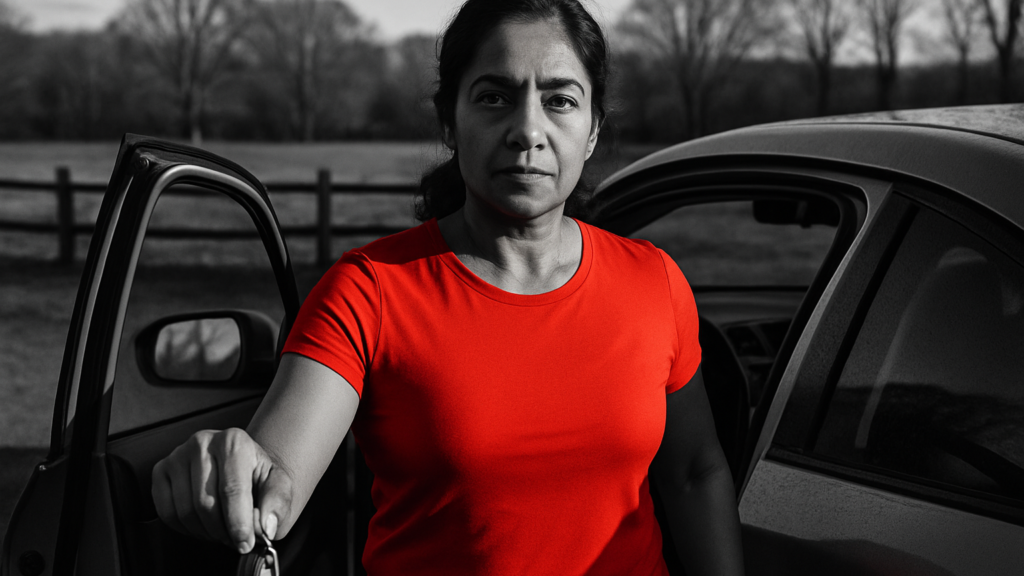
Back pain driving home is usually worse than desk pain because a car seat holds your pelvis in one fixed position, adds road vibration to that position, and removes the small shifts you make all day in an office chair without noticing. Your desk chair lets you stand, lean, cross a leg, walk to the printer; the car gives you a bucket seat, a fixed pedal distance and a steering wheel that pulls you forward. Stiffness at the end of the drive is not the injury. It is the message, and it is worth testing rather than guessing at.
Why is my back pain driving home worse than sitting at my desk?
Because the car changes three things at once: how long you hold one position, how much your pelvis can move inside that position, and how much vibration passes through the seat into your lower back. Your office chair allows hundreds of small corrections an hour that you never notice. The driver’s seat allows almost none, because your right foot is committed to a pedal and your hands are committed to a wheel.
Route 34 southbound at five o’clock. Brake lights. Forty minutes of the same seat angle, the same foot position, the same slight forward lean toward the windshield. You get out in the driveway and the first two steps tell you something the whole workday did not.
This is not rare. In a systematic review and meta-analysis of 19 studies covering 7,723 professional drivers, low back pain was reported by 39% in the past seven days and 53% in the past 12 months, with seat discomfort, driving posture and extended hours behind the wheel among the risk factors identified. Most Monmouth County commuters are not professional drivers, so treat that as a signal about the exposure, not a forecast about you. The exposure is the same kind; the dose is smaller.
What does a car seat do that an office chair does not?
A car seat fixes your pelvis, your knees and your feet in relation to each other and then asks you not to change any of it. An office chair does the opposite: it lets you stand up, shift your weight, drop one hip, push back from the desk. The difference is not comfort. It is the number of positions available to you per hour.
Seat back shape matters too. A radiological investigation of automobile seat lumbar support prominence examined how that support changes spinal and pelvic posture, which is the mechanism behind why two cars with the same commute can feel completely different to the same back. A deep bucket seat rolls the pelvis backwards. A flat bench lets it drop. Neither is wrong for everyone, and that is exactly the point.
Here is the real problem. The seat is a fixed instruction to your body, repeated every working day, and the body follows instructions well. Your commute is training. It trains your hip flexors to stay short. It trains your pelvis to tuck. It trains the tissues at the back of your lumbar spine to sit under a long, low, unchanging load, and then it asks them to go from that to standing in the space of one second when you open the door.
Does road vibration actually load the lower back?
Yes, and the frequency matters more than the roughness you feel. A seated body is not a rigid block; it has resonances, and some road frequencies get amplified on the way from the tyre to your lumbar spine rather than damped out.
In experimental modal analysis of seated people under whole-body vibration, a clear resonance around 5.8 Hz appeared in transmissibility to the head, chest, pelvis and the lumbar spine at L3. A separate finite element and transient dynamic analysis of fore-and-aft vibration found the lumbar spine’s response most pronounced at 5 Hz, with modal frequencies of concern at 4.7 Hz and 5.5 Hz. Occupational health bodies take this seriously: NIOSH has published guidance on reducing whole-body vibration for bus drivers.
That is not hyperbole about your Honda. It means the stop-and-go idle, the expansion joints on the Parkway, the county road that never quite recovered from the last freeze-thaw winter — these are not neutral. They are a small load applied many thousands of times to a spine that is already being held still. Static posture and vibration are not two separate stories. They are one exposure, stacked.
What does this pattern say about my hips, pelvis or discs?
It suggests a mechanical pattern rather than a specific structure, and nobody can tell you which structure from a description of your commute. Pain that shows up in one sustained position and eases when you move is behaving like a loading problem. That narrows the question. It does not answer it.
Three mechanisms are usually in the conversation. Hip flexors that spend the day shortened, so the pelvis tips and the lumbar spine has to absorb the difference. A pelvis held in a tucked position by the seat, so the lower lumbar segments sit at the end of their available flexion for the whole drive. And disc behaviour, which depends on movement: in in vivo intradiscal pressure measurements published in Spine in 1999, Wilke and colleagues concluded that constantly changing position is important to promote fluid flow, and therefore nutrition, to the disc. Stillness is not neutral for a disc even when the pressure is modest.
Which of those applies to you is an examination question, not an article question. As Dr. Michael Brandon, DC puts it: “What is their pain, where is their pain, and what motions or activities cause it.” That is the order the assessment follows, and the drive home is a useful answer to the third part of it. If you would like the background on how the evidence holds up against the stories people repeat about backs, we covered that in seven common beliefs about back pain, checked against the evidence.
What can I change about my seat and my drive before tomorrow?
Change the position before the drive, change the seat so your pelvis is not tucked, and break the stillness at least once on a long trip. None of this is exotic, and boring is good here.
- Move before you sit. Stand in the parking lot and take your hips through extension — a slow, upright stretch with the hips pushed gently forward — before you fold into the seat.
- Raise the back of the seat pan slightly and open the hip angle. A seat back a little past vertical, with the pelvis supported rather than sinking, gives the lumbar spine somewhere to sit other than full flexion.
- Bring the seat close enough that your foot reaches the pedal without stretching. A long reach pulls the pelvis into the tuck you are trying to avoid.
- Break the position. Shift your weight at a red light. On a long drive, stop and walk before your back asks you to.
- Walk when you arrive. Do not go from the seat to the sofa. Give the tissues a transition.
Active breaks from sustained sitting have been tested formally: a randomized controlled trial in BMC Musculoskeletal Disorders examined an active break intervention for nonspecific low back pain during prolonged sitting in young people. That was a young cohort in a controlled setting, so read it as a mechanism worth trying rather than a result you should expect. If you are over 60 and the drive leaves you stiffer than it used to, the same principles apply; the transition just deserves more time and a slower first hundred steps.
When is back pain driving home worth a chiropractic evaluation?
When the pattern repeats on the same drive for weeks, when it stops settling within a short walk, or when anything travels into the leg. Seat changes are a reasonable experiment for a week. If you aren’t testing, you’re guessing, and a week is long enough to know whether the seat was the whole story.
Four situations belong in an examination rather than a cushion order: leg pain, numbness or weakness below the knee; a back that no longer loosens after the drive; pain that now shows up at your desk as well as in the car; and any drive that has started to feel unsafe because of how you are bracing. An assessment looks at what actually reproduces it — hip extension, lumbar flexion tolerance, how your pelvis behaves when you sit and stand — and what does not. Treatment is not one size either. In Dr. Brandon’s words: “You don’t need to ‘crack’ or give that large adjustment to people.”
There is a practical reason to book the appointment at the end of your commute rather than the start of your day. If you drive Route 34 south from Marlboro, our office at 8 Merchants Way sits by the corner of Route 34 and County Route 537, with free parking in front of and behind the building — which means our clinical team can examine you while the pattern is live, not after a night’s sleep has erased it. You can read more about how we assess back pain driving home and other loading patterns, or, if your commute also aggravates your neck, see why your neck may be worse since you went back to the office.
Frequently asked questions
Is it normal for my back to hurt only when I drive?
It is common, but common is not the same as normal. Pain that appears reliably in one position and eases when you move usually points to a mechanical pattern rather than something structural. If it repeats on the same drive, week after week, that pattern is worth testing with an examination rather than guessing at home.
Should I use a lumbar roll or cushion in my car?
A support that fills the gap behind your lower back may help some drivers, because seat back shape changes how the pelvis sits. Try it on a short drive before a long one. If a cushion only moves the ache somewhere else, the problem is likely how long you hold the position, not the foam.
Why does standing up after the drive hurt more than the drive itself?
Standing reloads tissues that were held still and slightly flexed for the whole trip. The first few steps are when your spine changes shape fastest, so that is when stiff tissue complains loudest. It usually settles within a short walk. If it does not settle, note how long it lasts and tell our clinical team.
Does a heated seat help back pain on the commute?
Heat may make a stiff back feel easier for a while, and comfort has value. It does not change how long you were still, how your pelvis was tilted, or how much the road shook the seat. Use it if you like it, and change the mechanics separately.
Can driving make sciatica worse?
Leg pain, numbness or weakness that travels below the knee while driving deserves an examination rather than a seat adjustment. Sustained sitting and vibration both load the lower lumbar segments, and symptoms that follow a nerve path need testing to see what reproduces them. Book an evaluation if the leg symptoms repeat.
The Bottom Line
Your desk is not innocent and your car is not guilty. The commute simply removes the one thing your back relies on all day, which is variety — and then adds vibration on top of a position you cannot change. So change what you can change: move your hips before you sit, set the seat so your pelvis is supported rather than tucked, break the stillness on the long trips, and walk for a few minutes when you get home instead of going straight to the sofa. Give that a week and pay attention to what actually shifts.
If the pattern holds, or if anything runs into the leg, get it examined rather than managed by cushion. Our clinical team can test what reproduces it and tell you plainly whether this is a loading pattern you can train out of or something that needs a different set of hands — and Dr. Brandon is direct about that second case: “If I can’t be the one to help them, I want to at least put them in the right direction to find someone who can.” Book at fitclinic.co/book, or call or text 848-301-1515.
Book your first visit at https://fitclinic.co/book/ — or call or text 848-301-1515.
FIT Clinic at Functionised — 8 Merchants Way, Colts Neck, NJ 07722.
Sources
- Prevalence of and risk factors for low back pain among professional drivers: a systematic review and meta-analysis (Journal of Orthopaedic Surgery and Research)
- Prevalence of and risk factors for low back pain among professional drivers (PMC full text)
- Effect of anteroposterior vibration frequency on the risk of lumbar injury in seated individuals (Ergonomics)
- Experimental modal analysis of the seated human body during whole-body vibration
- New in vivo measurements of pressures in the intervertebral disc in daily life (Wilke et al., Spine, 1999)
- Influence of automobile seat lumbar support prominence on spine and pelvic postures: a radiological investigation
- Reducing Whole Body Vibration to Improve the Safety and Health of Bus Drivers (NIOSH Science Bulletin, CDC)
- Effects of the active break intervention on nonspecific low back pain among young people: a randomized controlled trial (BMC Musculoskeletal Disorders)
- Prevalence of musculoskeletal pain among professional drivers: a systematic review (Journal of Occupational Health)
- The relative importance of whole body vibration and occupational lifting as risk factors for low-back pain