Acute Back Pain Colts Neck: What the First Weeks Need
Key takeaways
- Acute back pain Colts Neck residents wake up with is usually a short story with a good ending: most episodes settle over the first six weeks, and the early plan is movement, simple self-management and patience rather than an immediate scan.
- A multidisciplinary clinical practice guideline on acute low back pain asks you to stay active, consider heat and a short course of over-the-counter anti-inflammatories, skip routine imaging unless serious spine pathology is suspected, and add hands-on care, physical therapy or acupuncture if you are not improving after a week or two.
Acute back pain Colts Neck residents wake up with is usually a short story with a good ending: most episodes settle over the first six weeks, and the early plan is movement, simple self-management and patience rather than an immediate scan. A multidisciplinary clinical practice guideline on acute low back pain asks you to stay active, consider heat and a short course of over-the-counter anti-inflammatories, skip routine imaging unless serious spine pathology is suspected, and add hands-on care, physical therapy or acupuncture if you are not improving after a week or two. The job of an evaluation is to tell you which kind of episode you have.
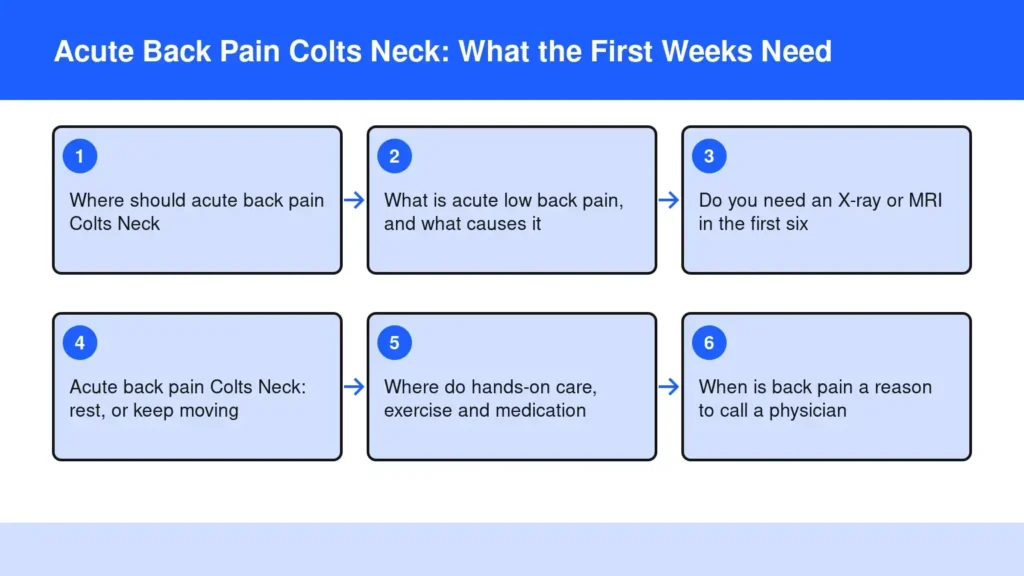
Where should acute back pain Colts Neck residents start?
Start by moving, not by booking a scan. A multidisciplinary group built a clinical practice guideline on the assessment and treatment of acute low back pain for exactly this situation. It covers pain of less than six weeks, with or without radiculopathy, in ordinary outpatient settings. Self-management comes first.
In plain English, the first stretch of an episode looks like this:
- Know the usual course. The self-management recommendations begin with information on how acute low back pain normally behaves and when clinical evaluation is indicated.
- Be told movement is safe. Reassurance that motion is safe and important to recovery is part of the care, not a pep talk bolted on afterwards.
- Consider superficial heat on the sore area.
- Consider a short course of oral NSAIDs at over-the-counter doses and frequency, if that is appropriate for you.
- Give it a week or two. Clinical management is aimed at people who do not improve with self-management after one to two weeks.
Here is the real problem. Most people do the reverse. They lie down, they wait, they stiffen, and then they ask for an MRI in week two because nothing has changed.
What is acute low back pain, and what causes it?
Acute means less than six weeks old, and in most cases no single structure can be named as the cause. The muscles, the joints between the vertebrae, the discs and the nerve roots sit within inches of each other. They share nerve supply. Pain from one is felt across a broad area rather than at a pinpoint.
So the useful question is not which bone moved. It is what provokes it. Dr. Michael Brandon, DC, our treating clinician, puts the exam in one line: “What is their pain, where is their pain, and what motions or activities cause it.” Bending to load a trunk, rotating to reach into a back seat, standing after a long sit — each points somewhere different. Symptoms that travel down a leg, or into an arm in a cervical episode, belong in a different category from a local ache with stiffness.
Most back injury of this kind is a loading problem, not a damage problem. Your spine tolerated the task on Monday and not on Tuesday, and the difference is rarely the box you lifted.
Do you need an X-ray or MRI in the first six weeks?
Usually not. The American Academy of Family Physicians notes that imaging and laboratory evaluation are for pain persisting beyond eight weeks despite appropriate therapy.
That is not cost-cutting. An image answers a structural question, and in a first episode the question on the table is a practical one: what can you load, how much, and in what order do you get it back. A picture of a disc does not answer that. An examination of how you move does.
Here is the test. If a scan would not change what you do tomorrow morning, it is not the next step. If it would, because a red flag is on the table, it is not optional, and it is not a chiropractor’s call to make alone.
Acute back pain Colts Neck: rest, or keep moving?
Keep moving, within what you can tolerate. In a Cochrane review of advice to rest in bed versus advice to stay active, two trials of 401 patients with acute low back pain found small improvements in pain relief and functional status favouring advice to stay active. For sciatica, there was moderate quality evidence of little or no difference between the two.
The course of an episode is reassuring on its own. In a meta-analysis of 95 studies, mean pain in acute low back pain fell from 56 out of 100 at baseline to 26 by six weeks. Time does much of the work. What you do with that time decides how the next episode goes.
This is where local reality bites. Workers in Howell have a mean travel time to work of 31.9 minutes, each way, in a seat that holds the lumbar spine in one flexed position while the engine adds vibration. Staying active does not mean a long commute followed by a couch. It means breaking the sitting up: park at the far end of the lot, two minutes upright before you drive, a short walk at lunch. We wrote separately about why the drive home often hurts more than the desk.
Where do hands-on care, exercise and medication fit?
They sit after the first week or two, for the people who have not turned the corner. For patients without radiculopathy, the clinical management recommendations offer NSAID optimization, skeletal muscle relaxants, referral to physical therapy, psychologically informed physical therapy, manipulation and mobilization, or acupuncture. With radiculopathy, systemic steroids and consideration of epidural steroid injections are added. On opioids, the recommendation is to “not routinely use opioids as initial treatment.”
Older evidence points the same way. The American College of Physicians’ guideline on noninvasive treatments for low back pain recommends superficial heat, massage, acupuncture or spinal manipulation for acute and subacute episodes. Spinal manipulation showed a small effect on improving function compared with sham manipulation, on low-quality evidence. That is an honest description of a modest, useful tool, not a promise.
Hands-on care also does not have to be dramatic. As Dr. Brandon puts it: “You don’t need to ‘crack’ or give that large adjustment to people.” Mobilization, soft tissue work and graded loading may help a stiff, guarded back tolerate motion again, and the exercise half is what carries the result past the visit.
When is back pain a reason to call a physician instead?
When the picture suggests something other than a mechanical episode. The guideline’s one carve-out for early imaging is suspected serious spine pathology, and that suspicion is built from the history and the examination, not from how loud the pain is.
- Loss of bladder or bowel control, or new numbness through the groin and inner thighs
- Progressive weakness in a leg or foot, rather than weakness limited by pain
- Fever alongside back pain, or a known infection
- A fall, a crash or another significant trauma, particularly with thin bone or osteoporosis
- A history of cancer, unexplained weight loss, or severe night pain that does not change with position
Those belong with a physician or an emergency department first. Our clinical team screens for them at the front of an evaluation and refers out when that is the answer. Dr. Brandon says it plainly: “If I can’t be the one to help them, I want to at least put them in the right direction to find someone who can.” If an episode has already outstayed the usual course, our honest look at what the research says helps with longer-standing pain covers what changes after that point.
Frequently asked questions
Does acute back pain mean a herniated disc?
Rarely on its own. A herniated disc is usually suspected when pain, numbness or tingling follows a nerve root down the leg, not when the back is simply sore and stiff. Even then, a disc finding is one piece of a picture that includes strength, reflexes, sensation and which motions provoke the symptoms.
Rarely on its own. A herniated disc is usually suspected when pain, numbness or tingling follows a nerve root down the leg, not when the back is simply sore and stiff. Even then, a disc finding is one piece of a picture that includes strength, reflexes, sensation and which motions provoke the symptoms.
Are acetaminophen, gabapentin or muscle relaxants useful for a new episode?
They are not equal. The American Academy of Family Physicians lists benzodiazepines, gabapentin, pregabalin, opioids and acetaminophen among drugs that should not routinely be used for acute low back pain, while NSAIDs sit first in line. Skeletal muscle relaxants appear as an option in clinical management. Medication decisions belong with your prescribing physician.
They are not equal. The American Academy of Family Physicians lists benzodiazepines, gabapentin, pregabalin, opioids and acetaminophen among drugs that should not routinely be used for acute low back pain, while NSAIDs sit first in line. Skeletal muscle relaxants appear as an option in clinical management. Medication decisions belong with your prescribing physician.
Which Monmouth County towns does FIT Clinic see for back pain?
FIT Clinic is at 8 Merchants Way in Colts Neck, by the corner of Route 34 and County Route 537, with free parking in front of and behind the building. We see people from Colts Neck, Freehold, Manalapan, Middletown, Red Bank, Marlboro, Howell, Neptune, Holmdel, Tinton Falls, Lincroft and Shrewsbury. Call or text 848-301-1515.
FIT Clinic is at 8 Merchants Way in Colts Neck, by the corner of Route 34 and County Route 537, with free parking in front of and behind the building. We see people from Colts Neck, Freehold, Manalapan, Middletown, Red Bank, Marlboro, Howell, Neptune, Holmdel, Tinton Falls, Lincroft and Shrewsbury. Call or text 848-301-1515.
The Bottom Line
Most acute back pain Colts Neck residents face improves on its own. The early plan is unglamorous: keep moving, use heat, consider a short course of over-the-counter anti-inflammatories if that suits you, and give it a week or two before escalating. Skip the scan unless a red flag puts it on the table. If you are not turning the corner, that is the moment for hands-on care, physical therapy or acupuncture, chosen on an examination rather than on a hunch.
There is no dealership for your body. If your back has gone out and you want a straight look at it, read what we check in a back pain evaluation, then book a visit at FIT Clinic in Colts Neck or call or text 848-301-1515.
Book your first visit at https://fitclinic.co/book/ — or call or text 848-301-1515.
FIT Clinic at Functionised — 8 Merchants Way, Colts Neck, NJ 07722.
Sources
- Assessment and Treatment of Acute Low Back Pain: A Clinical Practice Guideline (draft)
- New Guideline for Assessing and Treating Acute Low Back Pain
- Acute Low Back Pain: Diagnosis and Management (AAFP)
- Noninvasive Treatments for Acute, Subacute, and Chronic Low Back Pain: A Clinical Practice Guideline From the American College of Physicians
- Advice to rest in bed versus advice to stay active for acute low-back pain and sciatica (Cochrane)
- The clinical course of acute, subacute and persistent low back pain: a systematic review and meta-analysis (CMAJ)
- Howell township, Monmouth County, NJ profile data (Census Reporter)