Golf Swing Back Pain and What Is Actually Breaking Down
Key takeaways
- Golf swing back pain usually starts where the turn is supposed to happen, not with age.
- Each lumbar segment is designed to rotate only a few degrees.
Golf swing back pain usually starts where the turn is supposed to happen, not with age. Each lumbar segment is designed to rotate only a few degrees. When a hip or a mid-back will not turn, the low back borrows that motion and takes repeated shear stress at impact. Mobility-driven pain and a disc problem behave differently, and need different care.
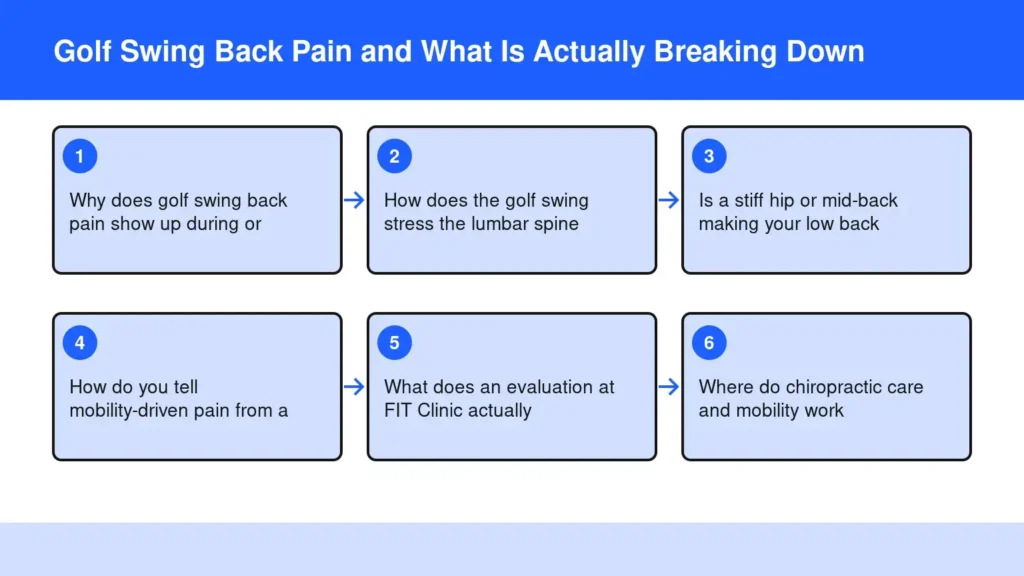
Why does golf swing back pain show up during or after a round?
Because the swing asks a small, stiff part of your spine to make motion the hips and mid-back were built to make. The low back is the loudest part of the chain. It is not usually the part that failed first.
The eighth hole. A pull above your belt. Then a slow climb out of the car at home.
This is common in the sport. In a study of UK golfers, the lower back had the largest injury incidence of any site, 9.94 injuries per 1000 hours of golf. A survey of 1170 male golfers, mean age 54.98 years, found most did no prevention exercises. Common does not mean inevitable. It means nobody checked.
How does the golf swing stress the lumbar spine?
Through side bend, compression and shear, all arriving in the same tenth of a second. Impact loads the joint while it is already turned, the least forgiving position your low back has.
Quantify it. In biomechanics reviewed in the Asian Journal of Sports Medicine, amateur golfers recorded higher peak shear loads at the L3-4 segment than professionals, 596 N against 329 N, with compressive loads over eight times body weight. Now look at the motion the region owns. In MRI analysis of trunk rotation, mean axial rotation of each lumbar segment at 45 degrees of trunk rotation ranged from 1.2 to 1.7 degrees. Swing mechanics do not change that ceiling.
Your low back was never the turning joint.
Is a stiff hip or mid-back making your low back do the work?
Often, yes, and that is the pattern I see most in golfers. When the leading hip or the upper back will not turn, the lumbar spine makes up the difference. Every swing, every round, every trip to the range.
Here is the evidence. In an observational study of amateur golfers, those with low back pain had reduced lead hip passive medial rotation, 21.14 degrees against 31.06 degrees in controls. The authors concluded the deficit may be relevant for screening or treatment selection. The thoracic spine behaves the same way. In a mobilization study, thoracic rotation rose from a pre-intervention mean of 50.0 degrees and lumbar rotation on MRI went down.
I coached strength and conditioning for the Toronto Blue Jays and the Tampa Bay Buccaneers. A twist is a twist. The athlete who cannot turn his hips turns his spine, and core muscles do not stop it.
How do you tell mobility-driven pain from a disc or facet issue?
By what provokes it, where it travels, and what it does with movement. The patterns overlap, which is why a stiffness story gets treated as soreness for years.
What our clinical team sorts through:
- Mobility-driven: one flank near the belt line, worse late in a round, better once you move, with a clear left-to-right difference in hip or trunk motion.
- Disc-related: pain, tingling or numbness below the knee, worse sitting and bending, often unchanged by stretching.
- Facet-related: local, worse leaning back and turning toward the painful side, easier forward.
- Physician first: bowel or bladder change, progressive weakness, saddle numbness, unexplained weight loss, fever, or a fall.
A T2 mapping study asked whether repetitive torsion and axial loading raise the risk of early degenerative change in the discs of high-level golfers. A scan finding does not automatically explain today’s pain. The exam leads, and imaging follows a reason.
What does an evaluation at FIT Clinic actually check?
Where your turn comes from, and whether the painful tissue is irritable. We test the hips, the mid-back and the trunk left to right, then load the activity that bothers you.
Dr. Michael Brandon, DC, our treating clinician, puts the first part plainly: “What is their pain, where is their pain, and what motions or activities cause it.” He is direct about what he does not know yet: “I explain the options and tell them I don’t actually know what they need yet — I need to go over the exam first.”
For golfers that means lead hip internal rotation against the other hip, hip extension, seated trunk rotation, and how the low back answers extension with a twist. A FIT Sports Evaluation is a 20-minute appointment with Dr. Brandon or with me. If you are not testing, you are guessing.
Where do chiropractic care and mobility work fit for a Monmouth County golfer?
Together, in that order. Settle the joint that hurts, then give the hip and mid-back the motion that keeps it settled. Easing soreness after each round only maintains the problem.
For acute and subacute low back pain, the American College of Physicians guideline lists spinal manipulation among first-choice non-drug options, with exercise and rehabilitation leading for chronic pain. Adjustments are graded, not theatrical. As Dr. Brandon says, “You don’t need to ‘crack’ or give that large adjustment to people.” Chiropractic care handles the irritable joint. Mobility training for active adults builds the range back.
One local note. Play Hominy Hill on Mercer Road in Colts Neck, and the drive home to Lincroft runs down County Route 537 with your back still hot. That stretch runs on the same mechanism behind back pain worse driving home than at a desk. Walk a lap of the lot first. We are at 8 Merchants Way, at Route 34 and County Route 537.
Frequently asked questions
Can the wrong club or setup contribute to golf back pain?
Yes, because equipment changes the posture you swing from. A club that is too short makes you stoop and reach, adding side bend to a spine already turning under load. A review in the Asian Journal of Sports Medicine covers swing and equipment factors. Screen the body first, then get fitted.
Yes, because equipment changes the posture you swing from. A club that is too short makes you stoop and reach, adding side bend to a spine already turning under load. A review in the Asian Journal of Sports Medicine covers swing and equipment factors. Screen the body first, then get fitted.
Should I see an orthopedic surgeon or a chiropractor first for golf back pain?
See whoever will examine you and refer honestly. Progressive weakness, saddle numbness or bladder change belongs with a physician now. Dr. Michael Brandon, DC puts our standard this way: “If I can’t be the one to help them, I want to at least put them in the right direction to find someone who can.”
See whoever will examine you and refer honestly. Progressive weakness, saddle numbness or bladder change belongs with a physician now. Dr. Michael Brandon, DC puts our standard this way: “If I can’t be the one to help them, I want to at least put them in the right direction to find someone who can.”
Why does my back hurt the morning after a round more than during it?
Because irritation from repeated loading builds while you are warm and distracted. It declares itself once you cool, sit through dinner and lie still overnight. Stiffness on the first step out of bed that eases within the hour is usually a mobility story. Pain that stays all day deserves an exam.
Because irritation from repeated loading builds while you are warm and distracted. It declares itself once you cool, sit through dinner and lie still overnight. Stiffness on the first step out of bed that eases within the hour is usually a mobility story. Pain that stays all day deserves an exam.
Do prevention exercises help golfers, and do many golfers do them?
Most do not. Targeted hip and trunk work may help if it matches your exam.
Most do not. Targeted hip and trunk work may help if it matches your exam.
How long should I wait before getting a sore low back looked at?
If the same ache arrives round after round, there is no information left in waiting. Restriction compounds: you guard the sore flank, lose more turn, swing with less of it. A short evaluation now is a smaller problem than a season of swinging around a stiff hip.
If the same ache arrives round after round, there is no information left in waiting. Restriction compounds: you guard the sore flank, lose more turn, swing with less of it. A short evaluation now is a smaller problem than a season of swinging around a stiff hip.
The Bottom Line
Stiffness is not the injury. It is the message, and the message is that your turn is coming from the wrong place. A hip that will not move, a mid-back that will not follow, a low back paying for both at impact. Playing through it tends to compound the restriction. You groove the same compensation, and the tissue takes the same stress. Catching it early keeps people on the course.
If your low back has talked to you for more than a round or two, get it checked. Our team tests your hips, mid-back and trunk, explains what we find, and says so if we are not the right people for it. If it flared up recently, read what the first weeks of acute back pain need. Book an evaluation at 8 Merchants Way in Colts Neck, or call or text 848-301-1515.
Book your first visit at https://fitclinic.co/book/ — or call or text 848-301-1515.
FIT Clinic at Functionised — 8 Merchants Way, Colts Neck, NJ 07722.
Sources
- Epidemiology of injuries in UK based golfers: a retrospective study (The Physician and Sportsmedicine)
- Cross-sectional study of characteristics and prevalence of musculoskeletal complaints in 1170 male golfers (BMJ Open Sport & Exercise Medicine)
- Golf-Related Low Back Pain: A Review of Causative Factors and Prevention Strategies (Asian Journal of Sports Medicine)
- Kinematics of the lumbar spine in trunk rotation: in vivo three-dimensional analysis using magnetic resonance imaging
- The relationship between hip rotation range of movement and low back pain prevalence in amateur golfers: An observational study
- The relationship between hip rotation range of movement and low back pain prevalence in amateur golfers (PubMed abstract)
- Effects of Thoracic Spine Mobilization on the Lumbar Spine Rotation Angle during Trunk Rotation
- Early intervertebral degeneration patterns among elite amateur golfers: A T2* mapping study
- American College of Physicians issues guideline for treating nonradicular low back pain
- Monmouth County Park System Golf Courses