Sciatica Recovery Step Count: What Your Phone Shows After Pain Settles
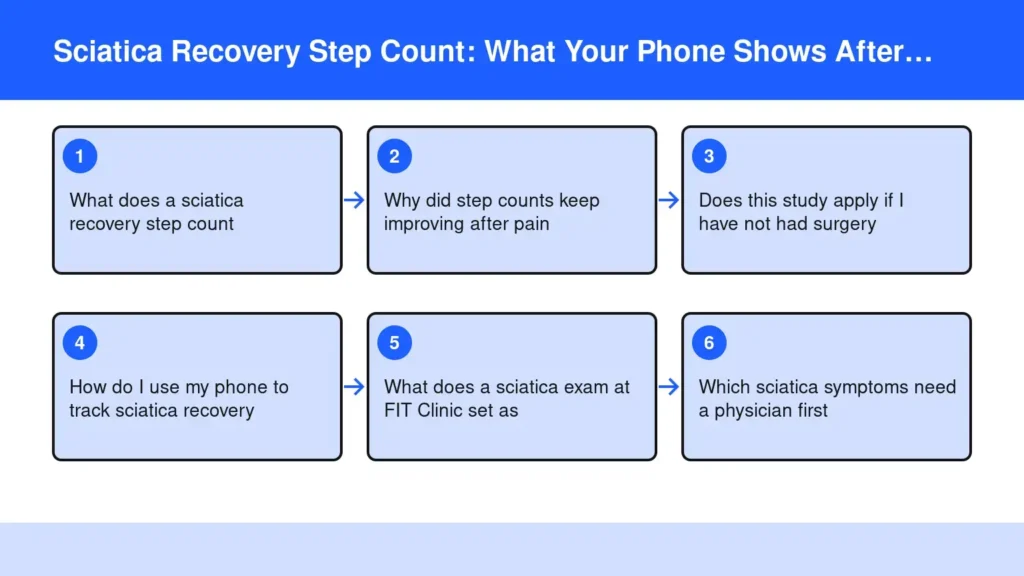
Key takeaways
- Your sciatica recovery step count may show progress that a pain score misses.
- In a multicenter Neurospine study of patients who had lumbar surgery for sciatica, smartphone step counts tracked with disability scores and kept rising after pain and questionnaire scores had flattened.
Your sciatica recovery step count may show progress that a pain score misses. In a multicenter Neurospine study of patients who had lumbar surgery for sciatica, smartphone step counts tracked with disability scores and kept rising after pain and questionnaire scores had flattened. The study involved surgical patients only, but the lesson carries: feeling a bit better and moving like yourself again are two different things, and you can track both.
What does a sciatica recovery step count actually measure?
A sciatica recovery step count measures what you do on an ordinary day, not how you feel about it. That distinction carries the whole study. In a multicenter prospective study published in Neurospine, researchers used patients’ own smartphones to work out average daily steps and compared them with standard clinical tools. Step count lined up with disability scores. It also responded to change, which is what you want from any measure of recovery.
Think about the first walk to the mailbox after a bad week of leg pain. You feel it in every step. You also don’t count them. A questionnaire asks how you feel. A phone records what you did. The study treated those two as separate things, and the data says that was the right call.
Here is the real problem with relying on feel alone. Feel adapts. Once the sharp pain goes away, “better” becomes the new normal, and you stop noticing that you still park closer, skip the stairs and cut the walk short.
Why did step counts keep improving after pain scores stopped?
Step counts kept climbing because the standard measures hit a ceiling and daily activity did not. The journal’s featured-articles summary for April 2026 reports that the six-minute walk test and patient-reported outcomes improved early and then plateaued after six weeks, while smartphone activity data rose in a continuous, linear way. The editors describe this as a ceiling effect in conventional assessments.
Sit with that for a moment. On paper, those patients had stopped improving. Their phones said otherwise. The questionnaire ran out of room to show progress, but their legs had not.
That gap matters for anyone deciding whether to keep going. If you judge your recovery only by how much it hurts, you may quit the work right when your capacity is still growing. Stiffness is not the whole story. It is a message, and the step count is a second message worth reading next to it.
Does this study apply if I have not had surgery?
Not directly. The study only included people who had lumbar spine surgery for sciatica. The April 2026 issue of Neurospine lists it as a study of physical performance after surgery, and no one should read it as evidence about care without surgery. I will say that plainly, because a study stretched past its sample is marketing dressed up as science.
The broader lesson still holds. Pain, function and real-world activity can move at different speeds. Sciatica often lingers, too. In a Finnish follow-up of people with sciatica, 55% still reported symptoms two years later. A long tail like that is exactly when you need a measure beyond feel.
For pooled trial evidence on conservative options, see our earlier post on what pooled trials rank first for sciatica. This post covers something else: how you know whether whatever you chose is working.
How do I use my phone to track sciatica recovery?
Use the step counter your phone already runs, and look at weekly averages instead of single days. One bad day tells you about that day. A trend tells you about your recovery. Here is a simple checklist:
- Find your starting line. Open your phone’s health app and note your average daily steps from the weeks before the pain began, if the history is there.
- Record your current average. That is your baseline now.
- Carry the phone the same way every day. If it sits on the counter half the day, the number means nothing.
- Track one provoking activity in words. For example: “I can walk the dog the full loop” or “I still stop at the stairs.”
- Compare weekly averages, not daily spikes. Boring is good. A steady climb beats one heroic day followed by three days on the couch.
Walking itself is worth paying attention to for reasons beyond sciatica. A meta-analysis of 15 international cohorts in The Lancet Public Health linked more daily steps with lower all-cause mortality. That is one vehicle, and you own exactly one.
Don’t push your step count up through worsening leg symptoms. The number tracks your recovery. It is not a target you beat at any cost.
What does a sciatica exam at FIT Clinic set as a baseline?
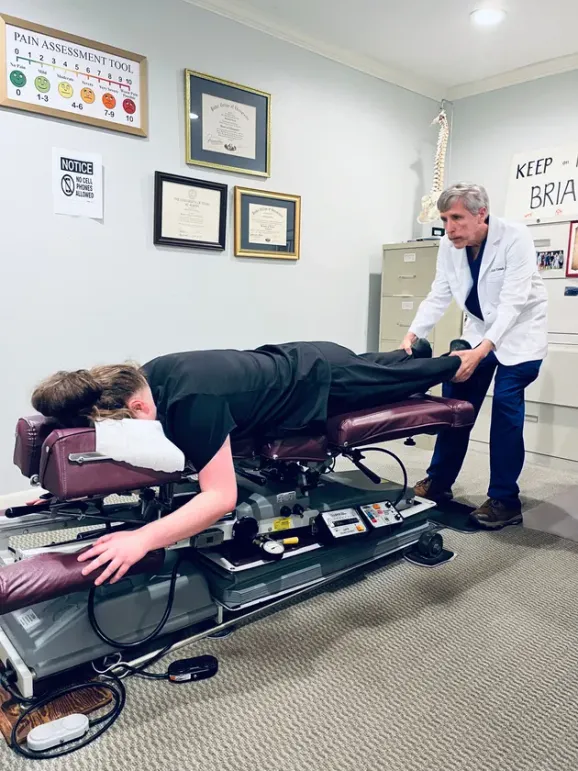
At FIT Clinic, the exam sets the baseline before anyone talks about a plan. Dr. Michael Brandon, DC, starts from three questions: “What is their pain, where is their pain, and what motions or activities cause it.” With sciatica, that means mapping where the leg symptoms go and which movements bring them on.
He is blunt about the order of things: “I explain the options and tell them I don’t actually know what they need yet — I need to go over the exam first.” At Functionised, where FIT Clinic is based, the working rule is short. If you aren’t testing, you’re guessing. FIT Clinic shares the building with FIT Lab, which measures strength and recovery instead of estimating them. Tests there include an ARX strength baseline, grip strength, sit-to-rise, a 3D body-composition scan, a VO2 estimate and an HRV snapshot.
Your phone gives you one number. The exam and those tests give you the rest of the picture. Care here also does not depend on forceful cracking. In Dr. Brandon’s words: “You don’t need to ‘crack’ or give that large adjustment to people.” More on how our clinical team approaches leg pain is on the sciatica page.
Which sciatica symptoms need a physician first?
Some symptoms need urgent medical care before any exam here. NHS guidance on cauda equina syndrome lists numbness around the back passage or buttocks, changed feeling when wiping, and growing difficulty starting or controlling urination. An NHS Resolution briefing adds sciatica in both legs, weakness or sensory loss in both legs, and bowel disturbance.
- Numbness in the saddle area, buttocks or inner thighs
- New trouble passing urine, controlling it, or controlling your bowels
- Symptoms in both legs, or weakness that keeps getting worse
- Leg pain along with fever, unexplained weight loss or a history of cancer
If any of these apply, go to emergency care or call your physician the same day. When FIT Clinic is not the right fit, Dr. Brandon says so: “If I can’t be the one to help them, I want to at least put them in the right direction to find someone who can.” For a broader look at first steps with back pain, see what the back pain guideline update means for your next step.
Frequently asked questions
Is a smartphone step count accurate enough to track sciatica?
For trends, it can be. The Neurospine study found that smartphone step counts were valid and responsive in people recovering from sciatica surgery. Any single day’s count is rough. It depends on where you carry the phone. The weekly average is the number to trust, and it only means something if you carry the phone the same way every day.
Should I walk with sciatica or rest?
The NICE guideline on low back pain and sciatica encourages people to stay active rather than rest. How much walking is right for you depends on what provokes your leg symptoms. That is the reason an exam maps those activities first. If your leg symptoms spread further down the leg while you walk, stop and get checked before adding more.
What if my pain is gone but I still feel weak?
That gap is common, and it is worth measuring. In the Neurospine study, pain and questionnaire scores levelled off while daily activity kept improving. Pain going away does not mean your strength and capacity are back. Strength testing, such as a grip or sit-to-rise test, may show what still needs work.
Can I bring my phone's step history to a first visit?
Yes. Bring it. Step history from the weeks before and after the pain started gives our clinical team context that memory often gets wrong. Bring it together with a plain description of which activities bring on your leg symptoms. Together, those two make a more useful starting point than a pain score alone.
The Bottom Line
Feeling a bit better is real progress, and so is moving like yourself again, but they are not the same thing. Track both. Start with the step counter you already carry, read the weekly trend, and write down which activity still holds you back. If any of the warning signs above apply, see a physician first.
Book your visit, or call or text (848) 301-1515.
Book your first visit at https://fitclinic.co/book/ — or call or text 848-301-1515.
FIT Clinic at Functionised — 8 Merchants Way, Colts Neck, NJ 07722.
Sources
- Ziga M et al. Physical performance continues to improve after surgery for sciatica (Neurospine 2026)
- Neurospine: From the Editor-in-Chief, Featured Articles in the April 2026 Issue
- Neurospine current issue, Vol 23 No 2
- Natural history and prognostic indicators of sciatica (PubMed)
- Daily steps and all-cause mortality: a meta-analysis of 15 international cohorts (SORA)
- Sussex Community NHS: Sciatica – Cauda Equina Syndrome
- NHS Resolution: Did you know? Cauda equina syndrome
- NICE Pathways: Low back pain and sciatica
Get The Thrive Letter. One short email from Jim every Thursday: one idea, one 60-second fix you can feel, and what to do next. Unsubscribe any time.