Back Pain Normal for My Age? What to Check Before You Wait

Key takeaways
- Back pain is common as people get older, but common is not the same as normal, and it is not the same as fixed.
- Many age-related changes on a scan show up in people with no pain at all, so your age alone explains very little.
Back pain is common as people get older, but common is not the same as normal, and it is not the same as fixed. Many age-related changes on a scan show up in people with no pain at all, so your age alone explains very little. A careful exam, plus strength and mobility numbers you can retest, gives you a better answer than 'it comes with age'.
Is back pain normal for my age, or just common?
Back pain is common at every adult age, but that does not make it a normal part of aging you have to accept. Common describes how many people have it. Normal suggests nothing can be done. Those are different claims.
Picture the first step out of bed. The slow straighten. The hand on the dresser. Many people over sixty tell themselves this is simply what life looks like now. Here is the real problem: once you file pain under age, you stop asking what is causing it.
The largest dataset yet assembled on this question built age- and sex-specific reference curves for 11 pain sites from 6.1 million people in 118 countries. The researchers designed them as a tool for benchmarking pain, so a person can see where they sit against people their own age. The team behind it reported that pain peaks earlier in life than might have been expected. Sit with that for a moment. If pain simply rose with every birthday, the curve would climb to the end. It does not.
Why does back pain become more common as we get older?
Back pain becomes more common with age partly because there are more older people, and partly because strength, activity and joints change over time. The global numbers are large. The Global Burden of Disease analysis in The Lancet Rheumatology put the age-standardised prevalence of low back pain at 7460 per 100 000 people in 2020, and found the 80 to 84 age group carried the highest rate of years lived with disability. The same study projected case numbers forward to 2050 as the population ages.
What actually matters is what that does not tell you. A systematic review of spine imaging in people without symptoms concluded that many degenerative features are likely part of normal aging and unassociated with pain. Worn discs, bone spurs and arthritis on a scan are often present in people who feel fine.
So the stiffness is not the verdict. It is the message. Age changes the spine, but how your hips, joints and muscles share the load often matters more for daily activities like walking, posture at the sink or lifting a grandchild.
What does waiting actually cost you?
Waiting often costs the activities that make life yours: the long walk, the afternoon in the garden, the trip with the airport and the suitcase. Pain rarely takes them all at once. It takes them one at a time.
First you shorten the walk. Then you skip the bending in the garden. Then you choose the trip with less walking. Each choice feels small. Together they compound, and less activity tends to mean less strength, which makes the next activity harder.
That is the entire stakes. Not a scary diagnosis. A shrinking week. The honest answer is that nobody can promise you will get every activity back, but you cannot measure what you lose if you never measure at all.
What are the red flags of back pain?
Red flags are signs that back pain may come from a serious condition and needs a medical physician first. A review of back pain guidelines found red flags group into four main categories: malignancy, fracture, cauda equina syndrome and infection.
- New back pain after age 50. A clinical review in JAAPA lists acute back pain over age 50 as a red flag.
- A history of cancer, or weight loss you cannot explain.
- Fever or feeling unwell with the pain.
- A fall or minor injury in someone with low bone density.
- Numbness in the saddle area, new bladder or bowel changes, or leg weakness that is getting worse.
If any of these fit, see a physician before anything else. At FIT Clinic, when we are not the right fit, Dr. Michael Brandon, DC, sends the patient on. In his words: “If I can’t be the one to help them, I want to at least put them in the right direction to find someone who can.”
How does an exam replace guessing about my age?
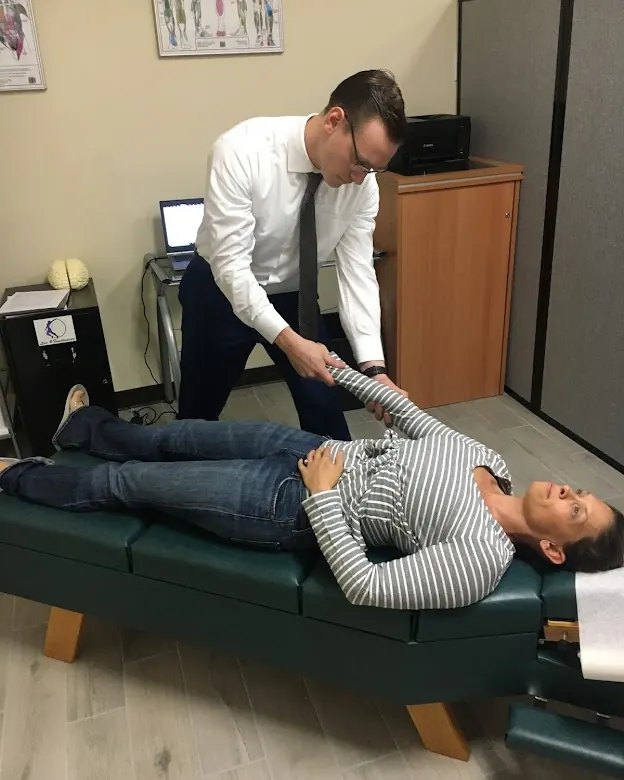
An exam replaces the guess by asking what the pain is, where it is, and what sets it off, before anyone talks about treatment. At FIT Clinic the exam comes before any plan. Dr. Brandon tells new patients: “I explain the options and tell them I don’t actually know what they need yet — I need to go over the exam first.”
His exam starts from three questions: “What is their pain, where is their pain, and what motions or activities cause it.” That last part is the key. Pain on stairs points somewhere different from pain after sitting. Pain in the morning that eases with walking tells a different story than pain that builds through the day.
Care, if you choose it, does not have to mean forceful cracking. “You don’t need to ‘crack’ or give that large adjustment to people,” Dr. Brandon says. Nothing happens without your OK. If you want the longer version of how back pain works, my book Why Your Back Hurts is free in full on fitclinic.co.
Which numbers can I retest instead of blaming age?
Grip strength and the sit-to-rise test are two simple numbers you can measure now and retest later. FIT Clinic shares its building with FIT Lab, where we measure an ARX strength baseline, grip strength, sit-to-rise, a 3D body-composition scan, a VO2 estimate and an HRV snapshot. The working rule here is plain: if you aren’t testing, you’re guessing.
Why these? In the PURE study of 139 691 adults, grip strength was a stronger predictor of all-cause and cardiovascular mortality than systolic blood pressure. The ability to sit on the floor and rise again also carries weight: in a study in the European Journal of Preventive Cardiology, sitting-rising scores predicted natural and cardiovascular deaths in middle-aged and older men and women.
Neither test diagnoses your back. What they do is give you a starting line that is yours, not an average. Retest after a block of work and you see whether things are moving. I spent two decades coaching professional athletes on that principle. It applies just as well to a retired reader who wants to keep gardening.
Frequently asked questions
How can I tell if my back pain is from my kidneys?
Kidney pain tends to sit higher and deeper, under the ribs and to one side, and it usually does not change when you move. Cleveland Clinic describes kidney pain as deep pain in the sides or back that can spread to the belly or groin, and notes it is often mistaken for back pain. Fever or urinary changes call for a physician.
Is it normal for my back to hurt in my 30s and 40s after sleeping wrong?
It is common, but it is not something to accept as permanent. Brief stiffness after sleeping wrong often settles with normal movement within days. If the same motion keeps setting it off, or episodes come closer together, that pattern is worth an exam, because a repeating trigger usually points to something in how the body is moving.
What can I do to lower my risk of back pain as I age?
Stay active, keep your legs and trunk strong, and keep walking most days. Strength work for the hips and legs shares the load the spine would otherwise carry. Measuring a few simple things, such as grip strength and sit-to-rise, gives you a baseline so you can see whether your routine is helping rather than guessing.
Does arthritis on my X-ray mean my back pain will get worse?
Not necessarily. Arthritis and disc wear on imaging are very common in older adults, including many with no pain at all, so the scan alone does not predict your future. How you move, how strong you are and which activities trigger the pain usually tell a clinician more than the picture.
The Bottom Line
Back pain is common with age, but common is not a sentence. If your back pain feels normal for your age, ask a better question: what is it, where is it, and what sets it off. Then put a number on your strength and retest it. For more on what tends to help, read what actually helped people prevent chronic back pain and what the back pain guideline update means for your next step.
Your next step is simple:
- Check the red flags above, and see a physician first if any fit.
- Read how we approach mobility and stiffness for active and older adults.
- Book an exam at FIT Clinic, or call or text 848-301-1515.
Book your first visit at https://fitclinic.co/book/ — or call or text 848-301-1515.
FIT Clinic at Functionised — 8 Merchants Way, Colts Neck, NJ 07722.
Sources
- Global age- and sex-specific reference curves for pain across the lifespan (Nature Medicine)
- Pain across the lifespan: global and regional reference curves (University of Aberdeen)
- Pain peaks earlier in life than might have been expected, global study finds (McGill University)
- Global, regional, and national burden of low back pain, 1990–2020, with projections to 2050 (The Lancet Rheumatology)
- Low back pain is a growing concern (Nature Reviews Rheumatology)
- Systematic literature review of imaging features of spinal degeneration in asymptomatic populations
- Prognostic value of grip strength: the PURE study (The Lancet)
- Simple sitting-rising test linked to natural and CV mortality (TCTMD)
- Ability to sit and rise from the floor is closely linked to longevity (EurekAlert)
- Red flags presented in current low back pain guidelines: a review
- Red flags of low back pain (JAAPA)
- Kidney pain (Cleveland Clinic)
Get The Thrive Letter. One short email from Jim every Thursday: one idea, one 60-second fix you can feel, and what to do next. Unsubscribe any time.