Weighted Vest Bone Density: What the Evidence Supports
Key takeaways
- A weighted vest may support bone, but only when you are genuinely moving and loading under it.
- In a 2026 systematic review in Osteoporosis International, vest plus exercise raised bone mineral density against usual activity, while adding a vest to exercise people already did changed body fat more than bone.
A weighted vest may support bone, but only when you are genuinely moving and loading under it. In a 2026 systematic review in Osteoporosis International, vest plus exercise raised bone mineral density against usual activity, while adding a vest to exercise people already did changed body fat more than bone. So the weighted vest bone density question is really about your gait, hips, ankles and balance, and the amount of load they can carry now.
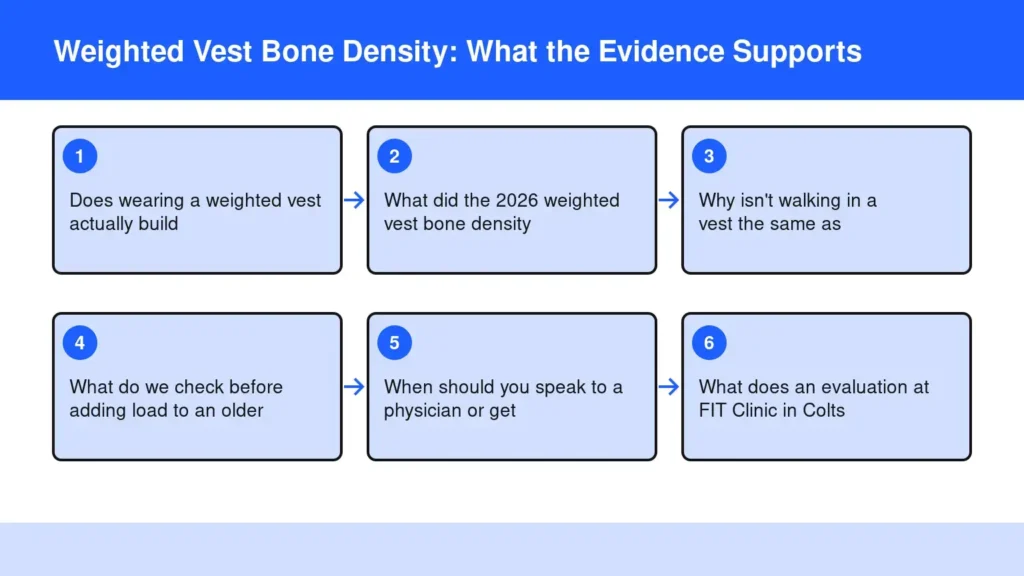
Does wearing a weighted vest actually build bone after 60?
Sometimes, and only as part of real loading. The vest is not the stimulus; the movement you do while wearing it is, and the vest only raises how much load that movement sends through your skeleton.
Picture the walking loop at Seabrook on a cold morning. The DEXA scan came back low. The vest arrived in a box, and now it goes on before the second lap. The instinct is sound — walking is weight-bearing, extra weight is more load, and load is the signal bone responds to.
Here is the real problem: a vest changes how much you weigh, not how hard you push, and bone responds to strain that is large and fast.
What did the 2026 weighted vest bone density review actually find?
It found a benefit for vest plus exercise against usual activity, and no significant extra bone benefit when a vest was added to exercise people already did. That distinction is the whole story.
The pooled weighted vest bone density study published in Osteoporosis International in 2026 searched five databases through March 9, 2026 and combined nine randomized controlled trials in middle-aged and older adults, measuring bone density, bone turnover markers and body fat. Against usual activity, vest plus exercise significantly increased bone density and reduced fat. Against exercise alone, the vest added fat reduction, however the bone benefit was not significant.
Wake Forest researchers analysing their INVEST in Bone Health trial, where the vest group wore it at least eight hours a day during a year of weight loss, found more time standing or stepping in the vest tracked with positive bone density changes. Wearing is not loading.
Why isn't walking in a vest the same as squats, stairs or hip hinge work?
Because bone reads peak force and rate of loading, not hours worn. A loaded squat or a stair climb drives a large force through hip and spine in a second or two; a flat walk spreads a small extra load over thousands of soft repetitions.
The strength studies show the contrast. In the LIFTMOR trial, postmenopausal women with low bone mass (T-score below -1.0) trained twice weekly for 8 months, 30 minutes a session, at 5 sets of 5 repetitions above 85% of one repetition maximum, and the trial reported improvements in bone density and physical function.
That does not make vests useless. It makes the vest a multiplier — on stairs, a hill or a sit-to-stand set, the extra load lands where bone can use it, and you get stronger doing it.
What do we check before adding load to an older spine or hip?
We check whether the load has somewhere to go: how you walk, how far the hip extends behind you, how far the ankle bends over the foot, and how steady you are on one leg.
- Gait. Step length, how the foot lands, whether one side quietly does less work.
- Hip extension. If the hip cannot open behind you, the vest gets carried by the low back.
- Ankle mobility. Limited dorsiflexion changes how you squat and descend stairs, where loaded work is most effective.
- Balance and leg strength. Single-leg stance and a timed sit-to-stand; the CDC’s STEADI 30-second chair stand counts fewer than 11 stands as below average for a woman aged 65 to 69.
- Tolerance. What spine and hip do under a small load before anyone discusses a bigger one.
If stiffness is the limit rather than strength, our clinical team names that first; our guide to staying mobile after 60 covers where it usually sits.
When should you speak to a physician or get imaging before adding weight?
Before the vest, not after, whenever the picture is unclear. Even the heavy-loading studies worked this way: LIFTMOR screened participants for conditions and medications that influence bone and physical function before a single lift.
What sends someone back to their physician or for imaging first: a vertebral or recent fragility fracture; new mid-back pain with no clear mechanism; pain that wakes you at night; a recent fall or new unsteadiness; numbness, weakness, or bladder or bowel changes; or a bone density result nobody has explained to you. Losing bone and muscle raises risk for fracture and disability — a reason to be deliberate, not to stop moving.
As Dr. Michael Brandon, DC puts it: “If I can’t be the one to help them, I want to at least put them in the right direction to find someone who can.”
What does an evaluation at FIT Clinic in Colts Neck involve?
A history, a physical exam, and a plain-English explanation of what we found before anything is added. Nothing goes on your shoulders until we know what hips, spine and balance do without it.
Dr. Michael Brandon, DC describes the starting point plainly: “What is their pain, where is their pain, and what motions or activities cause it.” And on the plan: “I explain the options and tell them I don’t actually know what they need yet — I need to go over the exam first.” Our page on mobility and stiffness explains how we work through it, and if the hip is the sticking point, why a hip catches when you stand up is the place to start.
Driving in from Freehold, we are at 8 Merchants Way, by the corner of Route 34 and County Route 537, with free parking in front of and behind the building.
Frequently asked questions
Is a weighted vest safe if I have osteoporosis?
It depends on your fracture history, balance and how the vest is used, which is why a screen comes first. Loading studies in people with low bone mass are supervised and progressed, not improvised. If you have had a fragility fracture, new unexplained back pain or a recent fall, speak with your physician first.
It depends on your fracture history, balance and how the vest is used, which is why a screen comes first. Loading studies in people with low bone mass are supervised and progressed, not improvised. If you have had a fragility fracture, new unexplained back pain or a recent fall, speak with your physician first.
How much weight should a beginner use in a weighted vest?
Start below what feels challenging, and add load only when your walking pattern does not change under it. If the vest shortens your step, tips you forward, or leaves your low back sore rather than your legs tired, the amount is ahead of your capacity today.
Start below what feels challenging, and add load only when your walking pattern does not change under it. If the vest shortens your step, tips you forward, or leaves your low back sore rather than your legs tired, the amount is ahead of your capacity today.
Does walking with a weighted vest improve bone density?
Walking in a vest adds load, but pooled evidence shows the clearest bone benefits when a vest is combined with exercise rather than added to what you already do. Standing and stepping under a vest tracked better with bone outcomes than sitting in one. Stairs and loaded strength work give a larger signal.
Walking in a vest adds load, but pooled evidence shows the clearest bone benefits when a vest is combined with exercise rather than added to what you already do. Standing and stepping under a vest tracked better with bone outcomes than sitting in one. Stairs and loaded strength work give a larger signal.
Can a weighted vest replace strength training?
No. They are different doses. Bone responds to large, fast loads, and supervised heavy resistance training in women with low bone mass was studied at five sets of five repetitions, twice weekly, over months. Using a vest adds load to stairs, carries and squats, but it does not replace lifting.
No. They are different doses. Bone responds to large, fast loads, and supervised heavy resistance training in women with low bone mass was studied at five sets of five repetitions, twice weekly, over months. Using a vest adds load to stairs, carries and squats, but it does not replace lifting.
How long should I wear a weighted vest each day?
There is no single correct number, and hours worn matter less than what you do while wearing it. In the Wake Forest weight-loss trial the vest group wore it at least eight hours daily, yet standing and stepping time tracked with positive bone changes. Build movement first, then load.
There is no single correct number, and hours worn matter less than what you do while wearing it. In the Wake Forest weight-loss trial the vest group wore it at least eight hours daily, yet standing and stepping time tracked with positive bone changes. Build movement first, then load.
The Bottom Line
A vest is a tool, not a program. The pooled evidence supports load plus movement in middle-aged and older adults; it does not support wearing extra weight while you sit. If your bone density came back low, the useful question is what your body can load safely today, and how to progress it.
Book an evaluation at fitclinic.co/book, or call or text 848-301-1515. FIT Clinic, 8 Merchants Way, Colts Neck, NJ 07722. We tell you what we find in plain English, and you decide what happens next.
Book your first visit at https://fitclinic.co/book/ — or call or text 848-301-1515.
FIT Clinic at Functionised — 8 Merchants Way, Colts Neck, NJ 07722.
Sources
- Effects of weighted vest on bone health and body fat in middle-aged and older adults: a systematic review and meta-analysis, Osteoporosis International (2026)
- Wearing a weighted vest to strengthen bones? Make sure you're moving — Wake Forest News
- High-Intensity Resistance and Impact Training Improves Bone Mineral Density and Physical Function in Postmenopausal Women With Osteopenia and Osteoporosis: The LIFTMOR Randomized Controlled Trial — PubMed
- STEADI Assessment: 30-Second Chair Stand — Centers for Disease Control and Prevention
- 30 Second Sit to Stand Test — Shirley Ryan AbilityLab Rehabilitation Measures Database
- Incorporating Nutrition, Vests, Education, and Strength Training in Bone Health (INVEST in Bone Health) — ClinicalTrials.gov NCT04076618