Back pain
Most back pain isn’t dangerous, but it’s rarely “nothing”. It’s usually a joint, a disc, or the muscles around them reacting to a load they weren’t ready for — a lift, a long drive, a hard week of training, or eight hours a day in a chair. Here’s what’s commonly going on, what you can do this week, and how to tell when it’s time to have someone look at it.
You're in the right place if…
- Your low back is tight or sharp when you get out of the car, out of bed, or up from your desk.
- It "went" while lifting, twisting, or reaching for something ordinary.
- You're active and your back is the thing that keeps interrupting training.
- The ache sits between your shoulder blades after a long day at a screen.
- It's been a few weeks and it's not improving on its own.
What's commonly going on
The low back is built to handle a lot, but it has a limit, and the limit drops when you’re tired, stiff, or sitting all day. The usual sources of pain are the small joints at the back of the spine, the discs between the vertebrae, the sacroiliac joints where the spine meets the pelvis, and the muscles that guard all of them. Most episodes involve some combination, and the exact source often matters less than how the whole system is moving. An evaluation looks at which movements reproduce your pain, how your hips and mid-back are contributing, and whether anything points to a nerve being involved. Imaging usually isn’t needed on day one; it’s ordered when the exam suggests it would change what we do.
Upper back pain between the shoulder blades is most often the mid-back joints and muscles reacting to posture and hours, and it responds to the same combination of hands-on care and movement.
What you can try this week
- Keep moving. Bed rest makes most back pain worse; walking, even five minutes a few times a day, usually helps.
- Change position every 30 minutes if you sit for work. Stand, walk to get water, sit again.
- Use heat for stiffness and, if it helps, ice for the first day or two after a sharp onset. Either is fine; use what feels better.
- Gentle movement — knee-to-chest, cat-camel, hip hinges without load — within a comfortable range. Stop anything that sends pain down your leg.
- Sleep on your side with a pillow between your knees, or on your back with a pillow under them.
When to get it looked at — and when to go straight to a physician
See a physician or go to urgent care today if back pain comes with any of these: new trouble controlling your bladder or bowel; numbness around your groin or inner thighs; weakness in a leg that's getting worse; fever; unexplained weight loss; a history of cancer; a significant fall or accident; or if you're over 70 with a new, severe onset.
Book an evaluation if the pain is limiting what you can do, keeps coming back, has lasted more than two to three weeks, or runs into your buttock or leg.
What an evaluation at FIT Clinic looks like
Dr. Brandon will ask when it started, what makes it worse and better, what you’ve tried, and what you want to get back to. He’ll watch you bend, twist, and move, check your hips and mid-back, test the nerves if there’s leg pain, and press on the areas involved. Then he’ll tell you what he thinks is going on — and what he’s not sure about — and lay out options. About 60 minutes. No treatment plan to sign.
What care may include, and what the evidence says
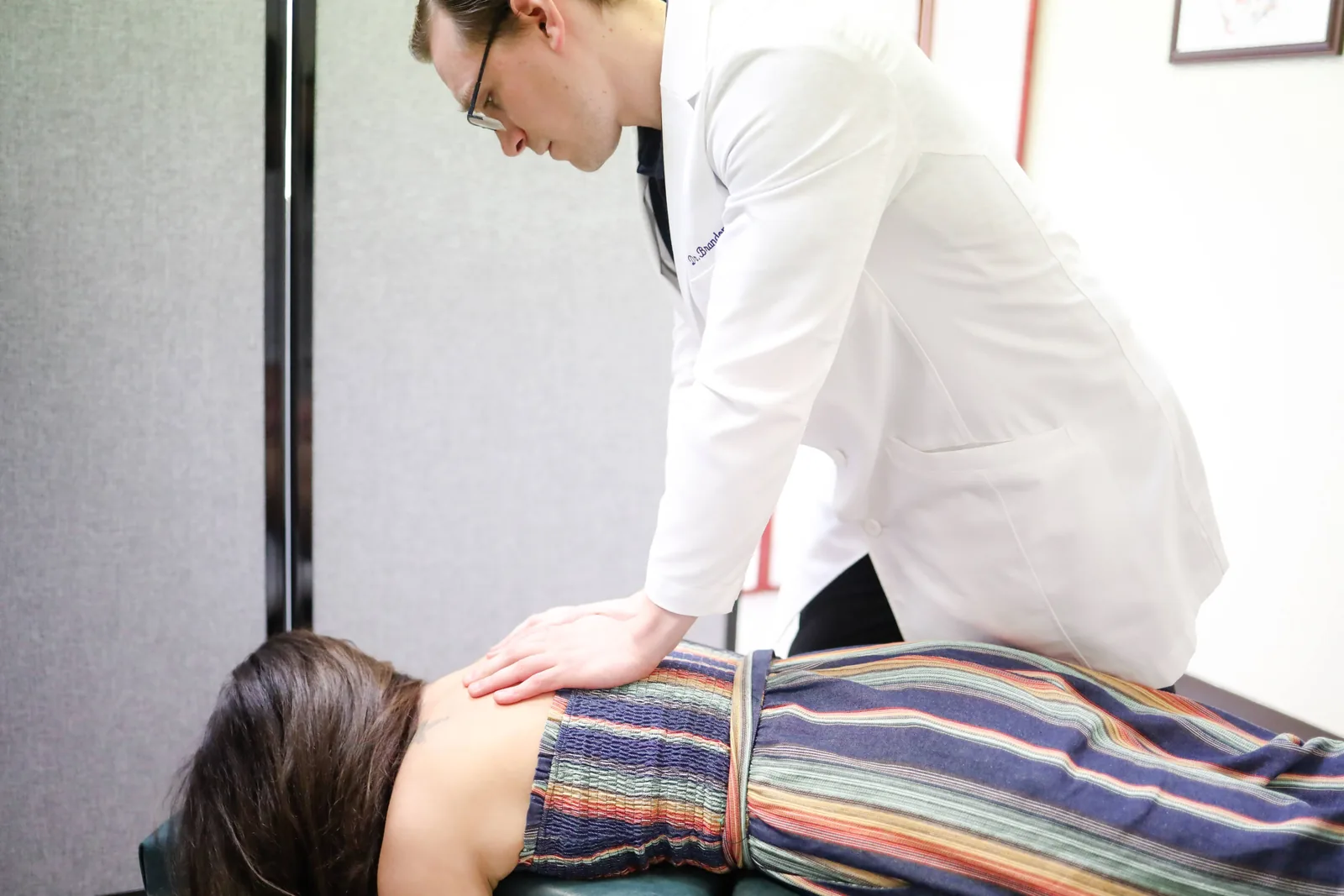
Care for back pain here usually combines adjustment of the joints that aren’t moving well, soft-tissue work on the muscles guarding them, and specific movements to do at home, plus straight talk about sitting, lifting, and training load. Research on spinal manipulation for low-back pain shows small-to-moderate improvements in pain and function, in the same range as other recommended conservative care, and clinical guidelines list it among the non-drug options to try first for acute and chronic low-back pain. Your response will be your own; most people know within a few visits whether it’s helping, and we’ll tell you honestly if it isn’t.
What people tell us
“Dr. Mike & the staff are very friendly & professional. They really know how to help improve your quality of life.. I went in to see them & after a couple of visits with Dr. Mike he made me feel relax & got my range of motion with my back good again.”
Individual experiences shared by patients; results vary.
Questions
Is it a disc?
Sometimes. Disc-related pain often refers into the buttock or leg and is worse with sitting or bending; joint pain is often worse standing or extending. The exam usually sorts this out without imaging.
Should I stop exercising?
Usually not entirely. Modify what hurts, keep what doesn't, and let the evaluation guide the return.
Do I need X-rays?
Not usually on the first visit. They're ordered when the exam or your history suggests they'd change the plan.
How many visits will it take?
It depends on how long it's been going on and how you respond. You'll get an honest estimate after the evaluation and an honest reassessment within a few visits.
Cost
First visit: $0 consultation and exam for new self-pay patients. Most major plans and Medicare accepted; text your card to 848-301-1515 for a free benefits check.
The no-charge consultation and exam is for new self-pay patients. If you have Medicare, NJ FamilyCare/Medicaid, or another federal or state health program, your visit is billed under that program's rules, and you'll know your cost before anything happens. If you have private insurance, the exam is billed to your plan and normal copays apply — text us a photo of your card with the word BENEFITS for a free benefits check first.
Related: Sciatica · Hip pain · Sports and activity pain
Written by Dr. Michael Brandon, DC
Sources: NCCIH spinal manipulation; NCCIH low-back pain; CDC 2022 clinical practice guideline for pain.