Weight Loss Medication Muscle Loss: What the Data Shows
Key takeaways
- Weight loss medication muscle loss is part of it, yes.
- Some of what came off was lean mass.
Weight loss medication muscle loss is part of it, yes. Some of what came off was lean mass. But lean mass is not the same thing as muscle. The share of it varies enormously between trials. And eating far less while asking your legs for far less force explains much of the weakness on its own. The number that says whether the back and knee relief holds is not the one on the scale.
Why do the stairs feel harder now that the weight is off?
The back is quiet on the drive. The knees have stopped arguing. Then you carry two bags up from the car and your legs shake at the top.
Weight comes off as a mixture, so lean tissue leaves alongside fat. At the same time, you are eating far less than you used to. Nothing in a normal week asks a hip or a knee for real force. Strength is a trained quality. You hold it only for as long as something keeps demanding it. So it goes quietly, with the rest. That is why the stairs noticed before you did. For the wider picture, see what a weight loss search in Colts Neck actually gets you.
How much of weight loss medication muscle loss is really muscle?
Less of it than a scan implies. Lean mass and muscle are not the same number.
Lean mass is simply what a DXA or bioimpedance machine reports once fat is subtracted. That means muscle, organ tissue, bone mineral and the water that travels with all of it. So a fall in that figure after months of eating far less is itself a mixture. In fact, a review of muscle loss and GLP-1 receptor agonist use is explicit that sarcopenia requires reduced function as well as reduced quantity before the word belongs in the conversation. Most of what you read about weight loss medication muscle loss is also about one molecule at one dose: semaglutide, sold here as the FDA-approved injections Ozempic and Wegovy. Meanwhile, trials of liraglutide and exenatide get pooled in alongside it, and those agents behave differently from one another.
An average is not your result.
Why does coverage of GLP-1 muscle loss contradict itself?
Because the trials contradict each other, and coverage picks a side.
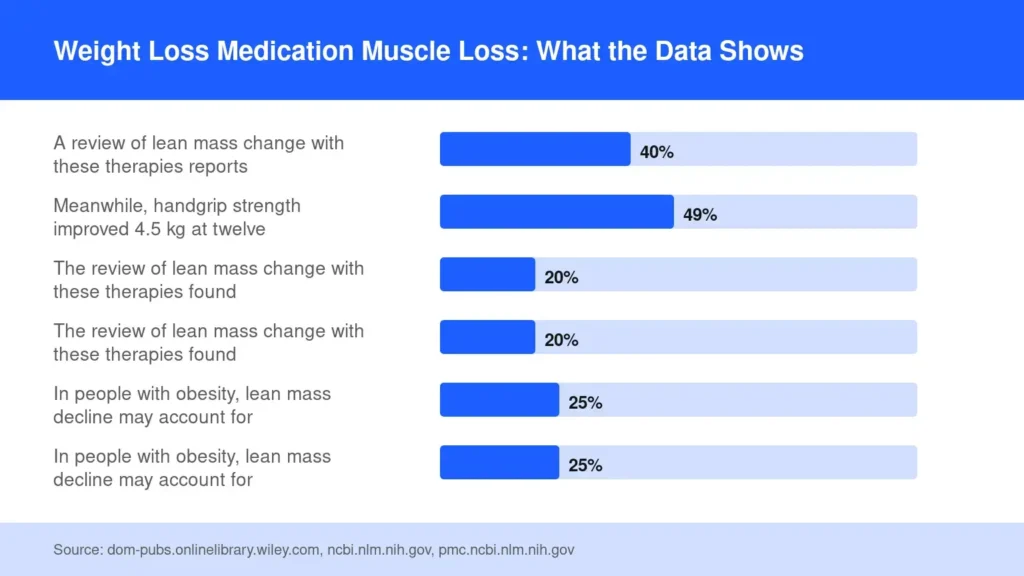
A review of lean mass change with these therapies reports that some studies show reductions of 40% to 60% of total weight lost while others show about 15% or less. That is the figure that gets quoted. But read the other half of that same trial. In STEP-1, lean mass rose as a proportion of total body mass, with no consistent clinically meaningful declines in function. In SEMALEAN, 106 patients on semaglutide lost about 3 kg of lean mass by seven months and then stabilised. Meanwhile, handgrip strength improved 4.5 kg at twelve months and sarcopenic obesity fell from 49% to 33%.
Both overstatements of weight loss medication muscle loss come from one mistake: reading a percentage of weight lost as a measure of capability.
Why is strength a better number to watch than the scale?
Because the clinical definition is built on strength, not on mass. The revised European consensus on sarcopenia uses low muscle strength as the primary parameter, with cut-offs of grip strength under 27 kg for men and 16 kg for women, and five chair rises slower than 15 seconds. Function carries thresholds of its own. In the CDC’s STEADI assessment of leg strength and endurance, a below-average 30-second chair stand — under 14 rises for a man aged 60 to 64 — indicates a risk for falls.
Here is why that matters to your back. Tissue tolerates load in proportion to the strength around it. So a knee or a low back that went quiet at a lighter body weight can start arguing again. It happens the moment life asks for force the legs can no longer produce. None of that shows up on a bathroom scale. If you aren’t testing you’re guessing. Same view in our piece on chronic pain.
What does an evaluation at FIT Clinic look for after major weight loss?
Force and control, measured, before anyone discusses treatment. Our clinical team starts with the history. In Dr. Michael Brandon’s words: “What is their pain, where is their pain, and what motions or activities cause it.” Then comes the exam, because the history only narrows it. As he puts it, “I explain the options and tell them I don’t actually know what they need yet — I need to go over the exam first.” After big weight loss, the exam goes looking for the strength side of weight loss medication muscle loss, not only the sore joint.
- Hip and knee strength under load — sit-to-stand, step-up and step-down
- Single-leg control — whether the pelvis stays level and the knee tracks on one foot
- Grip strength — cheap, repeatable, tied to the cut-offs above
- Trunk endurance — not how hard you brace, but how long before position fails
- Getting off the floor and walking — the tasks patients name as lost
We are at 8 Merchants Way in Colts Neck, by the corner of Route 34 and County Route 537, with free parking front and back. If it looks like the joint rather than the strength around it, our page on hip pain covers that.
How should you load training while eating far less than before?
Moderately, and with protein alongside it. A network meta-analysis of exercise during caloric restriction ranked moderate- and low-intensity resistance training, and moderate-intensity combined training, highest for maintaining lean body mass, with heavy resistance training performing less well. In practice, that means less load and more frequency for as long as energy intake stays low. In a trial of 100 adults aged 55 to 80 on a ten-week hypocaloric diet, 1.3 g/kg protein and resistance exercise three times weekly did not significantly change fat free mass alone, though the group doing both gained 0.6 kg within group. Modest, and the direction you want.
Terrain decides the rest. If your walk is the hills across the river from Red Bank, the Monmouth County Park System describes Hartshorne Woods as a hilly 831-acre site above the Navesink River with roughly 16 miles of challenging trail. A treadmill does not prepare a knee for repeated downhill steps. So the step-downs come first.
Frequently asked questions
Do GLP-1 medications cause more muscle loss than dieting or surgery?
Not clearly. The review of lean mass change with these therapies found that 20% to 50% of total weight lost was lean mass across interventions, with the proportion highly variable but similar between dietary, GLP-1-based and surgical weight loss. Speed and size of the loss matter more than the drug class.
Not clearly. The review of lean mass change with these therapies found that 20% to 50% of total weight lost was lean mass across interventions, with the proportion highly variable but similar between dietary, GLP-1-based and surgical weight loss. Speed and size of the loss matter more than the drug class.
Should I get a DXA scan to see if I am losing muscle?
A scan tells you quantity, not capability. DXA and bioimpedance are how lean mass is measured in research. But sarcopenia requires reduced function too. So a scan cannot say whether your legs will hold up on stairs. Strength testing answers the question you actually have.
A scan tells you quantity, not capability. DXA and bioimpedance are how lean mass is measured in research. But sarcopenia requires reduced function too. So a scan cannot say whether your legs will hold up on stairs. Strength testing answers the question you actually have.
Do I have to stop my weight loss medication to rebuild strength?
No, and that decision belongs with the physician who prescribes it. We do not manage medications at FIT Clinic. What we can do is measure what your hips, knees, grip and trunk produce now. Then we build loading around the eating pattern you are on today.
No, and that decision belongs with the physician who prescribes it. We do not manage medications at FIT Clinic. What we can do is measure what your hips, knees, grip and trunk produce now. Then we build loading around the eating pattern you are on today.
What is sarcopenic obesity?
It is excess fat mass combined with low muscle mass and low strength. In people with obesity, lean mass decline may account for up to 25% to 30% of total weight loss where reduction is rapid or marked. Strength testing, not the scan alone, is how it gets noticed early.
It is excess fat mass combined with low muscle mass and low strength. In people with obesity, lean mass decline may account for up to 25% to 30% of total weight loss where reduction is rapid or marked. Strength testing, not the scan alone, is how it gets noticed early.
I have no energy for training now that I eat so much less. Where do I start?
Start with short, frequent sessions at moderate load rather than long hard ones. Then anchor protein to the meals you still eat. Low energy availability is why people on these medications drift away from training, and the volume lost there is what shows up later as weakness.
Start with short, frequent sessions at moderate load rather than long hard ones. Then anchor protein to the meals you still eat. Low energy availability is why people on these medications drift away from training, and the volume lost there is what shows up later as weakness.
The Bottom Line
You did the hard part. The weight is off, and the knees and the low back are quieter for it. But whether that quiet holds depends on force rather than on the scale, and force is testable. Weight loss medication muscle loss is only half the story. Weakness is not the injury; it is the message.
Book an evaluation at FIT Clinic, 8 Merchants Way in Colts Neck, at fitclinic.co/book, or call or text 848-301-1515. Get the numbers now, while the work to change them is small.
Book your first visit at https://fitclinic.co/book/ — or call or text 848-301-1515.
FIT Clinic at Functionised — 8 Merchants Way, Colts Neck, NJ 07722.
Sources
- Muscle loss and GLP-1R agonists use
- Changes in lean body mass with glucagon-like peptide-1-based therapies and mitigation strategies
- Impact of Semaglutide on fat mass, lean mass and muscle function in patients with obesity: the SEMALEAN study
- Sarcopenia: revised European consensus on definition and diagnosis (EWGSOP2)
- CDC STEADI: 30-Second Chair Stand assessment
- Effect of a high protein diet and/or resistance exercise on the preservation of fat free mass during weight loss in overweight and obese older adults
- Comparing exercise modalities during caloric restriction: a systematic review and network meta-analysis on body composition
- Monmouth County Park System: Hartshorne Woods Park
- FDA Declaratory Order: Resolution of Shortages of Semaglutide Injection Products (Ozempic and Wegovy)