Leg Pain When Walking That Eases the Second You Stop
Key takeaways
- Leg pain when walking that eases the moment you stop usually comes from one of two places: nerves crowded by a narrowing lower spine, or muscles starved by narrowed arteries.
- The fastest tell at home is posture and position — if leaning forward on a shopping cart or a counter buys you more distance, the pattern leans toward the spine; if simply standing still settles a calf cramp, and the foot is cold or the skin heals slowly, that is a circulation question for a physician and a vascular workup, not a chiropractic case.
Leg pain when walking that eases the moment you stop usually comes from one of two places: nerves crowded by a narrowing lower spine, or muscles starved by narrowed arteries. The fastest tell at home is posture and position — if leaning forward on a shopping cart or a counter buys you more distance, the pattern leans toward the spine; if simply standing still settles a calf cramp, and the foot is cold or the skin heals slowly, that is a circulation question for a physician and a vascular workup, not a chiropractic case. An evaluation sorts the pattern before anyone talks about treatment.
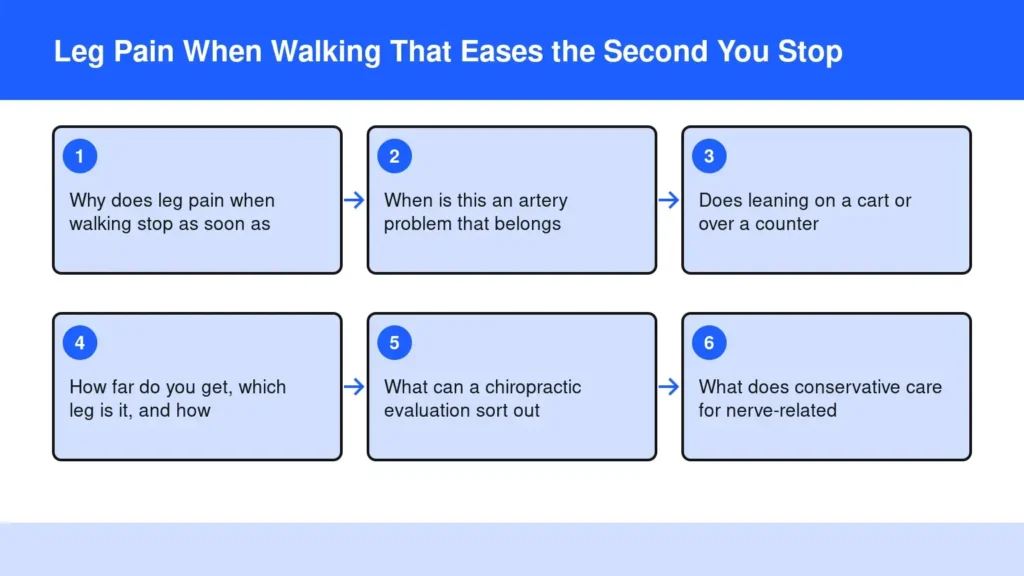
Why does leg pain when walking stop as soon as you stand still?
Because the two usual causes are supply problems rather than damage. Walking raises a demand your leg cannot meet, and stopping drops the demand. What matters is what kind of stopping helps. Pain from narrowed arteries tends to settle when you simply stand still, because a resting muscle needs far less blood. Pain from a narrowed spinal canal often needs a change of shape before it lets go: sitting down, bending forward, resting both forearms on a counter.
Here is the mechanism. The lumbar spinal canal changes size with posture. Extension of the spine draws the laminar edges together and buckles the ligamentum flavum inward, which crowds the nerves; bending forward reverses it. Standing tall and walking is a sustained extension position for most people, so the nerve irritation builds over a few minutes and stays until the shape changes. In the arteries, the story is plumbing: narrowed vessels cannot deliver enough blood to keep up with demand, producing cramping that begins with exercise and ends with rest, most often in the calf.
So the pain is not the injury. It is the message, and the message is about position and blood supply. That is why leg pain when walking gets worked up as a pattern over distance and posture, not as a single sore spot you press on.
When is this an artery problem that belongs with a physician first?
When the legs show circulation signs, that is a physician and vascular question before it is anything else. Cramping in the calf that arrives at a predictable distance and fades within minutes of standing still, cold feet, hair thinning on the shins, shiny skin, a toe or heel sore that heals slowly, or a pulse at the ankle you cannot find: any of those move this out of a chiropractic office and into a medical workup. Say it plainly to whoever you call.
Peripheral arterial disease is common and often quiet. The CDC reports that approximately 6.5 million people aged 40 and older in the United States have PAD, with smoking, diabetes, high blood pressure, high cholesterol and age above 60 among the risk factors. The first test is usually simple and non-invasive: the ankle-brachial index, in which ankle systolic pressure is divided by arm systolic pressure, with a ratio below about 0.9 treated as abnormal.
There is a second group that needs a physician the same day rather than an appointment next week: numbness in the saddle area, a change in bladder or bowel control, or sudden weakness in both legs. NHS guidance lists saddle anaesthesia and bladder changes among the symptoms of cauda equina syndrome, and that is an emergency department conversation, not a clinic one. As Dr. Michael Brandon, DC puts it, “If I can’t be the one to help them, I want to at least put them in the right direction to find someone who can.”
Does leaning on a cart or over a counter actually change anything?
Yes, and it is one of the better clues you can collect without a single test. If the supermarket is easy because you are pushing a cart, and the walk from the car to the door is hard, your posture is doing the work that a clinician would otherwise have to infer.
Researchers put that observation on a treadmill. In a crossover study published in Chiropractic & Manual Therapies, 55 patients — 23 with lumbar spinal stenosis, 14 with peripheral arterial disease and 18 with non-specific low back pain — walked two five-minute tasks at 1.9 km/h (1.2 mph), once upright and once with the trunk leaning forward to mimic a shopping cart. The stenosis group improved its walking time to symptom change from the upright task to the forward-leaning task more than the arterial disease group or the low back pain group. The authors were careful: the test distinguished the groups, and further study is needed to validate it.
Read it the way they intended. Leaning forward buying you time points toward the nerve; leaning forward changing nothing while standing still fixes it quickly points toward the artery. Neither observation is a diagnosis. Both are worth writing down.
How far do you get, which leg is it, and how fast does it ease?
Those three answers narrow the field faster than almost anything else you can tell a clinician. Distance to onset that is the same every time, in the same leg, is a different story from a pain that varies with how you slept. Quantify it literally: not “a little way,” but the mailbox, the second bend, the far side of the lot.
Here is where living in Monmouth County helps, because we have flat, fixed-distance walking to measure against. The Henry Hudson Trail is a former rail line; its south section runs 12 miles toward Freehold and is open dawn to dusk, and the Manasquan Reservoir in Howell has a five-mile perimeter trail around the water. Same route, same pace, same shoes, three days running. If you aren’t testing you’re guessing.
What to record:
- Distance to first symptom, on level ground, at your normal pace.
- One leg or both, and whether it is buttock, thigh, calf or foot.
- What ends it: standing still, sitting, or bending forward.
- How long until the leg feels normal again.
- Other signs: cold foot, numbness, a foot that catches on curbs, skin that is slow to heal.
What can a chiropractic evaluation sort out when the pattern points to your lower back?
It can work out whether your symptoms behave like a nerve under pressure, whether the irritation changes with position and load, how far you can walk before it starts, and whether anything in the exam says this is not a case for conservative care at all. Dr. Michael Brandon, DC describes the starting point this way: “What is their pain, where is their pain, and what motions or activities cause it.”
A sensible evaluation for this complaint is mostly testing and history. Walking tolerance, extension and flexion loading, a neurological screen of strength, reflexes and sensation in the legs, hip and ankle motion, how you get out of a chair, and the pulses in your feet. Nothing is assumed from a scan, and nothing starts before the findings are explained. “I explain the options and tell them I don’t actually know what they need yet — I need to go over the exam first,” as Dr. Brandon puts it.
Being honest about the limits: an exam cannot rule arterial disease in or out, and when the findings lean that way the referral is the service. Care here, when it is indicated, may include manual therapy, graded walking and specific strengthening, and Dr. Brandon is direct about technique — “You don’t need to ‘crack’ or give that large adjustment to people.” Our clinical team will also say when the honest answer is that something else is needed, which is the same instinct that makes an exam worth doing in the first place.
What does conservative care for nerve-related claudication actually involve?
Mostly hands-on treatment plus loaded exercise, with education about posture and pacing, delivered over weeks rather than in a single visit. That combination is where the evidence is strongest, and the evidence is honest about its own size.
An updated systematic review in BMJ Open concluded that there is moderate-quality evidence that a multimodal approach including manual therapy and exercise, with or without education, is an effective treatment for lumbar spinal stenosis with neurogenic claudication, and that epidural steroids are not effective; the same review found manual therapy, education and exercise delivered with a cognitive-behavioural approach produced clinically important improvements in walking distance compared with self-directed home exercise. Moderate quality means it may help. It does not mean it will work for you, and transient soreness after manual treatment was more common in those groups than in the comparison groups.
If the answer turns out to be arterial, the treatment is still partly walking, under supervision: the CDC notes that supervised exercise training programs can improve and prolong the ability to walk longer distances for people with PAD, alongside medical management. Either way, the plan ends with you walking further than you do now, measured rather than guessed. Older adults weighing the cost of care may also want to read what Medicare Part B actually pays for chiropractic care, and anyone whose back complains hardest in the car will recognise the pattern in why back pain is often worse driving home than at the desk.
Frequently asked questions
Why can I ride a bike for miles but not walk to the end of the block?
Because pedalling keeps your trunk bent forward, which opens the space the lumbar nerves pass through, while upright walking closes it down. A leg that tolerates cycling but objects within minutes of walking points toward the spine rather than the arteries, since narrowed vessels limit any effort that raises muscle demand, seated or standing. Mention it at your appointment.
Because pedalling keeps your trunk bent forward, which opens the space the lumbar nerves pass through, while upright walking closes it down. A leg that tolerates cycling but objects within minutes of walking points toward the spine rather than the arteries, since narrowed vessels limit any effort that raises muscle demand, seated or standing. Mention it at your appointment.
Should I stop walking until I know what is causing it?
Not on your own initiative, unless a clinician has told you otherwise. A common approach is to walk within the distance that stays comfortable, rest, then go again, which keeps conditioning without provoking symptoms. If pain now arrives at rest or at night, or a sore on the foot is slow to heal, that changes the picture and belongs with a physician promptly.
Not on your own initiative, unless a clinician has told you otherwise. A common approach is to walk within the distance that stays comfortable, rest, then go again, which keeps conditioning without provoking symptoms. If pain now arrives at rest or at night, or a sore on the foot is slow to heal, that changes the picture and belongs with a physician promptly.
Do I need an MRI before anyone can help me?
No. History and examination carry most of the weight in sorting these patterns, and imaging is ordered when the result would change the plan — progressive weakness, bladder or bowel change, or a referral for a surgical opinion. A scan of the spine also says nothing about your arteries, which are assessed with pressures and ultrasound instead.
No. History and examination carry most of the weight in sorting these patterns, and imaging is ordered when the result would change the plan — progressive weakness, bladder or bowel change, or a referral for a surgical opinion. A scan of the spine also says nothing about your arteries, which are assessed with pressures and ultrasound instead.
Can I have a spine problem and an artery problem at the same time?
Yes. Shared risk factors mean the two can sit side by side, so one finding does not rule out the other. Somebody can get real relief leaning on a cart and still have weak pulses in the feet. That is why an evaluation checks both patterns rather than stopping at the first plausible explanation.
Yes. Shared risk factors mean the two can sit side by side, so one finding does not rule out the other. Somebody can get real relief leaning on a cart and still have weak pulses in the feet. That is why an evaluation checks both patterns rather than stopping at the first plausible explanation.
The Bottom Line
Legs that quit at a predictable distance are telling you something specific, and the two likeliest messages ask for two different doors. If standing still is enough and the foot runs cold, call your physician and ask about a vascular workup. If you need to bend forward before the leg lets go, the lower back and the nerves that leave it are the sensible place to look, and that is an examination, not a guess.
Bring your three measured walks. FIT Clinic is at 8 Merchants Way in Colts Neck, by the corner of Route 34 and County Route 537, with free parking in front of and behind the building, and we see people from Freehold, Marlboro, Holmdel, Howell, Middletown, Red Bank and across Monmouth County. Nothing is decided before the exam is explained to you in plain English. Book an evaluation, or call or text 848-301-1515.
Book your first visit at https://fitclinic.co/book/ — or call or text 848-301-1515.
FIT Clinic at Functionised — 8 Merchants Way, Colts Neck, NJ 07722.
Sources
- Comparison of walking variations during treadmill walking test between neurogenic and vascular claudication: a crossover study (Chiropractic & Manual Therapies)
- Non-operative treatment for lumbar spinal stenosis with neurogenic claudication: an updated systematic review (BMJ Open)
- Spinal Stenosis and Neurogenic Claudication — StatPearls, NCBI Bookshelf
- About Peripheral Arterial Disease (PAD) — CDC
- Peripheral artery disease — Symptoms and causes, Mayo Clinic
- Peripheral Artery Disease and Cardiovascular Disease: Screening and Risk Assessment With the Ankle-Brachial Index — U.S. Preventive Services Task Force
- Cauda Equina Syndrome — Buckinghamshire Healthcare NHS Trust
- Henry Hudson Trail accessibility guide (PDF) — Monmouth County, NJ
- Henry Hudson Trail — Monmouth County Park System
- Manasquan Reservoir, Howell NJ (PDF brochure) — Monmouth County Park System
- Manasquan Reservoir — Monmouth County Park System