Fall Prevention Monmouth County: What the Evidence Says
Most fall prevention Monmouth County advice arrives as a vitamin D bottle and a grab bar. The evidence points elsewhere. The U.S. Preventive Services Task Force recommends exercise for community-dwelling adults 65 and older at increased risk. It calls multifactorial programs an individualized decision with a small net benefit. Its earlier statement recommended against vitamin D for fall prevention. Supervised, progressive work on gait, balance and strength is the part nobody hands you in a bag.
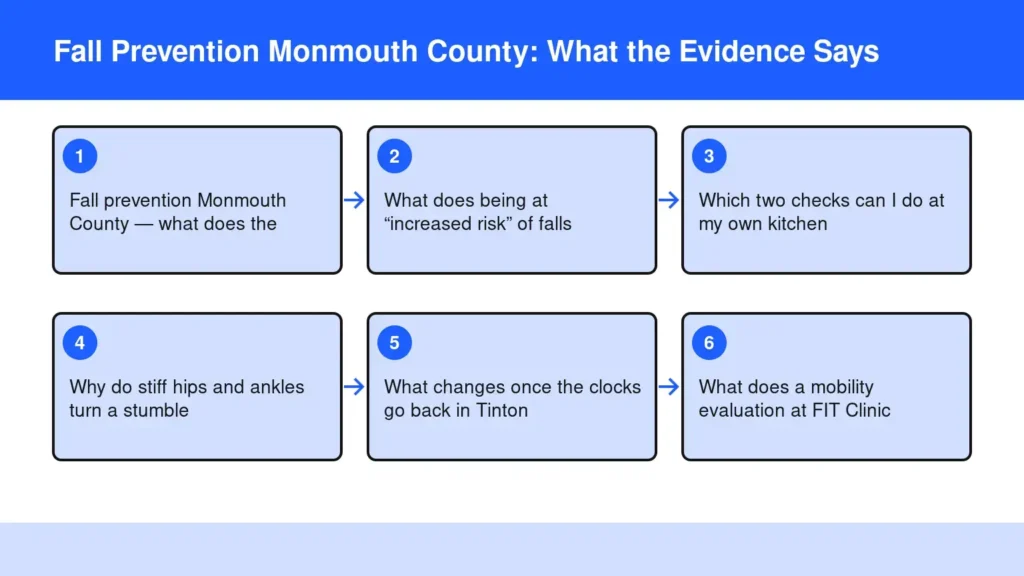
Fall prevention Monmouth County — what does the Task Force actually recommend?
Exercise comes first. Good fall prevention Monmouth County care starts with supervised movement, not a supplement. The U.S. Multifactorial programs are a different matter. Clinicians should individualize that decision, because the net benefit is small. Exercise carries a B grade. That means it is recommended.
Now the part most families miss. The 2018 statement recommended against vitamin D supplementation to prevent falls in community-dwelling adults 65 and older.
Here is the real problem: the intervention with the highest-grade evidence is the only one nobody can bottle or screw to a wall, so it gets talked about last.
What does being at “increased risk” of falls actually mean?
Usually it means a fall already happened, or that walking and standing have stopped feeling automatic. The factors that commonly put someone in that group include a previous fall, unsteady gait or balance, medication effects, sensory problems and hazards at home.
The scale is worth stating plainly. Falls are the leading cause of injury death for adults 65 and older. Closer to home, about 600 New Jersey residents in that age group die from falls each year. And every five minutes, someone 60 or over turns up in a state emergency room after a fall.
Those are not numbers about frail people in facilities. They are people who drive and garden, and many of them first notice the problem as stiffness that will not loosen.
Which two checks can I do at my own kitchen counter?
Two of them: a single-leg stand and a sit-to-stand. Neither one diagnoses anything. Both tell you something a conversation cannot.
- Single-leg stand. Fingertips on the counter, lift one foot. In middle-aged and older adults, failing to hold that stance for 10 seconds was linked to a near doubling of death risk over the next decade.
- Sit-to-stand. Rise from a firm chair without your hands, then sit down under control. The CDC uses the 30-second chair stand in its STEADI resources to assess leg strength and endurance.
Here is the test behind both checks: can you produce force on one leg, and can you control it coming down?
Why do stiff hips and ankles turn a stumble into a fall?
Because catching yourself is a range-of-motion problem before it is a strength problem. A stumble gives you a fraction of a second to throw a leg out and take your weight on it. If the ankle will not bend forward over the foot, the recovery step lands short. The same happens when the hip will not open behind you. Short is how a trip becomes a landing.
Stiffness is not the injury. It is the message.
It also reads differently in a driveway than in a hallway: loose gravel, a sloped apron, a dark walk from the car. Our mobility and stiffness work starts there, and it is the same pattern behind many pickleball falls and lunges.
What changes once the clocks go back in Tinton Falls and Lincroft?
Two things change: light and surface. The walk from the car now happens in the dark, and the first freeze turns familiar ground into something your ankle has to negotiate.
Local geography is part of why the season matters. A hip fracture on an icy apron in Lincroft or Tinton Falls is very likely headed to the Level II regional trauma center in Neptune. The hospital describes it as the regional trauma center for adults and children. The drive is short. The recovery is not.
Local fall prevention Monmouth County support costs nothing to ask about. The Monmouth County Division on Aging, Disabilities and Veterans Services takes calls at 732-431-7450. New Jersey runs A Matter of Balance in eight two-hour group sessions. The state also keeps a falls prevention page for older residents.
What does a mobility evaluation at FIT Clinic look at, and what does it not promise?
It looks at how you move, where motion is missing and what you can produce on one leg. It does not promise you will never fall, because no honest exam can.
Our clinical team takes the history first. Then we watch walking, turning, standing from a chair and balance. We check hip, ankle and spine motion to find the joints that are not contributing. Dr. Michael Brandon, DC puts the first part simply: “What is their pain, where is their pain, and what motions or activities cause it.”
If the findings belong to a physician instead, that is the answer you get. As Dr. Brandon says: “If I can’t be the one to help them, I want to at least put them in the right direction to find someone who can.” On Medicare, see what Part B actually pays.
Frequently asked questions
Should I stop taking vitamin D?
That is a conversation for the physician who suggested it. The Task Force statement addressed vitamin D taken specifically to prevent falls in community-dwelling older adults, not vitamin D taken for a documented deficiency or another medical reason. Those are different questions, and only your prescriber has your bloodwork and medication list in front of them.
That is a conversation for the physician who suggested it. The Task Force statement addressed vitamin D taken specifically to prevent falls in community-dwelling older adults, not vitamin D taken for a documented deficiency or another medical reason. Those are different questions, and only your prescriber has your bloodwork and medication list in front of them.
Is chiropractic care safe if I have thinning bones?
It depends on the findings, and the technique is a choice rather than a fixed thing. Dr. Michael Brandon, DC is direct about it: “You don’t need to ‘crack’ or give that large adjustment to people.” Bone density, medications and prior fractures all belong in the history before anyone decides what care may include.
It depends on the findings, and the technique is a choice rather than a fixed thing. Dr. Michael Brandon, DC is direct about it: “You don’t need to ‘crack’ or give that large adjustment to people.” Bone density, medications and prior fractures all belong in the history before anyone decides what care may include.
Do grab bars and home safety changes still help?
Yes, as part of a multifactorial approach, which the Task Force treats as an individualized decision with a small net benefit. Removing a loose rug, adding light at the top of the stairs and fitting bars in the bathroom take hazards away. They do not add strength or balance, so they work alongside exercise, not instead of it.
Yes, as part of a multifactorial approach, which the Task Force treats as an individualized decision with a small net benefit. Removing a loose rug, adding light at the top of the stairs and fitting bars in the bathroom take hazards away. They do not add strength or balance, so they work alongside exercise, not instead of it.
Can balance improve after 70?
Yes. Balance responds to training at every age studied. The National Institute on Aging lists balance work alongside endurance, strength and flexibility as one of the four kinds of exercise older adults need. That is why the exercise evidence covers adults 65 and older, with no upper cutoff. Progress is slow and unglamorous: the same drill, loaded a little more each week. Boring is good. What we see most often in clinic is steadier single-leg work before anyone feels braver on stairs.
Yes. Balance responds to training at every age studied. The National Institute on Aging lists balance work alongside endurance, strength and flexibility as one of the four kinds of exercise older adults need. That is why the exercise evidence covers adults 65 and older, with no upper cutoff. Progress is slow and unglamorous: the same drill, loaded a little more each week. Boring is good. What we see most often in clinic is steadier single-leg work before anyone feels braver on stairs.
Which towns do you see, and where do I park?
We do fall prevention Monmouth County wide. FIT Clinic is at 8 Merchants Way in Colts Neck, by the corner of Route 34 and County Route 537, and parking is free in front of and behind the building. We see adults from Colts Neck, Freehold, Manalapan, Middletown, Red Bank, Marlboro, Howell, Neptune, Holmdel, Tinton Falls, Lincroft and Shrewsbury.
We do fall prevention Monmouth County wide. FIT Clinic is at 8 Merchants Way in Colts Neck, by the corner of Route 34 and County Route 537, and parking is free in front of and behind the building. We see adults from Colts Neck, Freehold, Manalapan, Middletown, Red Bank, Marlboro, Howell, Neptune, Holmdel, Tinton Falls, Lincroft and Shrewsbury.
The Bottom Line
If you are 65 or older and any of this sounded familiar, the order of operations for fall prevention Monmouth County is short. Take the two checks this week, write down what happened, then have the stiff joints and the weaker side looked at by someone who tells you what the exam shows first.
- Do the single-leg stand and the sit-to-stand, with a counter in reach.
- Note any fall or unsteady moment, and the surface it happened on.
- Bring your medication list.
- Ask what care would involve and how it is measured.
Book an evaluation at FIT Clinic, 8 Merchants Way, Colts Neck, or call or text 848-301-1515.
Book your first visit at https://fitclinic.co/book/ — or call or text 848-301-1515.
FIT Clinic at Functionised — 8 Merchants Way, Colts Neck, NJ 07722.
Sources
- USPSTF Recommendation: Falls Prevention in Community-Dwelling Older Adults: Interventions
- Archived USPSTF Recommendation (2018): Falls Prevention in Community-Dwelling Older Adults
- JAMA: Interventions to Prevent Falls in Community-Dwelling Older Adults, US Preventive Services Task Force Recommendation Statement
- APTA: Falls Prevention Recommendations Reinforce Importance of Exercise
- CDC: About Older Adult Fall Prevention
- CDC STEADI: Clinical Resources
- NJSHAD: Deaths due to Falls among Persons Aged 65 and Older
- New Jersey Leadership Making a Difference to Address Fall Prevention (NJ Falls Prevention Profile 2024)
- NJ Division of Aging Services: A Matter of Balance
- University of Bristol: Inability to stand on one leg in mid to later life linked to higher risk of death
- Hackensack Meridian Health: Jersey Shore University Medical Center Level II Regional Trauma Center Receives Verification
- Monmouth County Division on Aging, Disabilities and Veterans Services
- NJ Division of Aging Services: Falls Prevention
- National Institute on Aging: Four Types of Exercise Can Improve Your Health and Physical Ability