Outer hip pain at night and what to try before a procedure

Key takeaways
- Outer hip pain at night most often comes from the gluteal tendons on the side of the hip being squeezed while you lie down.
- The hip joint and the lower back can feel similar.
Outer hip pain at night most often comes from the gluteal tendons on the side of the hip being squeezed while you lie down. The hip joint and the lower back can feel similar. Before any procedure, the usual steps are an exam to tell those sources apart, changing the positions that press on the tendon, and loading it back up gradually. An orthopedist is the right call for red flags, a suspected tear, or pain that a fair trial of that care has not moved.
Why does outer hip pain at night get worse lying on that side?
Outer hip pain at night usually gets worse on that side because your body weight presses the gluteal tendons against the bony point of the hip for hours. Roll onto the other side and the top leg drops across your body, which squeezes the same tendons from another angle.
You know the scene. You lie down tired. The ache starts on the outside of the hip. You roll over, and now the top hip aches instead. By the small hours you are on your back, staring at the ceiling, doing the math on how much sleep is left.
Here is the mechanism. The gluteus medius and minimus tendons wrap over the greater trochanter, the bump on the outside of your upper thigh. A physiotherapy guide from South Tees Hospitals NHS Trust notes that sleeping can mean 7 to 8 hours of exposure to compression. Side lying also squeezes the opposite tendons as the top leg crosses over. Tendons handle load well. They handle sustained squeeze poorly. A review on RunningPhysio explains that this compression rises further when the hip is bent or turned outward.
So do we feel pain more at night? For this problem, the honest answer is that night is when the compression lasts longest with the fewest breaks. During the day you shift, stand and walk. In bed you hold one position for a long time.
Is it bursitis or a tendon problem?
The older label was trochanteric bursitis. StatPearls now treats greater trochanteric pain syndrome as an umbrella covering bursitis, abductor tendinopathy and snapping hip. A general practice trial protocol puts the cause as tendinopathy of the gluteal tendons, with or without the bursa involved. The same protocol reports a prevalence of 15% in women aged 50 to 70. The ache is not the damage. It is the message that the tendon has taken more squeeze than it can handle.
What else could be causing pain on the outside of the hip and thigh?
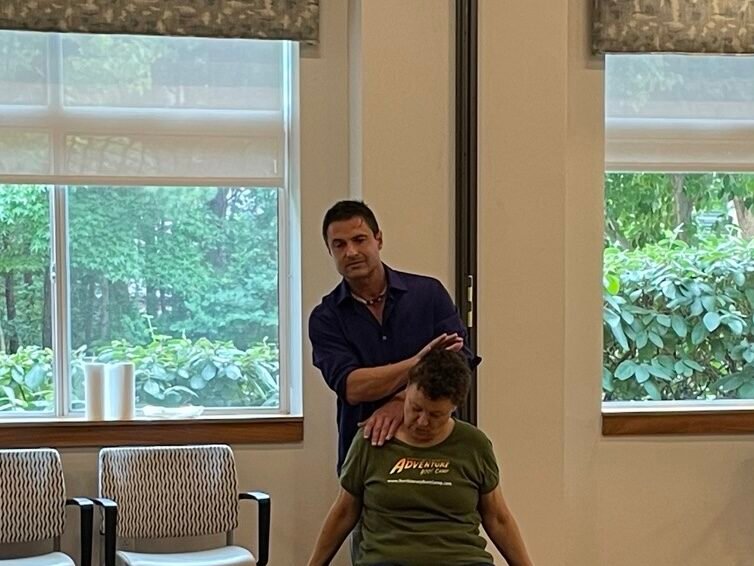
Three sources cause most pain on the outside of the hip and thigh: the gluteal tendons, the hip joint itself, and the lower back. They can overlap, which is why a single symptom rarely settles the question. Many conditions can affect the side of the hip, so the exam has to separate them.
The tendon
Tendon pain tends to sit right on the bony point and flare with pressure. The trial protocol lists walking, sitting, stair climbing and lying on the side as typical triggers. South Tees adds that the pain can go down the outside of your leg to the knee, and that crossing your legs makes it worse.
The hip joint
Joint pain usually announces itself differently. Mersey Care NHS notes that hip pain is often felt in the groin and buttock, and that osteoarthritis may develop with age or after injury. A topical review of gluteal tendinopathy care reports that groin pain during the FABER test, a figure-four position, raises the odds of hip osteoarthritis in older patients. That is why arthritis in the hip joint and a sore tendon can feel alike at night but behave differently on the exam table.
The lower back
The back can refer pain into the side of the thigh. In a large study, Segal and colleagues found that greater trochanteric pain syndrome was associated with low back pain, knee osteoarthritis or knee pain, and iliotibial band tenderness. That does not mean one causes the other. It means an exam that checks only the hip can miss half the picture. If the exam points to the spine, our pieces on what the back pain guideline update means and preventing chronic back pain take it from there.
How do you tell if hip pain is bone or muscle?
You cannot reliably tell at home, and neither can a single test in the clinic. One test is a single-leg stand against a wall. Physiopedia reports a specificity of 100% and a sensitivity of 38% when it was compared with MRI. In plain English, a painful stand points strongly at the tendon, while a comfortable stand rules nothing out. The topical review rates the evidence for these tests from very low to moderate, with none rated high. That is why clinicians combine several.
At FIT Clinic the exam comes before any plan. Dr. Michael Brandon, DC, starts from three questions: “What is their pain, where is their pain, and what motions or activities cause it.”
When is hip pain at night a red flag?
Night pain from a squeezed tendon is common and usually mechanical: it changes with position. It becomes a reason to see a physician first when it comes with signs that point away from a tendon.
The NHS guidance on hip pain in adults asks for an urgent appointment if any of these apply:
- severe hip pain that started suddenly without a fall or injury
- a hip that is swollen and feels hot
- skin around the hip that has changed color
- hip pain with feeling generally unwell or a high temperature
- tingling or loss of feeling in the hip or leg after an injury
The same NHS page suggests a routine GP visit if pain is affecting your sleep, keeps getting worse, or has not improved after treating it at home for 2 weeks. NHS advice also flags hip stiffness lasting more than 30 minutes after waking. Mersey Care is blunter about fever: acute hip pain while feeling unwell means seeing your doctor immediately.
If any of that fits, start with your physician. Dr. Brandon puts our side of it plainly. “If I can’t be the one to help them, I want to at least put them in the right direction to find someone who can.”
Which sleeping and sitting positions take pressure off the tendon?
The first step is usually taking pressure off the tendon, day and night. South Tees calls reducing the amount of compression over the outside of the hip a vital part of managing the problem.
Here is the checklist our clinical team works from, drawn from that guidance:
- Sleep with the top knee supported. A pillow between the knees helps keep the top leg from dropping across the body.
- Stop crossing your legs. Crossing while sitting or lying adds squeeze to the tendon on top.
- Stand on both feet. Hanging on one hip, with the pelvis pushed out to the side, compresses that tendon.
- Watch low, soft seats. Deep sitting bends the hip, and a bent hip adds compression.
- Break up long positions. Long stretches of time in one posture matter more than any single moment.
None of these things is exciting. Boring is good. Removing the positions causing the squeeze may help reduce night pain, but these changes do not rebuild the tendon. They stop you re-irritating it every night while the real work happens during the day.
How do you load a sore hip tendon back up without a flare?
The tendon is loaded back up gradually, with strength work that starts gentle and progresses as the tendon tolerates it. That approach, paired with education about compression, has the strongest trial behind it.
In the LEAP trial by Mellor and colleagues, published in the BMJ, people with gluteal tendinopathy received load management education plus exercise, a corticosteroid injection, or no treatment. At eight weeks, both active approaches beat doing nothing on global improvement and pain. The ACP Journal Club summary reports that education plus exercise improved outcomes compared with injection or a wait-and-see strategy. That program was not a handout of exercises. The LEAP-Ireland protocol notes it involved 14 physiotherapy sessions, and questions whether that many is feasible in everyday practice.
I spent years as a strength and conditioning coach for the Toronto Blue Jays, the Tampa Bay Buccaneers and the University of South Florida. The lesson that stuck is that load is a dose. Too little and the tissue never adapts. Too much, too soon, and it complains. The activity that hurts today is often the one the tendon needs to become strong enough for, at a dose it can tolerate. The working rule in our building is simple: if you aren’t testing, you’re guessing. Physiopedia describes functional loading tests, such as standing and hopping on the affected leg, used to track how well the tendon tolerates load over time.
FIT Clinic shares its building with FIT Lab, where strength and recovery are measured rather than guessed. That can include an ARX strength baseline and a sit-to-rise test, so progress is a number you can watch rather than a feeling you hope for. When daily movement gets easier and the numbers improve together, that is a signal worth trusting.
Why the classic outer-hip stretch can backfire
The cross-legged stretch many people reach for pulls the hip into adduction. RunningPhysio describes clinical tests for this problem that use exactly that position, including a modified Ober test, to provoke pain. A stretch that feels productive may simply be more compression on a tendon that already has too much.
When does a procedure or an orthopedist make sense for outer hip pain?
A procedure fits after the basics have had a fair trial and the tendon has not responded. An orthopedist is the right referral when red flags appear, when a tear is suspected, or when the joint itself looks like the main problem.
The procedures are real. One study in the Journal of Ultrasound in Medicine enrolled 30 patients, 24 of them female, with tendinosis or a partial tear on ultrasound. They received either ultrasound-guided tendon fenestration or a platelet-rich plasma injection. Both groups improved, though pain was tracked only over the first weeks. Registered trials on ClinicalTrials.gov are testing other ultrasound-guided options, such as percutaneous neuromodulation of the superior gluteal nerve.
Here is the real problem with waiting too long on either path. Every month of broken sleep is a month of avoided stairs and shorter walks. Mersey Care notes that keeping the hip moving matters because too little activity lets structures stiffen and muscles weaken. That is the entire stakes. The aim is not to delay a procedure forever. It is to make sure you only need one if the simpler steps have truly failed.
Our clinical team points people to an orthopedist for a few clear reasons. A limp or weakness that does not shift with care. Symptoms that suggest a tendon tear. Groin-dominant pain with joint stiffness. A fair trial of load care that has not moved the needle. Dr. Brandon describes the first visit the same way to everyone. “I explain the options and tell them I don’t actually know what they need yet — I need to go over the exam first.”
Frequently asked questions
Why is outer hip pain more common in women?
Outer hip pain is far more common in women, and the reasons appear to be anatomical, hormonal and mechanical. In Segal and colleagues, women had an odds ratio of 3.37 compared with men. StatPearls points to sex hormones, anatomical differences and biomechanics, with incidence peaking between 40 and 50.
Does a cortisone injection help outer hip pain?
A cortisone injection may ease pain in the short term, but it has not outperformed a structured education and exercise program. The ACP Journal Club summary of the LEAP trial reports better outcomes with education plus exercise than with injection. The LEAP-Ireland protocol cites evidence that education plus exercise improves quality of life and is cost-effective compared with injection.
Should I keep walking if the outside of my hip hurts?
Usually yes, within what the hip tolerates, because complete rest tends to weaken the muscles that support the tendon. Mersey Care NHS advises finding a balance between rest and exercise, since too much can increase pain and too little lets the hip stiffen. Flatter, shorter routes are a sensible starting point while the tendon settles.
Do I need an MRI or ultrasound for outer hip pain?
Imaging is most useful when the answer would change the plan, such as when a tear is suspected or a procedure is being weighed. The fenestration study selected patients by ultrasound findings of tendinosis or a partial tear. Your physician or an orthopedist decides when imaging is warranted, usually after a clinical exam.
What does a hip evaluation at FIT Clinic involve?
A hip evaluation at FIT Clinic starts with questions and an exam, not a plan. Dr. Brandon asks what the pain is, where it is and which motions trigger it, then explains the options in plain English. Care does not rely on forceful cracking. In his words, “You don’t need to ‘crack’ or give that large adjustment to people.”
The Bottom Line
Outer hip pain at night is usually a compression problem first and a strength problem second. The steps that tend to come before any procedure are simple: get the source identified, stop squeezing the tendon, and load it back up on a measured schedule. Rule out red flags with your physician, and see an orthopedist when the exam or your progress says so.
If you are in Red Bank, Middletown, Holmdel or anywhere nearby and the side of your hip is costing you sleep, here is the next step:
- Note which positions and activities set it off, and whether it ever reaches the groin or below the knee.
- Read our hip pain overview for more on how hip pain is assessed.
- Book a hip evaluation at FIT Clinic, 8 Merchants Way, Colts Neck, by the corner of Route 34 and County Route 537. Parking is free in front of and behind the building. You can also call or text 848-301-1515.
If your back turns out to be part of it, my book Why Your Back Hurts is free in full on fitclinic.co.
Book your first visit at https://fitclinic.co/book/ — or call or text 848-301-1515.
FIT Clinic at Functionised — 8 Merchants Way, Colts Neck, NJ 07722.
Sources
- Gluteal tendinopathy (GTPS) – South Tees Hospitals NHS Foundation Trust
- Hip pain in adults – NHS
- Hip pain – Mersey Care NHS Foundation Trust
- Greater Trochanteric Pain Syndrome (Greater Trochanteric Bursitis) – StatPearls
- Greater Trochanteric Pain Syndrome: Epidemiology and Associated Factors – Archives of Physical Medicine and Rehabilitation
- Greater Trochanteric Pain Syndrome: Percutaneous Tendon Fenestration Versus Platelet-Rich Plasma Injection – PubMed
- Mellor et al., Education plus exercise versus corticosteroid injection versus wait and see for gluteal tendinopathy (BMJ) – Google Scholar
- In gluteal tendinopathy, education + exercise improved outcomes vs corticosteroid injection or wait strategy – ACP Journal Club
- LEAP-Ireland RCT protocol – PMC
- Gluteal Tendinopathy – Physiopedia
- Gluteal Tendinopathy – RunningPhysio
- Physiotherapy management of gluteal tendinopathy – Journal of Physiotherapy
- Comparing Standard Care Approaches for Greater Trochanteric Pain Syndrome in General Practice – ClinicalTrials.gov protocol
- Ultrasound-Guided Percutaneous Neuromodulation on the Superior Gluteal Nerve in GTPS – ClinicalTrials.gov