Balance and Strength Longevity Tests Worth Retaking
Key takeaways
- The balance and strength longevity tests worth knowing are a single-leg stance, the sit-to-rise test, a chair sit-to-stand, a timed walk and grip strength.
- In published research on middle-aged and older adults, people who score better on these simple tests tend to live longer.
The balance and strength longevity tests worth knowing are a single-leg stance, the sit-to-rise test, a chair sit-to-stand, a timed walk and grip strength. In published research on middle-aged and older adults, people who score better on these simple tests tend to live longer. Treat your scores as a baseline you can improve, not a verdict on how long you have.
What are the balance and strength longevity tests worth knowing?
The tests worth knowing are simple: stand on one leg, get down to the floor and back up, rise from a chair, walk for a set time, and squeeze a grip gauge. One large study of older adults found that cardiorespiratory fitness, muscular strength, and balance and agility all had a connection to longevity.
- Single-leg stance. Balance on one foot, eyes open, then eyes closed.
- Sit-to-rise. Sit on the floor and stand again with as little support as you can.
- Chair sit-to-stand. A direct read on lower-body muscle.
- Timed walk. How far you cover in a fixed time.
- Grip strength. A hand dynamometer reading.
None of these is a diagnosis. A low score is not the problem; it is the message. Each one is a number, and a number can move.
Why is balance a longevity marker?
Balance may matter because it draws on several systems at once: leg strength, the inner ear, vision, and how fast the brain corrects a wobble. When one of them slips, a one-leg hold tends to show it early.
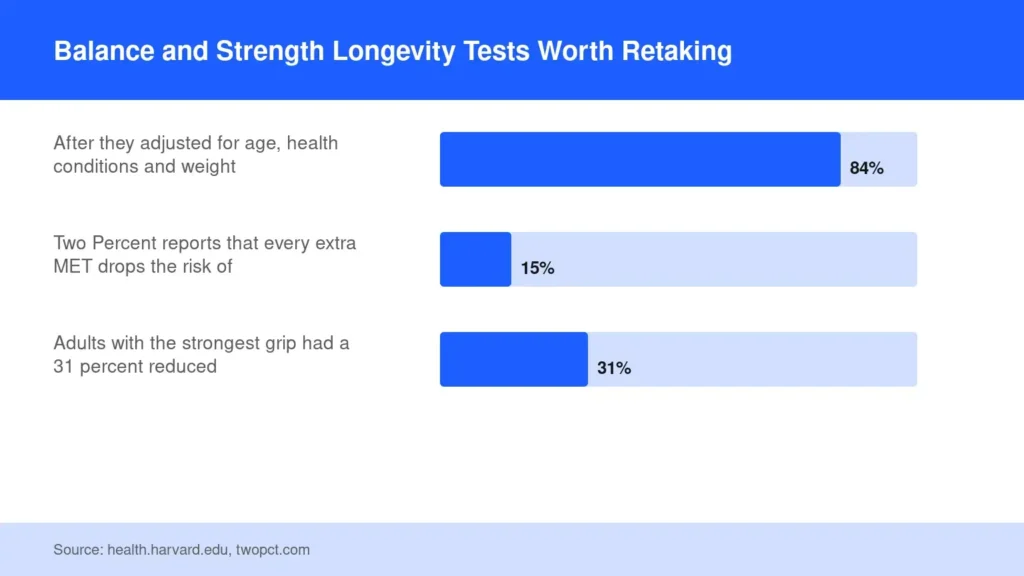
A study published in the British Journal of Sports Medicine found that people in middle to later life who could not stand on one leg for 10 seconds had nearly twice the risk of premature death. The researchers followed 1,700 men and women ages 51-75 for seven years. After they adjusted for age, health conditions and weight, failing the test went with an 84% higher risk of dying. AARP reports that standing on one leg was a stronger indicator of aging than changes in strength or walking patterns.
Sit with that for a moment. Association is not destiny. A failed hold tells you where to start training, not how your story ends.
How long should you be able to balance on one leg in your seventies?
About 26 seconds is typical. In research summarised by AARP, people in their 70s held one leg for 26 seconds. That is an average, not a pass mark.
The basic method is plain. Harvard Health describes holding the position for 10 seconds without hand support, then switching legs. The large older-adult study asked for up to 30 seconds on one leg with eyes open. For a harder read, AGEIST lists an eyes-closed version, barefoot on a hard floor, timed until you lose balance.
Stand beside a kitchen counter with someone nearby, and test both sides. A gap between your left and right leg is useful information in its own right.
What does the sit-to-rise test say about leg strength?
The sit-to-rise test shows how much strength, flexibility and balance you bring to one ordinary movement: getting off the floor. Harvard Health calls it a good way to assess all three.
Its study tracked several thousand people ages 46 to 75 for about 12 years. Compared with people who scored a 10, those scoring between 4.5 and 7.5 were about three times as likely to die during follow-up. As AGEIST puts it, “The less support you need, the longer you will live, at least according to this study.”
Two cousins of the test isolate the legs. In the chair version, people crossed their arms and alternated between sitting and standing. The wall squat asks you to hold thighs parallel to the ground, back on the wall, for time.
Which test is the strongest predictor of longevity?
The honest answer is that no single test wins every study. An expert quoted by Everyday Health says cardio fitness tends to be the biggest predictor of mortality.
The cardio and grip data are strong. Two Percent reports that every extra MET drops the risk of death and heart attack by 13 and 15 percent respectively. On its stair test, finishing in 45 seconds or less equals about 10 METs. Adults with the strongest grip had a 31 percent reduced risk of all-cause mortality. In a walking test, people in their 70s who covered more than 450 meters had the lowest risk of death.
So what actually matters? Not one magic number. Balance, legs, grip and cardio describe one vehicle from different angles. Together they show your overall physical reserve: the margin between what daily life asks and what your body can supply.
How does FIT Clinic turn a test into a baseline, not a verdict?
At FIT Clinic, a score starts the conversation; it does not end it. Dr. Michael Brandon, DC, tells new patients: “I explain the options and tell them I don’t actually know what they need yet — I need to go over the exam first.”
Next door, FIT Lab measures rather than guesses: an ARX strength baseline, grip strength, sit-to-rise, a 3D body-composition scan, a VO2 estimate and an HRV snapshot. I have worked with force plates, motion capture and wearables, and the rule here stays the same. If you aren’t testing, you’re guessing. When the exam shows we are not the right fit, Dr. Brandon points you to someone who can help.
Our senior wellness and mobility page explains how our clinical team approaches stiffness and reserve. For exercises like these you can perform at home, see short strength workouts seniors can repeat daily. Preventing falls has its own post: what the evidence says on fall prevention.
Frequently asked questions
What fitness test is appropriate for a 50-year-old?
A one-leg balance hold is a sensible first test in your fifties. In research summarised by AARP, adults in their 50s stood on one leg for about 45 seconds. Add a floor-to-standing rise, a grip reading and a timed walk, and you have a fuller picture of strength, balance and cardio.
A one-leg balance hold is a sensible first test in your fifties. In research summarised by AARP, adults in their 50s stood on one leg for about 45 seconds. Add a floor-to-standing rise, a grip reading and a timed walk, and you have a fuller picture of strength, balance and cardio.
Can you improve your balance after sixty?
In many cases, yes. AARP reports that staying physically active, with walking recommended, and keeping up strength training as you age can help maintain and improve balance. Short, frequent one-leg practice beside a counter is a reasonable place to start, and progress tends to show when you retest the same way.
In many cases, yes. AARP reports that staying physically active, with walking recommended, and keeping up strength training as you age can help maintain and improve balance. Short, frequent one-leg practice beside a counter is a reasonable place to start, and progress tends to show when you retest the same way.
Is it safe to do these tests at home?
For most people, a one-leg hold or chair stand is low-risk when set up carefully. Use a sturdy chair, stand near a counter, test on a firm surface and have someone nearby. If you have had a recent fall, dizziness, or new weakness in a leg, ask your physician before you try any of them.
For most people, a one-leg hold or chair stand is low-risk when set up carefully. Use a sturdy chair, stand near a counter, test on a firm surface and have someone nearby. If you have had a recent fall, dizziness, or new weakness in a leg, ask your physician before you try any of them.
What are the secrets to longevity?
There is no secret list, despite the headlines. AGEIST calls consistent exercise one of the most powerful inputs to a long, healthy life. In practice that means work you will repeat: walking, strength training and balance practice, most weeks, for years. Boring is good, because boring is what people keep doing.
There is no secret list, despite the headlines. AGEIST calls consistent exercise one of the most powerful inputs to a long, healthy life. In practice that means work you will repeat: walking, strength training and balance practice, most weeks, for years. Boring is good, because boring is what people keep doing.
How often should I retest my balance and strength?
Retest after a steady block of training rather than every few days, so real change has time to show. Use the same chair, the same surface, the same shoes and a similar time of day. One bad morning is noise. A trend across several retests is information worth acting on, and it tells you whether your training is working.
Retest after a steady block of training rather than every few days, so real change has time to show. Use the same chair, the same surface, the same shoes and a similar time of day. One bad morning is noise. A trend across several retests is information worth acting on, and it tells you whether your training is working.
The Bottom Line
Balance, leg strength, grip and walking capacity are measurable, and the research above ties them to how long people live. Take your numbers as a baseline. Train the weak link, retest under the same conditions, and let the gains compound.
If you want those numbers measured properly, book a baseline assessment at FIT Clinic, 8 Merchants Way in Colts Neck, by the corner of Route 34 and County Route 537, with free parking in front and behind. Book online or call or text 848-301-1515. Everything gets explained in plain English, and nothing happens without your OK.
Book your first visit at https://fitclinic.co/book/ — or call or text 848-301-1515.
FIT Clinic at Functionised — 8 Merchants Way, Colts Neck, NJ 07722.
Sources
- Harvard Health Publishing: Can a 10-second balance test predict longevity?
- Harvard Health Publishing: A brief fitness test may predict how long you'll live
- Two Percent: 6 fitness longevity tests
- AARP: The 30-Second Test That May Reveal How Well You’re Aging
- Everyday Health: These Basic Fitness Tests May Reveal How Long You’ll Live
- AGEIST: 10 Science-Backed Fitness Benchmarks for Longevity