Do short strength workouts seniors can repeat daily really work?
Yes. Short strength workouts seniors repeat every day can make a real difference, and Penn State researchers found that a few minutes of daily resistance exercise significantly improved strength in older adults within weeks. The habit matters more than the length of each session, and it is worth checking your joints and balance first so you start with the right movements.
Do seniors really need strength training?
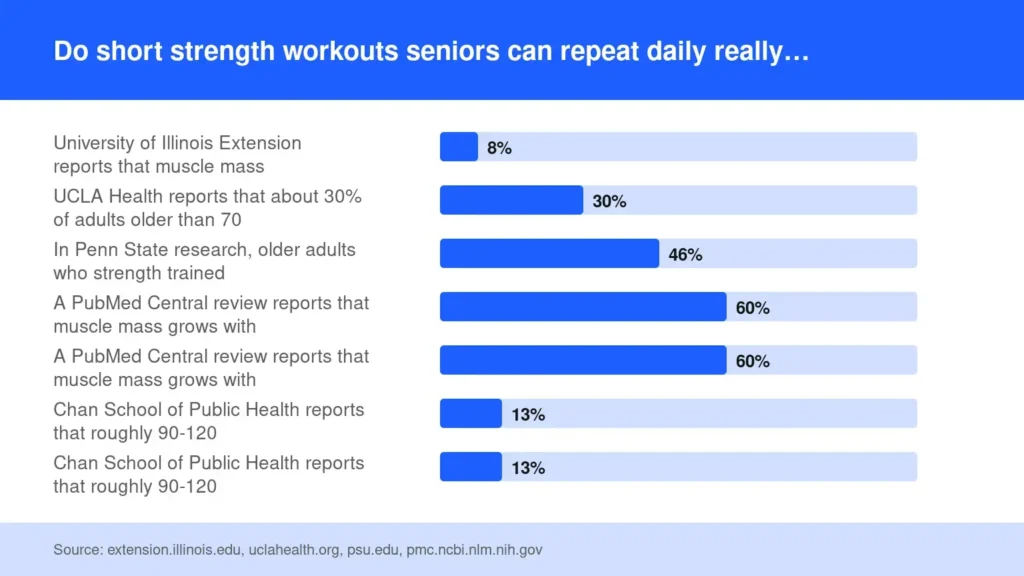
Yes, because muscle does not hold still on its own. University of Illinois Extension reports that muscle mass declines by about 3-8% each decade from your thirties. That loss speeds up after the age of 60 (University of Illinois Extension). You feel it in ordinary places. The step out of the car. The last stair. A low couch at a grandchild’s house.
UCLA Health reports that about 30% of adults older than 70 have trouble with everyday mobility. That includes walking, climbing stairs and getting to a standing position. Here is the real problem: waiting compounds. Every season without loading your legs is ground you have to win back later.
Why it matters beyond the stairs
The stakes go past the stairs. In Penn State research, older adults who strength trained at least twice a week had 46 percent lower odds of death for any reason than those who did not. That is an association, not a promise. It is still a large one.
What did the four-minute Penn State study find?
It found that a tiny dose, done every day, was enough to matter. Researchers at Penn State College of Medicine tested four minutes of strengthening exercise a day. Strength improved significantly for adults aged 65 and older in as little as 12 weeks, per Penn State Health News. The regimen included only 60 seconds of lower body resistance training. That alone produced significant gains in functional performance (Penn State Health News).
Sit with that for a moment. Not an hour at a gym. Not a new membership. A minute for the legs, every day. The same researchers call mobility, or physical fitness, a critical indicator of quality of life after 65 (Penn State Health News). It decides whether you finish everyday tasks on your own.
What exercises belong in short strength workouts seniors can repeat?
They look like a few slow, controlled repetitions of movements you already make, with something sturdy nearby for support. A few repetitions done regularly means you stop while the last rep still looks clean, then you come back tomorrow.
- Chair squat, the home leg press: Sit near the front of a sturdy chair, feet flat and hip-width apart. Lean your chest forward, push through your feet to stand, then sit back down slowly. A leg press machine trains the same push; the chair adds balance.
- Hip hinge, the deadlift pattern: Stand feet apart facing a counter, knees soft, back straight. Push your hips back as if closing a drawer behind you, then squeeze your glutes to stand tall.
- Supported split squat, the lunge made safer: Hold the counter, step one foot back and lower the back knee toward the floor only as far as you control. Bring it up and repeat on the other side.
- Counter push-up: Hands on the counter edge, body straight from head to heels. Lower your chest toward it and push back.
Breathe out on the effort. Let your knees stay over your toes. If a movement sends pain down a leg or into a joint, stop it and get it looked at rather than pushing through.
How often should seniors train?
Little and often works well. Much of the early gain comes from your nervous system learning the movement, and frequent practice feeds that learning. A review in PubMed Central explains how training builds strength in people over 60. It adds muscle, recruits more motor units and makes them fire faster.
What a coach looks for
I was a strength and conditioning coach for the Toronto Blue Jays and the Tampa Bay Buccaneers. I also coached at the University of South Florida. Programming is the heart of that job: find the smallest dose that keeps a body adapting, then make it repeatable. A plan you actually perform every day beats a heroic session you dread. Boring is good.
The guidance points the same way. That review recommends healthy older adults train 3 or 4 times weekly. People starting from poor performance can improve with less (PubMed Central). For beginners, University of Illinois Extension suggests starting at 2 days/week, then moving to 3 days/week. A short daily habit simply makes those sessions hard to miss.
Does strength training help with arthritis?
It may, and the evidence leans that way. University of Illinois Extension states that it can help with arthritis, joint pain and mobility. Better Health Victoria adds that regular exercise can reduce some arthritis symptoms and improve joint mobility and strength.
If land exercise aggravates a joint, water may be a gentler start. Better Health Victoria describes warm water exercise as particularly helpful for arthritis. The water supports your body while its resistance builds muscle and endurance (Better Health Victoria). Stiffness is not the injury; it is the message.
Is it safe to start if your joints are stiff?
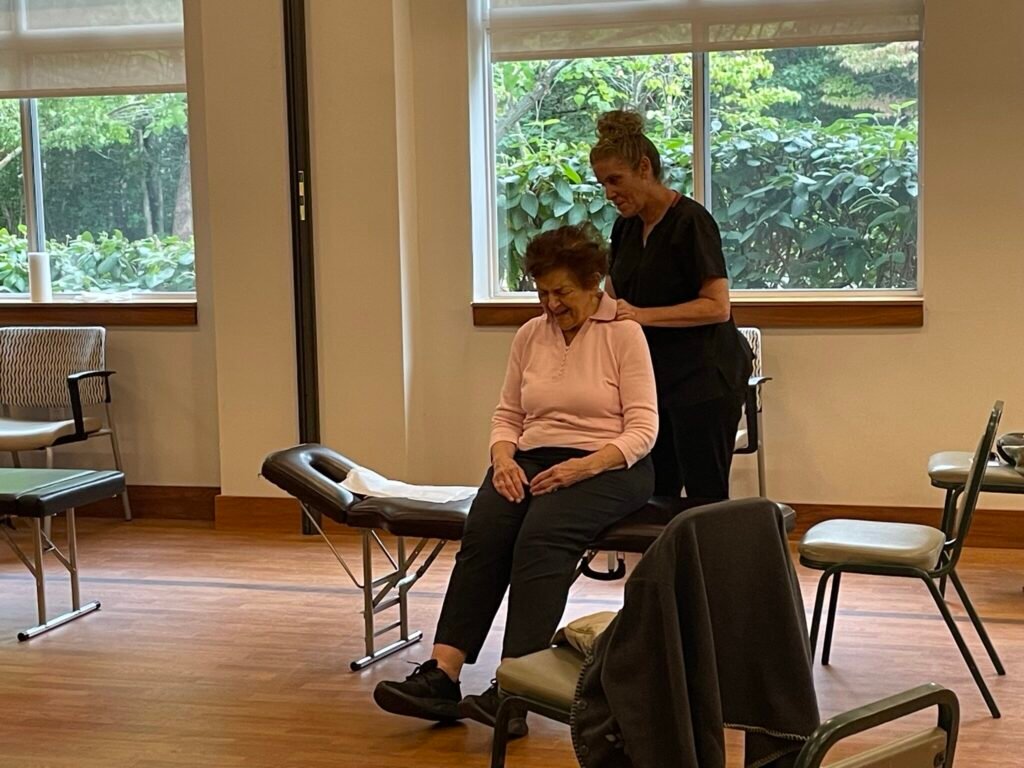
Usually, but the right first exercise depends on what your hips, knees and balance can handle today. If you aren’t testing, you’re guessing. A chair squat can irritate a cranky knee, and a split squat asks for balance some people have quietly lost.
Dr. Michael Brandon, DC, our treating clinician, starts with three questions: “What is their pain, where is their pain, and what motions or activities cause it.” Those answers set your starting point.
Where to learn more
Our page on mobility and stiffness explains what that evaluation looks at. Our piece on fall prevention in Monmouth County covers balance in depth. FIT Clinic is at 8 Merchants Way in Colts Neck, by the corner of Route 34 and County Route 537. Free parking sits in front of and behind the building, so a stiff knee does not have to walk far.
Frequently asked questions
What equipment do you need to train at home?
Very little. Harvard T.H. Chan School of Public Health notes you can train at home with weights, resistance bands, food cans and filled water bottles. A PubMed Central review lists your own body weight as a valid load too. A sturdy chair and a kitchen counter cover the rest.
Very little. Harvard T.H. Chan School of Public Health notes you can train at home with weights, resistance bands, food cans and filled water bottles. A PubMed Central review lists your own body weight as a valid load too. A sturdy chair and a kitchen counter cover the rest.
How hard should these exercises feel after sixty?
Hard enough that the last reps take real effort while your form stays clean. A PubMed Central review reports that muscle mass grows with training at 60% to 85% of your maximum voluntary strength. Beginners usually work up toward that level gradually rather than starting there. Add load yourself only when a movement feels easy.
Hard enough that the last reps take real effort while your form stays clean. A PubMed Central review reports that muscle mass grows with training at 60% to 85% of your maximum voluntary strength. Beginners usually work up toward that level gradually rather than starting there. Add load yourself only when a movement feels easy.
How much strength training per week is linked to a longer life?
A moderate amount appears to be enough. Harvard T.H. Chan School of Public Health reports that roughly 90-120 minutes a week was linked with a 13% reduced risk of premature death. UCLA Health notes that any weight training, compared with none, is associated with lower mortality risk.
A moderate amount appears to be enough. Harvard T.H. Chan School of Public Health reports that roughly 90-120 minutes a week was linked with a 13% reduced risk of premature death. UCLA Health notes that any weight training, compared with none, is associated with lower mortality risk.
Does walking count as strength training?
Not quite. Resistance training means your muscles contract against an external force, as UCLA Health explains, and walking rarely loads them enough. In Penn State research, people reporting resistance exercises appeared to gain more mortality benefit than those reporting activity alone. Keep walking, and add resistance work.
Not quite. Resistance training means your muscles contract against an external force, as UCLA Health explains, and walking rarely loads them enough. In Penn State research, people reporting resistance exercises appeared to gain more mortality benefit than those reporting activity alone. Keep walking, and add resistance work.
Is it too late to start lifting if you feel frail?
No. University of Illinois Extension states that muscle-strengthening activity can cause muscle growth and increase strength even in elderly and frail adults. UCLA Health adds that resistance training at least twice weekly enhances physical function, specifically walking speed. Starting from a low base simply means starting with support.
No. University of Illinois Extension states that muscle-strengthening activity can cause muscle growth and increase strength even in elderly and frail adults. UCLA Health adds that resistance training at least twice weekly enhances physical function, specifically walking speed. Starting from a low base simply means starting with support.
The Bottom Line
A few minutes of resistance work each day is a small dose aimed at what you care about most. That means getting up, getting out and being able to stay on your own feet. Start with a chair and a counter, whether you live in Seabrook, NJ, or near Colts Neck. Move slowly. Keep it going tomorrow. If protein is your next question, our article on what a protein shake adds to strength training after sixty covers it.
If a joint complains or your balance feels uncertain, have it checked before you build the habit. Our clinical team at FIT Clinic will explain what we find in plain English, and you decide what happens next. Book an evaluation online, or call or text 848-301-1515.
Book your first visit at https://fitclinic.co/book/ — or call or text 848-301-1515.
FIT Clinic at Functionised — 8 Merchants Way, Colts Neck, NJ 07722.
Sources
- The Intensity and Effects of Strength Training in the Elderly
- Four minutes of daily resistance training can quadruple fitness in older adults
- Strength at any age: The crucial role of strength training for adults
- Arthritis and exercise
- Why strength training is critical for older adults
- Strength training helps older adults live longer | Penn State University
- Moderate amount of strength training each week could boost longevity