Strength training after sixty: what a protein shake adds
Key takeaways
- For strength training after sixty, the pooled trials say an amino-acid supplement adds a modest, uncertain extra to the training itself.
- Most of that extra shows up in strength and physical performance, not in measured muscle mass.
For strength training after sixty, the pooled trials say an amino-acid supplement adds a modest, uncertain extra to the training itself. Most of that extra shows up in strength and physical performance, not in measured muscle mass. The training is the treatment; the shake is a possible add-on. Test your grip, chair-rise speed and walking first, then decide whether a powder belongs in the plan.
What does a protein supplement add to strength training after sixty?
Once the lifting is already happening, an amino-acid supplement appears to add a little more strength and physical performance, and no clear extra muscle mass. That is the honest answer to the question every protein-powder aisle is asking for strength training after sixty. The finding comes from a systematic review and meta-analysis by Xie, Yan and Tao that pooled nine trials. Each compared resistance training plus amino acids or their metabolites against resistance training alone. Every participant had sarcopenia, the progressive loss of skeletal muscle mass and strength that comes with age. That comparison is the whole point. It isolates what the supplement adds once you are already doing the work.
Here is what the pooled numbers showed, outcome by outcome. Each figure is a standardised mean difference, which measures the size of the gap between groups rather than kilos or seconds.
- Muscle mass: no clear added benefit. Across four studies, skeletal muscle index showed an SMD of 0.63 with a confidence interval running from −0.39 to 1.65, which crosses zero. Appendicular muscle mass across three studies came in at an SMD of 0.13, also crossing zero.
- Strength: handgrip improved more with the supplement, at an SMD of 0.69, with an interval from 0.04 to 1.35. The lower end sits barely above zero.
- Physical performance: gait speed favoured the supplement across six studies, at an SMD of 0.64 (0.02 to 1.25). The five-times sit-to-stand test across three studies came in at an SMD of −1.42, where lower means faster. The Short Physical Performance Battery, across three studies, showed an SMD of 1.69 (0.81 to 2.57).
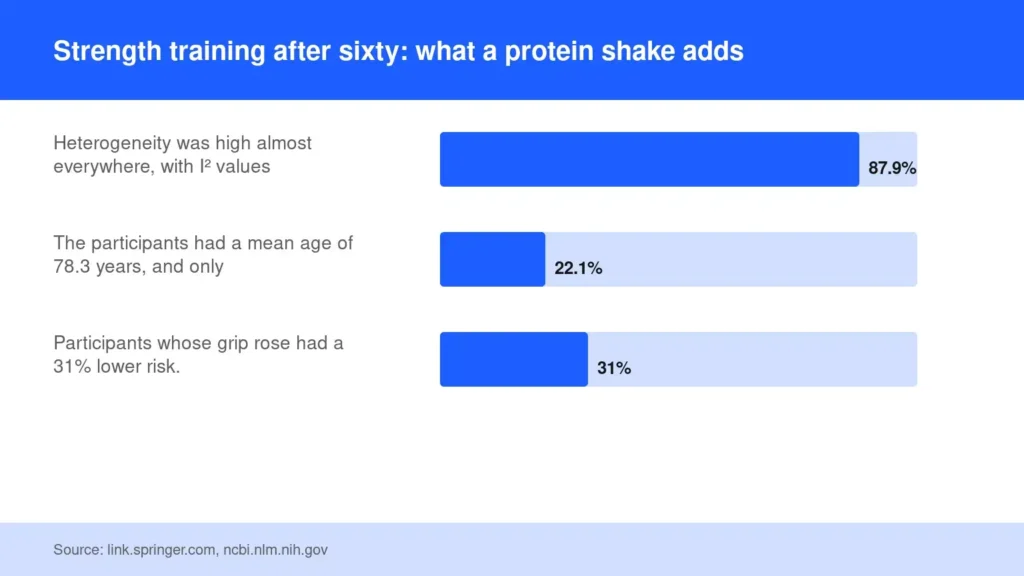
Now the part the label on the tub leaves out. Heterogeneity was high almost everywhere, with I² values reaching 87.9% for grip and 92.8% for the chair-stand test. In plain English, the individual trials disagreed with each other a great deal. Several outcomes rest on three or four small studies. The participants had a mean age of 78.3 years, and only 22.05% were men. A fit man in his sixties is not the person these trials studied. Sit with that for a moment. An earlier pooled analysis concluded that protein plus resistance exercise was effective for muscle mass and strength, and that is true of the pairing. What the newer comparison asks is narrower and more useful: how much of that came from the powder.
Why do grip and chair-rise speed tell you more than a scale?
Grip and chair-rise speed measure what your muscles can actually do, while a scale only weighs everything at once. Muscle, fat, water, bone density and breakfast all land on the same number. The scale cannot tell you whether your legs can get you out of a low car seat.
Strength, by contrast, keeps showing up in large ageing datasets. The Newcastle 85+ Study followed 845 very old adults. Participants whose grip rose had a 31% lower risk. A seven-year cohort of 2,468 older adults in Yilan, Taiwan found poor grip carried an adjusted hazard ratio of 1.87 for death. These are associations, not proof that squeezing harder extends life for your health. But they tell you grip is a signal worth reading.
The chair rise matters for the same reason. The revised European consensus on sarcopenia uses the chair stand test as a measure of muscle strength. It treats a usual walking speed at or below 0.8 m/s as a marker of severe sarcopenia. Here is the test. Can you stand up from a dining chair, arms crossed, without rocking? How fast, and how many times? That answer likely says more about how you will move in the years ahead than the bathroom scale. If you aren’t testing you’re guessing.
Is it safe to start resistance training at seventy or eighty?
For most people the evidence points to yes, provided the starting load matches the body in front of you and your physician clears any red flags first. The trials above enrolled people with sarcopenia whose mean age was 78.3 years, and they trained. In the Newcastle cohort, people aged 85 and older whose grip increased had lower mortality risk. That is not hyperbole. It is a population in its late eighties still showing change.
So is it too late at seventy or eighty? The data do not suggest a cut-off age. What changes with age is the starting point and the emphasis, not the principle.
How the emphasis shifts by decade
In your sixties, the emphasis is real load: a goblet squat, a hinge, a row, a press. The aim is to build a reserve before you need it. In your seventies, speed starts to matter as much as load, so the chair rise and the step-up become central. In your eighties, the daily tasks are the training: standing up, carrying, walking with purpose. Each decade uses the same rule, scaled to the person. Chest pain, new dizziness, a recent fall or a joint that has changed shape are reasons to see your physician before you start.
What do two strength sessions a week look like with a stiff hip?
Two workouts a week, each using the same handful of movements, worked hard enough that the last few reps are honest effort. The CDC guidance for older adults calls for muscle-strengthening activity at least two days a week, to the point where another repetition would be hard without help. Picture a woman in her late sixties with a stiff right hip. She does not need a new gym or a complicated plan. She needs a routine she can repeat for months, with a walk on the day in between.
Here is a checklist for one session. It assumes nothing hurts sharply and that her physician has no objection.
- Warm up the hip first: gentle marching, hip circles and a few bodyweight sit-to-stands from a high chair.
- Squat pattern: sit-to-stand from a box or chair, holding a light weight at the chest. Raise the seat if the stiff hip pinches at the bottom.
- Hinge pattern: a hip hinge with a dowel along the back, then a light kettlebell deadlift from a raised block.
- Push: an incline push-up against a kitchen counter or a wall.
- Pull: a resistance band row anchored to a door.
- Carry: walk with a weight in each hand, tall and slow. The carry also trains grip.
- Balance: stand on one leg near a counter. The CDC lists standing on one leg among balance activities that help prevent falling.
The stiff hip changes the range, not the plan. Stiffness is not the injury; it is the message. If the hip limits depth, the box goes up and the work continues. For the mobility side of a stiff hip, our mobility and stiffness page explains how our clinical team looks at joints that have stopped moving well. Our guide to staying mobile after 60 covers the daily movement between sessions. If you live in Holmdel, the township Senior/Community Center on Crawfords Corner Road lists a Senior Workout among its programs. A class like that can serve as one of the two sessions, as long as the load keeps building over time.
How do you choose the weight and know when to increase it?
Choose a load you can lift for the target reps with good form, where the last few feel like real work. When those reps start to feel easy session after session, add a little weight, a rep or a slower lowering phase. That is progress. Boring is good. The best sign you are improving is a log that reads slightly heavier each month, even if the mirror says nothing yet.
Let me explain why the effort matters. The CDC wording is plain on this point: work until another repetition would be hard without help. A weight you could lift all afternoon never reaches that point. Too light, done faithfully, is still too light. Heavy is relative, and it should feel heavy for you.
Can older adults overdo it?
Yes, and the signals are usually clear. Soreness still there at the next session is one. A joint ache that changes the way you walk is another. Sleep that falls apart after training is a third, and together they suggest the dose is ahead of recovery. The answer is rarely to stop. It is to drop a set, lower the weight and keep the habit. Some people track recovery with heart rate variability; what HRV tracking can tell you after 60 covers what that number can and cannot show. Strength compounds. A missed week costs less than a flare that keeps you out for weeks.
Should you buy the protein powder before you start lifting?
Only after the training is in place and you know what you are measuring. The pooled trials found the supplement added something to strength and performance, with wide disagreement between trials, and nothing clear to measured mass. Buying the powder first gets the order backwards.
I spent years as a strength and conditioning coach for the Toronto Blue Jays, the Tampa Bay Buccaneers and the University of South Florida. The principle that carries from a professional weight room to a woman in her late sixties is simple: quantify literally everything. That matters as much for fitness at any age as it did for the pros. Measure grip, chair-rise speed and walking pace before you change anything. Then train. Then measure again. If the numbers move with training alone, you have your answer. If they stall and your diet runs short on protein, a supplement becomes a reasonable experiment rather than a hope.
Dr. Michael Brandon, DC, is our treating clinician. He puts the starting point plainly: “I explain the options and tell them I don’t actually know what they need yet — I need to go over the exam first.” That applies to powders as much as to treatment. The important thing is to maintain the order. The honest sequence is test, train, retest, and only then add. Never sell yourself a product before you know what problem it is meant to address.
Frequently asked questions
Can resistance training help with arthritis or other conditions?
The pooled trials discussed here studied older adults with sarcopenia, so they cannot answer that for arthritis, osteoporosis or other conditions. Each condition changes which exercises fit and how load should build. That is why an evaluation of your joints and history matters before a program, rather than a generic plan copied from a video.
The pooled trials discussed here studied older adults with sarcopenia, so they cannot answer that for arthritis, osteoporosis or other conditions. Each condition changes which exercises fit and how load should build. That is why an evaluation of your joints and history matters before a program, rather than a generic plan copied from a video.
Do resistance bands count as strength training for older adults?
Yes. The CDC lists working with resistance bands alongside lifting weights and bodyweight exercises as muscle-strengthening activity for older adults. Bands suit a home routine, though they make exact load harder to track. Note the band colour and the reps each session, so you can see real progress from week to week.
Yes. The CDC lists working with resistance bands alongside lifting weights and bodyweight exercises as muscle-strengthening activity for older adults. Bands suit a home routine, though they make exact load harder to track. Note the band colour and the reps each session, so you can see real progress from week to week.
How many reps and sets should an older adult do?
The CDC suggests 8 to 12 repetitions per activity as one set, at least one set, and two or three sets for more benefits. Start with one set while you learn form. Once the reps feel steady and controlled, add a set before you reach for a much heavier weight.
The CDC suggests 8 to 12 repetitions per activity as one set, at least one set, and two or three sets for more benefits. Start with one set while you learn form. Once the reps feel steady and controlled, add a set before you reach for a much heavier weight.
Does lifting replace walking for adults over sixty-five?
No. The CDC asks older adults for 150 minutes a week of moderate-intensity aerobic activity, such as brisk walking, on top of muscle strengthening and balance work. Lifting and walking do different jobs. One trains the muscles to produce force; the other trains the heart and lungs to keep going. You need both.
No. The CDC asks older adults for 150 minutes a week of moderate-intensity aerobic activity, such as brisk walking, on top of muscle strengthening and balance work. Lifting and walking do different jobs. One trains the muscles to produce force; the other trains the heart and lungs to keep going. You need both.
Where is FIT Clinic and is parking easy?
FIT Clinic is at 8 Merchants Way in Colts Neck, by the corner of Route 34 and County Route 537. Parking is free in front of and behind the building, which helps if a stiff hip makes long walks across a lot hard. The clinic serves Holmdel, Freehold, Marlboro, Middletown, Red Bank and nearby Monmouth County towns.
FIT Clinic is at 8 Merchants Way in Colts Neck, by the corner of Route 34 and County Route 537. Parking is free in front of and behind the building, which helps if a stiff hip makes long walks across a lot hard. The clinic serves Holmdel, Freehold, Marlboro, Middletown, Red Bank and nearby Monmouth County towns.
The Bottom Line
The supplement is the smallest decision on the list. Start with a short checklist: know your grip, time your chair rise, check your walking speed, train twice a week, and retest. Only then ask whether a powder earns a place. What actually matters is whether your legs and hands are getting stronger, and you cannot know that without a starting number.
Book one evaluation at FIT Clinic, 8 Merchants Way, Colts Neck, so you know where your strength stands now rather than guessing. Book online or call or text (848) 301-1515. Nothing happens without your OK, and you decide what comes next.
Book your first visit at https://fitclinic.co/book/ — or call or text 848-301-1515.
FIT Clinic at Functionised — 8 Merchants Way, Colts Neck, NJ 07722.
Sources
- Combined resistance training and amino acid-based supplementation for sarcopenia in older adults: a systematic review and meta-analysis (BMC Musculoskeletal Disorders)
- Combined resistance training and amino acid-based supplementation for sarcopenia in older adults (PMC)
- The effectiveness of protein supplementation combined with resistance exercise programs among community-dwelling older adults with sarcopenia: a systematic review and meta-analysis
- Sarcopenia: revised European consensus on definition and diagnosis
- Initial level and rate of change in grip strength predict all-cause mortality in very old adults (Age and Ageing)
- Handgrip strength is associated with mortality in community-dwelling older adults: the Yilan cohort study, Taiwan
- What Counts as Physical Activity for Older Adults (CDC)
- What You Can Do to Meet Physical Activity Recommendations (CDC)
- Senior / Community Center, Holmdel Township