Once a week stretching flexibility and how to keep the range
Key takeaways
- Yes, a small weekly dose can help.
- In a randomized trial of active young adults, once a week stretching flexibility work and weekly full-range lifting both improved posterior chain flexibility.
Yes, a small weekly dose can help. In a randomized trial of active young adults, once a week stretching flexibility work and weekly full-range lifting both improved posterior chain flexibility. Stretching gained slightly more range. Lifting builds the strength to use it, which is why FIT Stretch pairs the two.
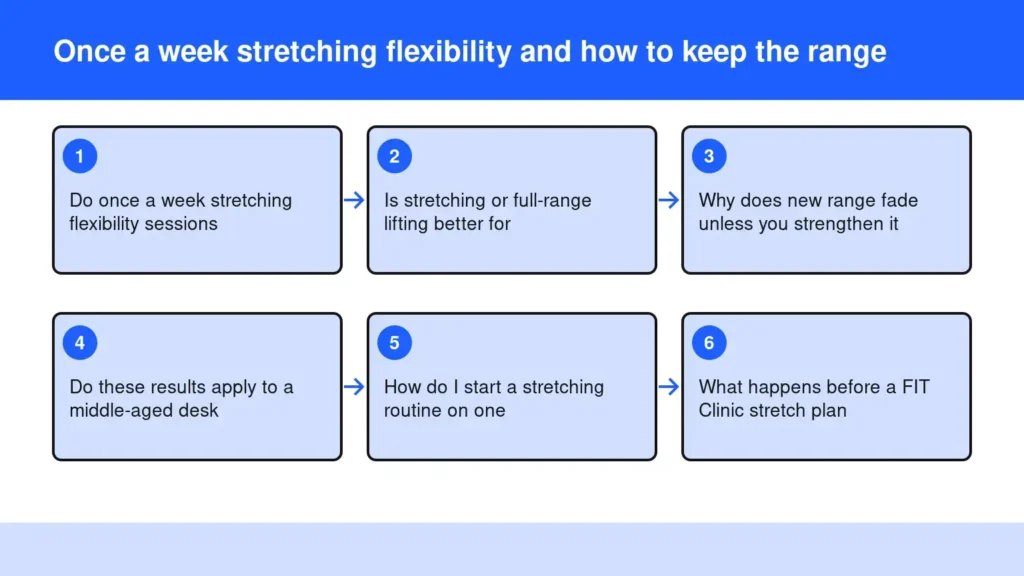
Do once a week stretching flexibility sessions actually work?
In one well-controlled trial, yes. Once a week stretching flexibility work improved posterior chain range over doing nothing. So did full-range lifting.
Here is the study. Researchers randomized 48 participants aged 18 to 25 into stretching, full-range lifting or control groups. The intervention lasted six weeks, with one supervised session per week. Each group got only 120 seconds of supervised exercise per week. Both active groups improved. The controls did not.
Sit with that for a moment. A tiny weekly dose moved the needle. A busy week is no excuse to do nothing.

Is stretching or full-range lifting better for flexibility?
For pure range, stretching gained a little more in that trial. For range you can load and control, full-range lifting adds what stretching lacks.
The mean gain was 3.93 cm for stretching and 1.81 cm for lifting. The larger picture agrees. A systematic review and meta-analysis found resistance training increased range of motion, with no meaningful difference against stretch training. An earlier randomized trial found full-range lifting matched stretching on sit-and-reach. It also built more hip and lower back extensor strength.
So the honest answer is not either-or. One tool opens the range. The other teaches the body to own it.
Why does new range fade unless you strengthen it?
Much of a stretching gain is likely your nervous system tolerating more stretch, not longer muscle. A tolerated range you never load is a range the body has little reason to keep.
A summary of the largest review on stretching mechanisms reports that tolerance probably dominates, with a small drop in stiffness, and that muscle fibres do not get longer. Strength work gives that new position a job. In a trial of inactive older men, lifting improved flexibility. Detraining reversed those gains.
That is the logic behind FIT Stretch. We find where you are tight, stretch you further than you can alone, then build strength at that end range. Stiffness is not the injury. It is the message.
Do these results apply to a middle-aged desk worker?
Not directly. The trial enrolled physically active young adults. Applying it to someone in midlife who sits all day is an extrapolation.
Some evidence makes that leap less of a stretch. A large dose meta-analysis found the effect of static stretching was not moderated by age, sex or training status. The older-men trial enrolled ages 65 to 78 and still saw range improve with lifting.
What actually matters is starting where you are. MedlinePlus advises that people who have not been active start slowly and build up.
How do I start a stretching routine on one session a week?
Pick a few areas, stretch each with real intent, then load the same range with a controlled lift. Keep it boring. Boring is good.
- Start with the back of the body. Both trials above targeted the posterior chain.
- Know the ceiling. Gains plateaued at about 4 minutes per session and 10 minutes per week. More time is not always better.
- Add days if you can. ACSM guidance calls for flexibility work 2 to 3 days per week, each stretch held 10 to 30 seconds.
- Finish with full-range strength. A slow hinge or squat through the range you just opened.
For a reader in Manalapan, the weekly dose matters practically. One planned trip to Colts Neck is a routine you can keep, which beats a daily plan you never start.
What happens before a FIT Clinic stretch plan is built?
An exam comes first. Dr. Michael Brandon, DC, tells new patients: “I explain the options and tell them I don’t actually know what they need yet — I need to go over the exam first.”
His starting questions are simple: “What is their pain, where is their pain, and what motions or activities cause it.” If FIT Clinic is not the right fit, he points the patient to someone who can help.
Our building also houses FIT Lab, where an ARX strength baseline, grip strength and sit-to-rise are measured rather than guessed. If you aren’t testing, you’re guessing. I spent years coaching strength for the Toronto Blue Jays and the Tampa Bay Buccaneers, and that rule never changed.
Frequently asked questions
What is flexibility?
Flexibility is the range a joint can move through, and how much stretch you tolerate at the end of it. A review summarised by PainScience suggests most gains come from better tolerance plus a small drop in stiffness. That helps explain why unused range slips back.
Is it possible to overstretch?
Yes, in the sense that more is not automatically better. A dose meta-analysis in Sports Medicine found flexibility gains plateaued once weekly stretching time passed a modest ceiling. A strong pull is the target. Sharp or worsening pain is a reason to stop and get it looked at.
Is stretching every day better than once a week?
Not necessarily for range alone. The same Sports Medicine meta-analysis found weekly session frequency did not change the flexibility effect, while total weekly time did. Daily stretching may suit people who like the habit, but a single focused session can still count.
Should I stretch before lifting weights to get more flexible?
For long-term range, it may not be needed. A meta-analysis on resistance training and range of motion concluded that extra stretching around lifting may not be necessary for flexibility. Many people still use a short stretch to feel ready, which is a preference rather than a requirement.
The Bottom Line
A small weekly dose may help, and the trial evidence supports trying it. Stretch to open the range and lift through it to keep it. Start from an honest look at what hurts and why. For strength you can repeat, read about short strength workouts for seniors and strength training after sixty.
If you want the stretch and the strength built for your body, book a FIT Stretch session at FIT Clinic, 8 Merchants Way, Colts Neck. We sit near the corner of Route 34 and County Route 537, with free parking. You can also call or text (848) 301-1515.
Book your first visit at https://fitclinic.co/book/ — or call or text 848-301-1515.
FIT Clinic at Functionised — 8 Merchants Way, Colts Neck, NJ 07722.
Sources
- Effects of Low-Volume Static Stretching and Full Range-of-Motion Resistance Training on Flexibility in Physically Active Young Adults (PMC)
- Effects of Low-Volume Static Stretching and Full Range-of-Motion Resistance Training on Flexibility (PubMed)
- Effects of Low-Volume Static Stretching and Full Range-of-Motion Resistance Training on Flexibility (Journal of Clinical Medicine, MDPI)
- Effects of Low-Volume Static Stretching and Full Range-of-Motion Resistance Training (DOI)
- Optimising the Dose of Static Stretching to Improve Flexibility: A Systematic Review, Meta-analysis and Multivariate Meta-regression (Sports Medicine)
- Resistance Training Induces Improvements in Range of Motion: A Systematic Review and Meta-Analysis
- Comparison of resistance training vs static stretching on flexibility and maximal strength in healthy physically active adults, a randomized controlled trial
- Resistance training and detraining effects on flexibility performance in the elderly are intensity-dependent (PubMed)
- Flexibility gains due to boosted tolerance (PainScience Bibliography)
- Physical Activity Guidelines and Recommendations (University of Minnesota open textbook)
- Exercise for Older Adults (MedlinePlus)
- Practical recommendations on stretching exercise: A Delphi consensus statement (PMC)