HRV Score Accuracy and Why One Bad Morning Is Not a Trend
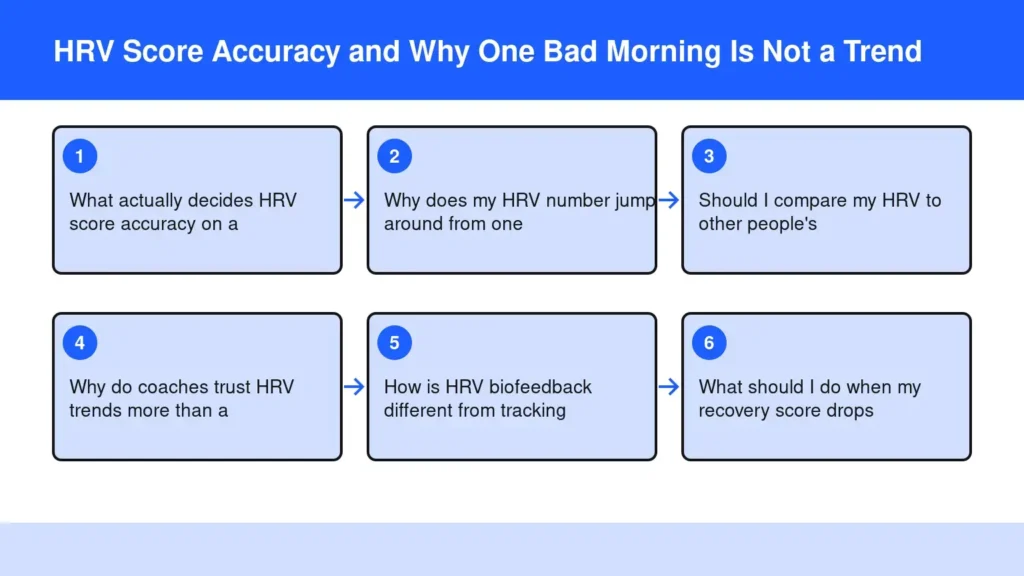
Key takeaways
- HRV score accuracy depends less on the device than on when and how the number is taken.
- A reading taken at rest can track a medical-grade signal closely, while one taken during movement or conversation often fails.
HRV score accuracy depends less on the device than on when and how the number is taken. A reading taken at rest can track a medical-grade signal closely, while one taken during movement or conversation often fails. One low morning tells you very little. A shift that holds against your own baseline is what matters, and watching the signal live during slow breathing is a different tool from passive tracking.
What actually decides HRV score accuracy on a wearable?
Conditions decide most of it. The same device can read close to a medical-grade signal at rest and fail badly once you move or talk. That is the core of HRV score accuracy, and it is rarely explained on the app.
The alarm goes off. You reach for the phone before your feet touch the floor. A number. A color. A word like strained. Here is the real problem. Accuracy is not one fixed property of a gadget. In a study of 78 adults, Apple Watch HRV was 99.3% accurate against a medical-grade ECG. The same report says accuracy dropped with movement, and failed measurements rose from 2.5% at rest to over 43% during conversation. Sit with that for a moment. Same wrist. Same watch. Very different reliability.
The clinical standard still sits on the chest. Cleveland Clinic notes that an EKG, using sensors attached to your chest, can measure HRV correctly, while most wrist trackers usually aren’t sensitive enough to detect it accurately. The research base is also thinner than the marketing suggests. A review of 82 Apple Watch validation studies found too few HRV studies to pool a summary estimate, against 22 for heart rate. The honest answer is that a wrist reading can be good under the right conditions, and the evidence has not yet mapped where those conditions end.
Why does my HRV number jump around from one morning to the next?
Small changes in how and when you measure move the number before your body has changed at all. Position, timing, talking and what you did in the minutes before all show up in the reading.
Welltory splits accuracy into two parts: what you do before and during the measurement, and how good the signal from your device is. Its rules are plain. Lie down, or sit with your back against the chair, and wait 10–15 minutes so your heart rate settles. When accuracy reaches 95–100%, the app treats the result as a close reflection of your body. A spot check taken while you scroll email in bed breaks every one of those rules.
Here is the test. Take your reading the same way, at the same point in your morning, for a stretch of days. If the swings shrink, much of what you were seeing was method, not physiology. If you aren’t testing you’re guessing. Inconsistent testing is just guessing with a chart attached.
Should I compare my HRV to other people's numbers?
No. Healthy HRV varies so widely between people that someone else’s number tells you almost nothing about yours.
Kubios puts the normal adult range at rest anywhere from below 20 to over 70 milliseconds, measured as RMSSD. It adds that young athletes at rest may exceed 200 milliseconds. Age moves it too. BodySpec cites norms of roughly 60–80 ms for adults in their 20s and roughly 25–40 ms for those over 60. A healthy retiree and a college rower can both be normal and sit miles apart on the same scale.
That is why Polar tells users their HRV is uniquely theirs, and the only fair comparison is their own recent baseline. Older readers face a further wrinkle. Researchers studying older adults found no standardized protocols for measuring how light to moderate exercise affects autonomic control in that group. They still reported moderate to strong evidence that short-term HRV was reliable enough to show similar results on retest. Translation: the method matters, and a consistent method makes your own numbers worth reading at any age.
Why do coaches trust HRV trends more than a single reading?
A single reading carries all the noise of one morning, and a trend smooths that noise out. Decisions about a training week rest on direction over days, not on one number.
I was a strength and conditioning coach for the Toronto Blue Jays, the Tampa Bay Buccaneers and the University of South Florida. I was later performance coach to the boxers Antonio Tarver and Antonio Tarver Jr. In that world, one bad day is information. It is not a verdict. An athlete who sleeps badly on a road trip has not lost his fitness overnight. What actually matters is whether the line keeps bending the wrong way while the work stays the same.
The better wearables already lean this way. BodySpec describes a good HRV status as an average that stays inside your personal baseline, typically established over 3 weeks. Most devices, it notes, only switch you to strained or low when you drop significantly below that range. Polar links a lower HRV with stress, illness or perhaps overtraining, and a higher one with good recovery and fitness. Often, not always. Read the trend, check how you feel, then decide whether the plan needs to change.
How is HRV biofeedback different from tracking HRV with a wearable?
Tracking records your HRV in the background and hands you a score later. Biofeedback shows you the signal live while you practice a slow breathing pattern that changes it.
That difference matters more than it sounds. A wearable is a rear-view mirror. It tells you where you were last night. Biofeedback puts the signal in front of you in real time. You see what your breathing does to it while you are doing it. One is a report card. The other is practice.
At FIT Clinic, HRV biofeedback training works exactly that way: one of your body’s stress-and-recovery signals on a screen, and a slow breathing pattern you practice to change it. We do not sell it as a fix for anything. It is a skill session, and what you practice between visits is the part that compounds. If you already wear a tracker, the two may work well together. The tracker shows the trend, and the training gives you something specific to do about it.
What should I do when my recovery score drops?
Check how the number was taken before you change anything. Then watch whether the drop holds over several days.
Start with the boring questions. Did you measure at your usual time, in your usual position? Were you moving or talking? Did your sleep shift, for instance after a clock change? If so, our piece on daylight saving time sleep recovery covers how to protect training through it. Boring is good. Many strange scores trace back to the routine around them.
If the drop holds, and especially if it arrives with pain, stiffness or a body that will not do what it did a month ago, the score has done its job. It has told you to look. Stiffness is not the injury; it is the message. Older readers rebuilding strength may find our guide to strength training after sixty a useful next step. If symptoms point to your heart, your breathing or a sudden change in your health, see a physician first.
Frequently asked questions
What is HRV in plain terms?
HRV, or heart rate variability, is a slight change in the time between your heartbeats. A healthy heart does not tick like a metronome. Polar calls it the tiny beat-to-beat variations in the intervals between heartbeats. Your wearable estimates those intervals from your pulse and condenses them into a single daily score.
HRV, or heart rate variability, is a slight change in the time between your heartbeats. A healthy heart does not tick like a metronome. Polar calls it the tiny beat-to-beat variations in the intervals between heartbeats. Your wearable estimates those intervals from your pulse and condenses them into a single daily score.
What is the difference between RMSSD and SDNN?
They are two ways of summarising beat-to-beat variation, and they produce different numbers. Kubios uses RMSSD for its resting adult ranges. Apple Watch’s original built-in metric is SDNN, and Cleveland Clinic says the preferred heart-health method uses SDNN over 24 hours. Never compare a figure from one against the other.
They are two ways of summarising beat-to-beat variation, and they produce different numbers. Kubios uses RMSSD for its resting adult ranges. Apple Watch’s original built-in metric is SDNN, and Cleveland Clinic says the preferred heart-health method uses SDNN over 24 hours. Never compare a figure from one against the other.
What counts as abnormally low HRV?
For young adults, Kubios suggests that a PNS index below -2 or RMSSD below 10 milliseconds may indicate abnormally low HRV. Those cutoffs come from young adults, so they do not transfer neatly to everyone. A reading that stays unusually low against your own baseline, alongside symptoms, is a reason to talk to a physician rather than a reason to keep retesting.
For young adults, Kubios suggests that a PNS index below -2 or RMSSD below 10 milliseconds may indicate abnormally low HRV. Those cutoffs come from young adults, so they do not transfer neatly to everyone. A reading that stays unusually low against your own baseline, alongside symptoms, is a reason to talk to a physician rather than a reason to keep retesting.
Do women and men have different HRV?
Often, yes. Kubios notes that females typically have a somewhat higher resting heart rate until the age of 40-45 and often show higher RMSSD values across most age groups. That is one more reason to skip comparisons with a partner or a training group. Your own baseline, built consistently over weeks, is the reference that means something.
Often, yes. Kubios notes that females typically have a somewhat higher resting heart rate until the age of 40-45 and often show higher RMSSD values across most age groups. That is one more reason to skip comparisons with a partner or a training group. Your own baseline, built consistently over weeks, is the reference that means something.
Which HRV measures are the least reliable?
In research on older adults, the low frequency and very low frequency measures showed weak agreement between assessments, while most other HRV indices agreed moderately to robustly. If your app reports frequency-band numbers, treat them as the shakiest part of the dashboard. Lean on the headline score and its trend over time instead.
In research on older adults, the low frequency and very low frequency measures showed weak agreement between assessments, while most other HRV indices agreed moderately to robustly. If your app reports frequency-band numbers, treat them as the shakiest part of the dashboard. Lean on the headline score and its trend over time instead.
The Bottom Line
Your wearable is a tool, not a judge. Measure the same way every time. Compare yourself only to yourself. Give a trend several days before you believe it. If you want more than a score, learn to move the signal with your breathing. If pain or stiffness is part of the picture, get an honest look from people who explain before they treat. As Dr. Michael Brandon, DC, puts it: “I explain the options and tell them I don’t actually know what they need yet — I need to go over the exam first.”
FIT Clinic is at 8 Merchants Way in Colts Neck, by the corner of Route 34 and County Route 537, with free parking in front of and behind the building. Book your visit online, or call or text 848-301-1515.
Book your first visit at https://fitclinic.co/book/ — or call or text 848-301-1515.
FIT Clinic at Functionised — 8 Merchants Way, Colts Neck, NJ 07722.
Sources
- MDPI/NIH: Validity and Reliability of Short-Term Heart Rate Variability Parameters in Older People in Response to Physical Exercise
- Kubios: Heart rate variability (HRV) – What is normal HRV range
- Cleveland Clinic: What Is Heart Rate Variability?
- Empirical Health: The average heart rate variability on Apple Watch is 36 ms
- BodySpec: What Is a Good HRV Status? | BodySpec
- Welltory: How to take accurate heart rate variability measurements? | Welltory Help Center
- Polar USA: What is Good HRV? | Polar USA