Strength training falls over eighty: why heavy may be tested
Key takeaways
- Nobody knows yet whether heavy strength training prevents falls in people over eighty, because the ReFit trial testing it is a protocol with no results.
- What has changed is the question: researchers now think high-intensity, progressive loading deserves a rigorous test in this age group, not only gentle exercise.
Nobody knows yet whether heavy strength training prevents falls in people over eighty, because the ReFit trial testing it is a protocol with no results. What has changed is the question: researchers now think high-intensity, progressive loading deserves a rigorous test in this age group, not only gentle exercise. Until the answer arrives, the sensible step is to measure where your strength stands today instead of guessing.
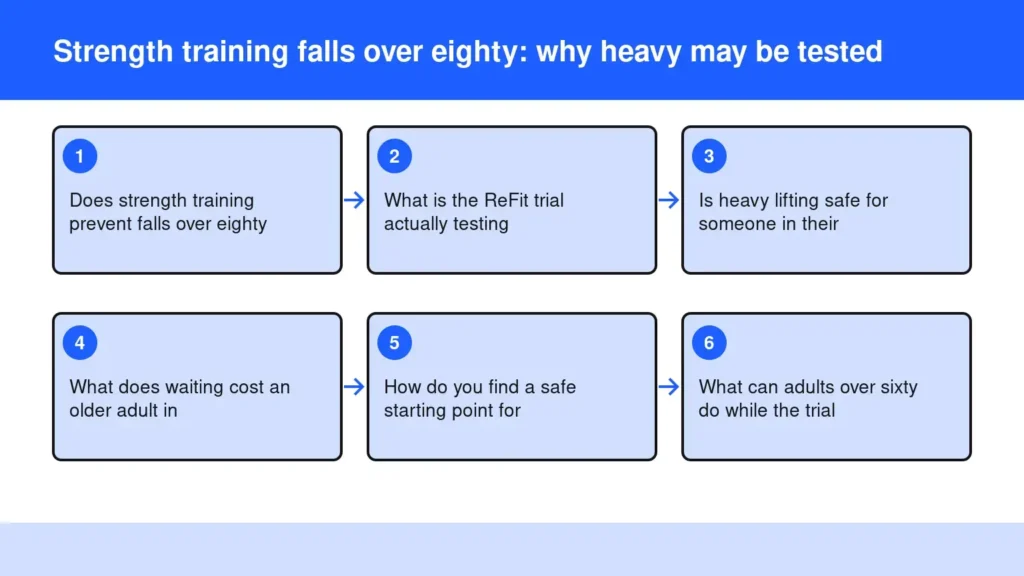
Does strength training prevent falls over eighty?
The honest answer is that nobody knows yet for heavy training, and that is exactly what the ReFit trial sets out to learn. The ReFit protocol on medRxiv describes a trial to see whether 12 months of high-intensity progressive resistance training reduces fall rates in adults aged 80 and older who live at home and have reduced muscle strength. It is a protocol. There are no results. Anyone who tells you the question is settled is selling something.
What we do know is broader. A Cochrane review summarized by Healthy People 2030 found that exercise targeting balance, gait and muscle strength can prevent falls in community-dwelling adults 65 and older. The US Preventive Services Task Force concludes with moderate certainty that exercise offers a moderate net benefit for older adults at increased risk of falling.
Here is the real problem. Most of that evidence comes from mixed programmes, and very little of it tests truly heavy loading in the oldest, weakest group. ReFit aims at that gap.

What is the ReFit trial actually testing?
ReFit compares twice-weekly high-intensity progressive resistance training with standard care, which means physical activity guidance. The full protocol describes a 12-month intervention with follow-up out to 36 months. It also notes that the training runs without a dedicated balance or multimodal component.
Sit with that for a moment. The researchers are isolating one variable: heavy, progressive load. They are not adding balance drills or bundling education. If falls drop, the credit goes to strength.
The people they chose matter too. Adults over eighty with low muscle strength carry the biggest fall burden. Gentle exercise has been the default for them. This trial asks whether the default sells them short.
Is heavy lifting safe for someone in their eighties?
Researchers consider it safe enough to test under supervision, which is a shift from treating the oldest adults as too fragile to load. That is not the same as proven safe for every person, and the trial will report on it.
There is precedent in younger older adults. In the LIFTMOR study, Medscape reports that researchers tested high-intensity resistance and impact training in 101 postmenopausal women and found improvements in bone density and physical function. Different population, different question. It still shows that heavy work under supervision is not reckless by definition.
I spent years as a strength and conditioning coach for the Toronto Blue Jays, the Tampa Bay Buccaneers and the University of South Florida. Load was never the enemy. Unmeasured load was. The same rule applies at any age, and it is why the exam comes before the plan.
What does waiting cost an older adult in strength?
Waiting costs the margin between a stumble and a fall. Strength is reserve, and reserve you do not train does not stay put.
The stakes are concrete. The CDC reports that more than one in four people 65 and older fall each year, fewer than half tell their doctor, and falling once doubles the chance of falling again. Strength is not only about falls either. In the PURE study in The Lancet, grip strength predicted all-cause and cardiovascular mortality better than systolic blood pressure.
If you are in your sixties or seventies, you are building the body your eighties will inherit. If you have a parent past eighty, the question is not whether they are too old to train. The question is where they stand right now.
How do you find a safe starting point for strength training?
You measure it. At FIT Clinic we share a building with FIT Lab, where strength is measured rather than guessed: an ARX strength baseline, grip strength and a sit-to-rise test, along with a 3D body-composition scan, a VO2 estimate and an HRV snapshot.
The working rule in our building is simple. If you aren’t testing, you’re guessing. A starting number tells our clinical team how much load is reasonable, and a retest shows whether the work is paying off. Our post on balance and strength tests worth retaking covers which numbers to track over time.
The exam comes first. Dr. Michael Brandon, DC, puts it plainly: “I explain the options and tell them I don’t actually know what they need yet — I need to go over the exam first.”
What can adults over sixty do while the trial runs?
Train strength now with the evidence we already have, progressing the load gradually instead of staying at the easiest level forever. The Task Force and Cochrane findings already support exercise that includes strength work for older adults at risk.
- Get a baseline. Grip, sit-to-rise and a strength test give you numbers to beat.
- Progress on purpose. The load should rise as you adapt. Boring is good. Consistent is better.
- Feed the muscle. Our post on strength training after sixty and protein covers what a shake adds and what it does not.
If something else needs attention first, a clinician should say so. Dr. Brandon’s approach is direct: “If I can’t be the one to help them, I want to at least put them in the right direction to find someone who can.”
Frequently asked questions
What counts as high-intensity resistance training for older adults?
It means lifting loads that feel genuinely hard for a small number of repetitions, then raising the load as strength improves. It is not light bands or chair exercises done indefinitely. In a trial setting it runs under supervision, and any older adult starting it should begin from a measured baseline rather than a guess.
Is a balance class enough to prevent falls?
Balance work is part of the evidence base, but it may not be enough by itself for someone with low strength. Reviews of fall prevention favour programmes that train balance, gait and strength together. ReFit is now asking whether heavy strength alone pulls its weight, which is why strength deserves a place in the plan.
What is a sit-to-rise test?
It is a simple test of how well you lower yourself to the floor and stand back up, using as little support from your hands and knees as you can. It reflects leg strength, mobility and balance in one movement. At FIT Lab it sits alongside grip strength and an ARX strength baseline.
Should my parent see a doctor before starting heavy strength training?
Yes, anyone with heart disease, recent falls, dizziness, osteoporosis or a recent surgery should talk to their physician before loading up. A physician can clear the medical side. A strength assessment then shows where to begin, so the first session matches the body in front of you instead of an age on a form.
Can strength training help after someone has already fallen?
It may help rebuild the strength and confidence a fall takes away, though results vary by person and by injury. The first step after a fall is a medical check for injury and the cause of the fall. After that, measured, progressive strength work is one of the options our clinical team can explain.
The Bottom Line
ReFit has not answered its question yet. It has changed the question. Heavy, progressive strength work in the oldest adults is now worth a rigorous test, and that tells you gentle is not the only option worth discussing. Whatever your age, the next step is the same: find out where your strength stands today, then train from that number. Our mobility and senior wellness page explains how we approach it.
FIT Clinic is at 8 Merchants Way in Colts Neck, by the corner of Route 34 and County Route 537, with free parking in front of and behind the building, and we see adults from Lincroft, Middletown, Holmdel and across Monmouth County. Book an exam or call or text (848) 301-1515.
Book your first visit at https://fitclinic.co/book/ — or call or text 848-301-1515.
FIT Clinic at Functionised — 8 Merchants Way, Colts Neck, NJ 07722.
Sources
- High-intensity progressive resistance training to prevent falls in adults aged 80 and older: protocol for the ReFit trial (medRxiv)
- ReFit protocol full text PDF (medRxiv)
- Facts About Falls (CDC)
- Exercise for preventing falls in older people living in the community (Healthy People 2030)
- Falls Prevention in Community-Dwelling Older Adults: Interventions (USPSTF)
- High-Impact Training Can Build Bone in Older Women (Medscape)
- Prognostic value of grip strength: the PURE study (The Lancet)
Get The Thrive Letter. One short email from Jim every Thursday: one idea, one 60-second fix you can feel, and what to do next. Unsubscribe any time.